
- 4E, No.3 Shenfeng Road, Liuyao Community, Henggang Street, Longgang District, Shenzhen,China
- cc.shen@xypltd.com
- Call: +86 15112667855
News
Understand these points and easily play with oscilloscopes!
- 2026-10-13
Oscilloscope is an indispensable tool in the field of electronic engineering. By mastering the skills and methods of using oscilloscopes, engineers can better cope with various challenges, improve their work abilities and professional level. We often use oscilloscopes in the design and development process. This article will introduce some basic concepts of oscilloscopes and how to use oscilloscopes to achieve basic measurements.
What is an oscilloscope?
An oscilloscope is an electronic measuring device that can display a graph of voltage as a function of time. This allows users to simultaneously observe changes in voltage and time. Many oscilloscopes can display multiple voltage signals on their screens, giving us the ability to compare the behavior of these signals
DigiKey oscilloscope
DigiKey oscilloscope
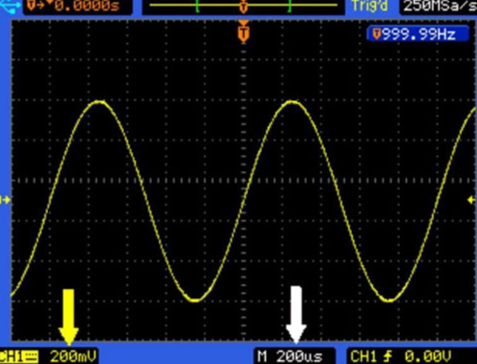
In the above figure, we can see two observation results:
The peak to peak voltage of the waveform can be measured along the vertical axis. It is divided into five main zones, with a vertical gain set at 200mv/zone (see yellow arrow), which gives the signal amplitude of 1-volt peak to peak.
The horizontal axis represents time, with a range set to 200 µ s/division (see white arrow). One cycle of a sine wave spans five main parts, so the cycle is 1 millisecond, which means the frequency is 1 kHz. (This special oscilloscope has a counter that displays the frequency of the signal in the upper right corner.)
Common functions of oscilloscope:
Measure voltage, voltage difference, and time interval.
Measure the frequency of repeated signals.
Compare two or more signals that vary over time and examine their relationship (e.g. whether a specific feature on one waveform appears before or after a feature on another waveform).
Capture special behaviors such as transients and malfunctions.
Measure the DC and AC parts of the waveform.
Measure various characteristics of waveforms, such as peak to peak voltage, root mean square voltage, period, rise time, fall time, etc.
Check the noise on the signal and modify the circuit or cable to change the signal noise.
Find distortions in a circuit by visually comparing the input and output waveforms of the circuit - or use an oscilloscope to subtract them and examine the mathematical differences.