
- 4E, No.3 Shenfeng Road, Liuyao Community, Henggang Street, Longgang District, Shenzhen,China
- cc.shen@xypltd.com
- Call: +86 15112667855
News
Single pair Ethernet power supply opens up new application prospects
- 2026-10-14
Although Power over Ethernet (PoE) technology powered by Ethernet cables has a long history, it has always been attractive only at distances of 100 meters or less. Now, Power over Ethernet (SPoE) has changed the game rules. SPoE is an IEEE standardized technology that allows the use of single twisted pair cables in Ethernet cables for long-distance power supply and data transmission, opening up new areas for innovative applications.
Ethernet uses four pairs of twisted pair copper wires to transmit data signals, with each pair transmitting a data stream in one direction, and has been widely used in data communication between devices. Devices using Ethernet typically require a separate power supply, which increases wiring and installation costs.
Power over Ethernet (PoE) was developed as an extension of the Ethernet standard, which uses two pairs of wires to transmit data and two pairs of wires to power devices, allowing them to receive data and power through the same cable.
PoE can provide up to 90 W of power over a distance of up to 100 meters. This has given rise to PoE applications such as IP cameras, wireless access points, VoIP phones, and smart lighting systems, which can be deployed and powered through a single cable. However, in addition to transmission distance limitations, PoE also faces other challenges, including the need for bulky and expensive connectors and cables to handle high currents and voltages, power loss, and heat dissipation.
Introduce SPoE
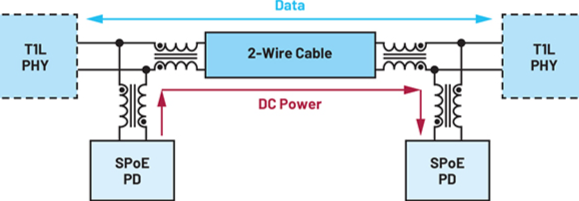
SPoE uses only one pair of wires to transmit data and provide power, with a data transmission rate of up to 1 Gbps, a transmission power of up to 52 W, and a cable length of up to 1 kilometer (Figure 1). The connectors and cables used are small in size, low in cost, and compatible with existing RJ45 sockets.
SPoE system with transmission power up to 52 W
Figure 1: SPoE system with a transmission power of up to 52 W. (Image source: Analog Devices)
SPoE can reduce costs, simplify implementation, and is highly suitable for a wide range of applications in industrial, automotive, building automation, and IoT environments. In these environments, starting new cabling or relying solely on wireless LAN is either impractical, expensive, or both issues coexist. This technology can provide comprehensive system telemetry functions for monitoring transmission status, fault detection, and overvoltage protection.
In industrial environments, SPoE can provide power to sensors and control devices from a distance without adding local power, simplifying network infrastructure, reducing installation costs, and achieving centralized power management. SPoE can be powered through existing Ethernet lines, making the process of adding SPoE switches and terminals fast and relatively simple.
SPoE is part of the IEEE 802.3 standard - IEEE 802.3 cg is used to achieve 10 Mbps Ethernet over a single twisted pair (10Base-T1L) and is an extension of the IEEE 802.3bu Power over Data (PoDL) standard. PoDL can be used for systems up to 40 meters in length, with voltages of 12 V, 24 V, or 48 V; SPoE can be used for systems up to 1000 meters in length, with voltages of 24 V or 55 V.
SPoE is very suitable for applications that require low to medium power consumption, long distances, and high data transmission rates, which are not feasible or economical for PoE.
The potential applications of SPoE include:
Reliable communication and transmission are crucial operational technology systems for process control and automation
Building and factory automation systems that can monitor environmental and mechanical parameters
Can deploy on-site instruments such as sensors and actuators more flexibly and economically
Security systems, such as access control and monitoring systems, make SpoE easier to expand in these applications
A traffic management system that needs to operate continuously and maintain connectivity
Power and manage IoT edge devices
Remote power supply for digital signage and outdoor lighting
Design considerations for SPoE
SPoE uses "Phantom Power" technology to stack power and data on the same pair of wires, requiring complex controllers to be installed at both ends of the cable to separate and regulate power and data signals. The power loss and heat dissipation of cables must also be considered in applications. These two issues will affect system performance and reliability.
The Power Equipment (PSE) controller can achieve precise power management and conversion, ensuring full, stable, and efficient power supply. This device is used in conjunction with a power supply device (PD) controller that receives power through a dual cable.
The PSE controller designed for multi-channel can supply power to various remote devices such as sensors. For example, Analog Devices, Inc.'s (ADI) LTC4296-1 (Figure 2) is a 5-port SPoE controller that can power up to five loads through five lines, each line up to 1000 meters long. This device uses external low drain source on resistance (RDS (ON)) and N-channel metal oxide semiconductor field-effect transistor (MOSFET) power supply to minimize voltage drop and ensure application stability.