
- 4E, No.3 Shenfeng Road, Liuyao Community, Henggang Street, Longgang District, Shenzhen,China
- cc.shen@xypltd.com
- Call: +86 15112667855
News
Provide support for mass customization, high-quality, and sustainable operation of Industry 4.0 factories
- 2026-11-25
For designers of Industry 4.0 automated manufacturing systems, utilizing high-quality and sustainable production processes to support mass customization may pose certain challenges. They need to deploy and connect multiple sensing and control devices on various wired and wireless networks, and monitor their status and energy consumption in real-time, while meeting established sustainable development standards.
To adapt to various functional, network, monitoring, and standard requirements while ensuring scalability and flexibility, designers of Industry 4.0 automation systems do not need to personally piece together all these components. On the contrary, they can adopt compact integrated controllers to deploy high-quality and sustainable flexible production systems. These controllers have numerous embedded control and energy management functions, digital and analog input/output (IO), and also provide the necessary secure communication capabilities for implementing scalable, flexible, and highly sustainable Industry 4.0 factories.
This article briefly describes the automation components and requirements of typical Industry 4.0 factories. Then, as an example of a programmable logic controller (PLC), Siemens' series of compact and scalable controllers were introduced, which include integrated communication interfaces and technical functions. Finally, the International Organization for Standardization (ISO) 50001 standard and related operational energy management standards were reviewed, including an example of achieving sustainable energy management.
Key components of Industry 4.0 factories
Typical Industry 4.0 factory applications include temperature controllers, pump and fan controllers, conveyor systems, and packaging machines, which require flexible integration and extremely high precision to ensure high-quality production. Moreover, it is necessary to continuously monitor and analyze the energy consumption of these devices to support efficient and sustainable operation. In addition, all of this requires support for multi-layer wired and wireless connections, from the connection of distributed sensors and controllers to real-time connections of motor drivers, energy meters, machine technicians, and operators.
In order to meet these different needs, while accelerating process deployment and reconfiguration, maximizing uptime, and ensuring efficient operation, automation system designers need dedicated process controllers with multiple key functions. These features include secure communication interfaces, digital and analog IO, as well as various integrated control functions such as high-speed counters, pulse width modulation (PWM), pulse sequence output, speed control, positioning, status monitoring, and energy management. In addition, communication interfaces need to be provided to support various protocols, such as serial communication PROFIBUS、IO-Link、 AS Interface for actuator sensors, MODBUS real-time unit (RTU), Universal Serial Interface (USI), TCP/IP, and mobile wireless standards.
Industry 4.0 Connection
To meet the connectivity requirements of Industry 4.0, Siemens' SIMATIC S7-1200 series PLC supports connections between sensors, actuators, motors, human-machine interfaces (HMI), and the cloud. This series adopts OPC Unified Architecture (OPC UA), which is a machine to machine (M2M) communication protocol used for industrial automation. OPC UA is a platform independent, service-oriented architecture that simplifies connectivity. It supports the integration of all types of devices, automation systems, and software applications in an inherently safe environment. It includes the field level communication (FLC) program specified, based on OPC UA framework, and field extensions specified in the International Electrotechnical Commission (IEC) 62541 standard.
FLC provides a secure and reliable independent communication platform for equipment suppliers, emphasizing identity verification, signature, and data encryption. OPC UA is not just an M2M communication protocol, it aims to support the connection between factory networks and commercial networks. The OPC UA Data Access on Siemens' SIMATIC S7-1200 PLC provides standardized horizontal and vertical communication and meets industry-specific requirements, such as the Packaging Machine Language Standard (OMAC PackML) for Machine Automation and Control Organizations, which is an automation standard that makes consistent machine data transmission easier; In addition, there is the Weinstein Standard (WS), which defines a communication interface for standardized transmission of machine data to higher-level IT systems. The main features of OPC UA implemented on S7-1200 PLC include (Figure 1):
Ability to effectively add new processes between PLC and any higher-level business oriented software layer.
By utilizing Siemens OPC UA modeling editor, the implementation of industry-specific supporting specifications has been simplified.
Provide cloud connectivity through wireless connection via Ethernet network.
DNS name resolution utilizes Open User Communication (OUC) to simplify addressing, including encryption.
Provide a secure way to send emails with optional attachments.
OPC UA is a picture of the basic elements of Industry 4.0 factory connectivity (click to enlarge)
Figure 1: OPC UA is a fundamental element of Industry 4.0 factory connectivity. (Image source: Siemens)
Scalable controller
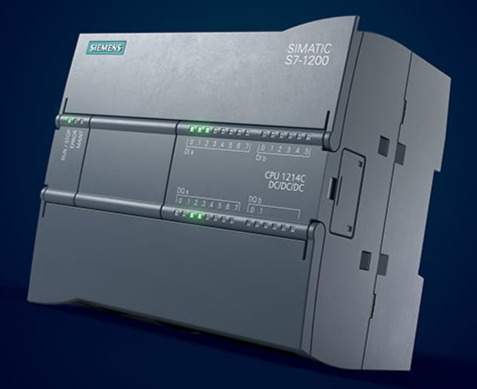
In addition to providing integrated support for OPC UA communication, S7-1200 controllers such as 6ESP2714AG400XB0 (Figure 2) and 6ESP2715BG400XB0 also have high flexibility and scalability. The former is powered by a 24 VDC power supply, with 24 VDC input and output; The latter is powered by a 120 or 230 VAC power supply, with a 24 VDC input and relay output.
All S7-1200 controllers have integrated IO, can be modularly expanded, and provide multiple communication options. The Siemens Fully Integrated Automation (TIA) portal provides a simple software environment for developing control programs, while SIMATIC automation tools can be used on-site to operate and maintain SIMATIC S7-1200 controllers. Other features include:
The PROFINET interface provides scalability and flexibility.
Security features, including comprehensive access, replication, and operational protection.
The diagnostic function displays information in simple plain text through Siemens TIA portal, network server, SIMATIC human-machine interface, and SIMATIC automation tools without the need for additional programming.
Some models provide safety features that can simultaneously execute standard procedures and safety related procedures, up to the safety integrity level 3 (SIL3) defined in IEC 61508 and IEC 62061, as well as performance level e (PLe) applications defined in ISO 13849.