
- 4E, No.3 Shenfeng Road, Liuyao Community, Henggang Street, Longgang District, Shenzhen,China
- cc.shen@xypltd.com
- Call: +86 15112667855
News
How flexible and simple debugging of industrial motor drivers can improve sustainability and productivity
- 2026-10-13
Agile processes are a hallmark of Industry 4.0 factories and logistics operations. There are multiple applications that require motors and variable speed drives (VSDs) with a rated power of 0.12 kW to 30 kW (0.16 hp to 40 hp).
The VSD used for these applications must be easy to install, with a rated operating temperature range of -10 ° C to+60 ° C. Larger drives should include integrated brake choppers, and certain applications require compliance with the C1 electromagnetic compatibility (EMC) standard of EN 61800-3. VSD must be user-friendly, able to operate within a wide range of power supply voltages, and automatically adapt to unstable power supply voltages to ensure uninterrupted operation.
Many applications can automatically execute simple motion sequences without the need for a programmable logic controller, but can be debugged using pre programmed macros or simple devices such as parameter loaders, basic operating panels (BOPs), or intelligent access modules.
Finally, these VSDs need to operate economically and have integrated energy-saving functions such as automatically reducing magnetic flux under predetermined operating conditions, as well as the ability to monitor and display real-time energy consumption.
This article first introduces Siemens' SINAMICS V20 series VSD and its features that enhance sustainability and improve productivity. Then, we will delve into how pre programmed macros and devices such as parameter loaders, BOPs, or intelligent access modules can be used to achieve flexible debugging, efficient operation, and sustainable maintenance.
The SINAMICS V20 driver is ready to use out of the box without the need for any additional modules or external controllers. Integrated BOP supports on-site debugging. In addition, a universal serial interface can be used to connect Siemens' SIMATIC programmable logic controller (PLC) for complex operations. The Modbus interface can connect third-party PLCs and other devices.
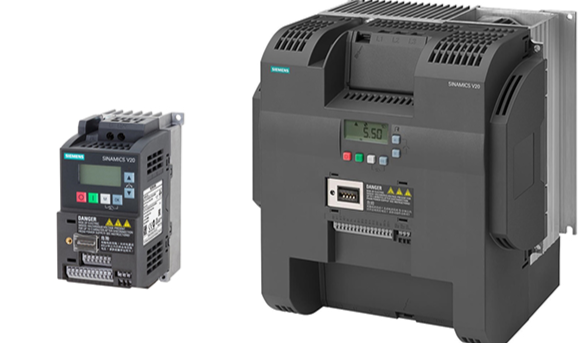
For equipment with a rated power exceeding 10 horsepower, the brake resistor can be directly connected to the brake chopper, and some models also comply with the C1 EMC standard of EN 61800-3. The operating temperature range of SINAMICS V20 driver is -10 ° C to+60 ° C, with a rated power of 0.12 kW to 30 kW. For example (Figure 1):
Driver model 6SL32105BB175UV1, rated power 0.75 kW, powered by 230 VAC single-phase power supply
The driver model 6SL32105BB230UV1 has a rated power of 3 kW and is powered by a 230 VAC single-phase power supply
The driver model 6SL32105BE322CV0 has a rated power of 22 kW and is powered by a 400 VAC three-phase power supply
Siemens SINAMICS V20 driver, 0.75 kW (left) and 22 kW (right)
Figure 1: SINAMICS V20 driver, 0.75 kW (left) and 22 kW (right) (not shown to scale). (Image source: DigiKey)
The integrated control modes in SINAMICS drivers include: per hertz volt (V/f) scalar, programmable multi-point V/f curve, V ²/f for automatically adjusting magnetic flux to save energy, and flux current control (FCC) for automatically adjusting driver output to adapt to load.
The operating mode can be automatically adjusted to compensate for unstable main power supply (Figure 2). In this mode, the voltage fluctuation of the line will be internally compensated, and the motor speed will automatically decrease to prevent accidental shutdown and send error messages when necessary. This mode is particularly suitable for building automation applications, such as pumps and fans in water or wastewater treatment plants, as well as heating, ventilation, and air conditioning (HVAC) systems.
Maintain operation mode of SINAMICS V20
Figure 2: SINAMICS V20 can maintain continuous operation of the motor even in the event of power interference while in maintenance mode. (Image source: Siemens)
Maximizing efficiency
According to different applications, efficiency can be improved by adjusting the motor speed to adapt to the current process flow. For example, for turbomachinery such as water pumps, variable speed operation can save up to 60% of energy compared to constant speed operation.
The SINAMICS V20 driver integrates Energy Optimized Control (ECO) mode to improve efficiency. In ECO mode, the motor flux will automatically adjust to the optimal operating point.
These drives can be set to sleep mode, cutting off motor power while maintaining the current state of the drive. Sleep mode can significantly reduce energy consumption while keeping the drive in a ready state for immediate restart when needed.
By utilizing the integrated cascading and energy balancing functions below, efficiency can be further improved:
Cascading can be used in high output pump, fan, and compressor applications that utilize multiple motors. By utilizing partially or fully controlled power cascades for phase connection and disconnection, the overall efficiency of the system can be improved without sacrificing performance.
When using a coupled driver for energy balance, energy exchange can be achieved through a shared DC link. Directly exchanging energy between frequency converters can minimize the power loss of the entire system and improve efficiency.
The BOP on the SINAMICS drive can display real-time energy consumption. The energy-saving counter can calculate the energy consumption during machine operation compared to constant speed operation, allowing operators to fine tune the process and further improve energy-saving efficiency and sustainability.