
- 4E, No.3 Shenfeng Road, Liuyao Community, Henggang Street, Longgang District, Shenzhen,China
- cc.shen@xypltd.com
- Call: +86 15112667855
News
Wi-Fi ® The positioning component overcomes the gap between GNSS and cellular technology in positioning applications
- 2026-10-10
Location based services have significant advantages in asset management, but often result in significant battery depletion, leading to the paralysis of certain IoT applications. Global Navigation Satellite Systems (GNSS) and a wide range of cellular services provide relatively simple methods for determining the geographic location of devices. However, there are gaps in coverage and performance among these networks, and the continuously expanding Wi Fi network coverage can compensate for these gaps and sometimes even replace them.
The gold standard for wireless tracking is the US led Global Positioning System (GPS), which is part of the global satellite navigation system and includes multiple regional satellite navigation systems. However, it may take several minutes for a GPS modem to go from cold start to "time to first fix" (TTFF), while also consuming a significant amount of battery capacity. In addition, line of sight obstacles between satellites and receivers (including building walls) can also affect them.
Fixed cellular base stations can also be used for "positioning" applications. Compared with GPS/GNSS, cellular positioning scanning has lower power consumption but lower accuracy. Mobile positioning may have a deviation of several hundred meters or even several thousand meters depending on the type of mobile signal tower used. This lack of accuracy can have a serious impact on applications such as tracking mobile assets on large warehouses or ocean going container ships.
Wi Fi is more accurate than cellular positioning and almost equally energy-efficient. The Service Set Identifier (SSID) unique to each Wi Fi network and the Basic Service Set Identifier (BSSID) unique to each access device provide an attractive location option, but most Wi Fi integrated circuits are not optimized for this task and are typically expensive, bulky, and power consuming.
The components provided by Nordic Semiconductor can help engineers flexibly create various applications that rely on wireless technology combinations and cloud based services, solving performance and coverage issues.
The value of Wi Fi positioning
Positioning can enrich various applications, including battery powered home sensors, health monitors and fitness equipment, industrial asset trackers and environmental sensors, as well as retail inventory management and cash register devices.
In the main use case, enterprises can track asset locations to simplify supply chain management and logistics; Wearable devices can remind medical teams to pay attention to health issues; Retailers and bankers can detect and reduce fraudulent use of payment cards; Fleet management operators can track vehicles in real-time. Due to the advantages and limitations of GPS, cellular phones, and Wi Fi, relying solely on one wireless technology may cause problems for devices that are not fixed in a particular location.
Wi Fi is a simple and cost-effective location solution when the network and access points are available and accessible at all times. Most Wi Fi devices integrate some type of location function, but there are significant differences in efficacy and accuracy.
The Wi Fi Alliance has taken measures to promote these features and ensure interoperability with the Wi Fi Certified Location program that incorporates the IEEE 802.11mc standard. By utilizing the Wi Fi Certified Location compatible Fine Timing Measurement (FTM) protocol, access points, and wireless LAN cards, Wi Fi access points (APs) can control location determination accuracy within one meter.
However, engineers need more compact and energy-efficient components to create more cost-effective positioning applications. Reducing power consumption and maximizing battery life are crucial for many IoT devices and sensors. Nordic offers a range of components that can enhance the connectivity of the IoT ecosystem using Wi Fi and other positioning options.
Wireless Companion
NRF7000 (Figure 1) is a wireless companion IC optimized for ultra-low power applications to ensure maximum energy efficiency. It does not send data, but provides active and passive scanning functions to the system on chip (SoC), memory protection unit (MPU), or microcontroller unit (MCU) host for Wi Fi positioning.
Nordic Semiconductor nRF7000 low-power Wi Fi 6 matching IC picture
Figure 1: nRF7000 low-power Wi Fi 6 matching IC for Wi Fi positioning applications. (Image source: Nordic Semiconductor)
The nRF7000 is capable of scanning both the 2.4 GHz and 5 GHz Wi Fi frequency bands simultaneously, and has implemented the PHY and MAC layers for this purpose. It uses QSPI (6-wire) or SPI (4-wire) interfaces for data and interfaces for hosts (including Bluetooth) ® A 3-wire or 4-wire coexistence control interface for LE/IEEE 802.15.4 wireless communication, connected to the host MCU or application processor that executes user applications.
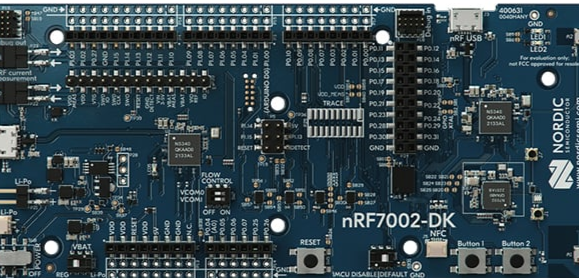
NRF7000 is a simplified version of nRF7002, which is another complementary IC that includes integrated 2.4 GHz and 5 GHz radios, providing direct Wi Fi 6 data connectivity and location functionality for another host chip. In addition, nRF7001 also offers single frequency 2.4 GHz radio. Both are suitable for adding modern Wi Fi 6 functionality to existing low-power Bluetooth ®、 Thread ® Or Zigbee ® In the system.
Although these devices can all connect to non Nordic hosts, the company states that with its nRF cloud platform, it can provide a "silicon to cloud positioning solution" where components support Wi Fi, cellular, and GNSS positioning.
Using nRF7000 to obtain Wi Fi location information
Nordic's nRF91 series cellular system in package (SiP) products (as shown in Figure 2, NRF9160-SICA-B1A-R7) are designated as the preferred Nordic host devices for nRF7000/7100/7200 ICs (nRF70 series). These products integrate application processors and multi-mode modems in a compact package of 10 x 16 x 1.04 mm, supporting LTE-M, NB IoT, GNSS, Radio Frequency Front End (RFFE), and power management. Other preferred hosts include Nordic nRF52 and nRF53 series Bluetooth multi protocol SoCs.