
- 4E, No.3 Shenfeng Road, Liuyao Community, Henggang Street, Longgang District, Shenzhen,China
- cc.shen@xypltd.com
- Call: +86 15112667855
News
Why choose lever type terminal blocks in PCB circuits
- 2026-09-07
Printed circuit board is the building block of electronic circuits, consisting of many components. A terminal block is a component that connects two wires or wires to a circuit board in an electrical or electronic circuit. Various electrical, mechanical, and other factors determine the selection criteria for terminal blocks.
The computing ecosystem driving the use of terminal blocks
As more and more enterprises, even those that used to operate traditional production lines, begin to be driven by data, the Industrial Internet of Things (IIoT) is also developing to adapt to this change. It is expected that by 2030, the number of IoT devices worldwide will reach 40 billion.
In addition to the rise of the Internet of Things, the following trends have also stimulated the growth in demand for various electrical and electronic components:
Industry 4.0 and 5.0: The Internet of Things and robots are the cornerstone of advanced manufacturing. Both require a large number of sensors and electronic devices to read machine data and transmit the information to personnel for processing. The development of industrial automation has driven the demand for electronic circuits and related terminal blocks.
Artificial intelligence and edge computing: the operation of the industrial Internet of Things routes data to the cloud for processing, but this situation is changing with the demand for real-time and instantaneous decision-making. The use of artificial intelligence at the edge has increased the demand for high-performance computing, which in turn requires precise and complex circuits.
Decarbonization and Electrification in the Economic Sector: With the advancement of decarbonization, more circuits will be put into use through various applications, including electric vehicles, hybrid vehicles, and the power grid.
In the context of the development of electrical and electronic circuits, the demand for terminal blocks will also continue to grow. It is expected that by 2027, the global terminal block market size will reach 5.2 billion US dollars, with a compound annual growth rate of 5.7%.
Connection mechanism of terminal block
Terminal blocks can be divided into different types, and one significant feature is their connection mechanism. Screw type terminal blocks use screws to secure wires. The button mechanism includes pressing the button, inserting the wire, and releasing the button to clamp the wire in place.
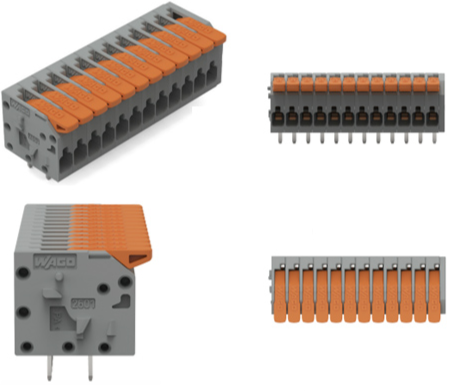
In the push in terminal block, users only need to push the wire in, and the wire will be locked under the action of the spring clamp. This is the WAGO 2601 series lever type PCB terminal block using WAGO's patented Push In CAGE CLAMP ® The working principle of the push in cage spring connection technology. When connecting, the user needs to push the wire into place. When releasing the wire, push the lever upwards to reduce the pressure on the spring clamp (Figure 1). The lever type terminal block is easy and fast to use, and can be easily connected by simply pushing up and down.
The lever on the terminal block
Figure 1: The lever on the terminal block clamps the wire in place using a simple device, helping to ensure quick and easy connection. (Image source: WAGO)
The advantages of leverage connection
Compared with other locking mechanisms, lever type terminal blocks have a series of significant advantages, including:
Tool free: No need to use a screwdriver to tighten the wires, making assembly faster and more efficient. For applications that require frequent replacement of wiring, such as on-site installation or laboratory prototyping, lever type terminal blocks are particularly useful.
Reduce wire pressure: The equipment has a longer service life because the wires are not tightened with screws, making them less prone to wear and tear. Connecting and reconnecting wires is easier and has less impact on the circuit, thereby increasing its lifespan.
Appropriate force: There is a risk of excessive tightening in the screw in mechanism used for terminal block connections. Excessive tightening causes an increase in pressure, which can damage wires faster and shorten the lifespan of electrical and electronic components. Push in terminal blocks come with release bars, eliminating the need to guess the force required to secure the wires in place.
Stronger and more stable connection: The screw in mechanism also carries the risk of loose connections, leading to signal errors and data loss. The terminal block using push in clamping technology ensures consistent connection and will not change due to the professional skills of technicians. The stable full touch connection makes these terminal blocks particularly suitable for high vibration environments such as industrial manufacturing and aerospace.
Flexibility and compatibility: When IoT sensors are integrated with larger circuits, it is likely to result in uneven wire combinations, all of which require connections to transmit data and signals. The plug-in terminal block with a release rod can be used to connect different types of wires - solid wires, twisted wires, or thin twisted wires.
Humanization: The terminal block has a release lever, making it easier to determine the locked or unlocked status of the connection. Visual and tactile cues make it easier for users to use and reduce the likelihood of errors when setting up complex circuits.
Due to the modular structure of each terminal block unit, inspection and maintenance are also more convenient. Modular design also helps to replace wires faster. When making changes, technicians do not need to disassemble and replace the entire circuit board; On the contrary, they can focus on the specific parts that need to be operated on and selectively replace modules.
Choose the appropriate terminal block
As circuits become increasingly complex, the demand for terminal blocks is also growing. When designers search for suitable terminal blocks, they are likely to focus on whether they can work under extreme environmental conditions and be packaged in smaller sizes.
The criteria to consider before selecting a terminal block include the current and voltage that the circuit must withstand. Before selecting a product, designers usually leave room for numerical considerations (150% of the required rated value). The number of electrodes determines the number of circuits that the terminal block can accommodate. The voltage and current margin, creepage distance, and other parameters of the terminal block determine the spacing between the terminal blocks, that is, the distance between the center of one electrode and the center of the next electrode (Figure 2). Finally, designers must ensure that the housing size of the terminal block can accommodate the wires, which are typically measured in American Wire Gauge (AWG).