
- 4E, No.3 Shenfeng Road, Liuyao Community, Henggang Street, Longgang District, Shenzhen,China
- cc.shen@xypltd.com
- Call: +86 15112667855
News
What support products are needed to maximize the effectiveness of VFD and VSD? -Part 2
- 2026-10-10
The first part of this article series introduced the factors that should be considered when selecting motor connection cables, output reactors, braking resistors, line reactors, and line filters. Part 2 continues to explore the differences between VSD/VFD and servo drives, reviews the uses of AC and DC rotary and linear servo motors, studies the application of soft start stop devices in industrial operations, and how DC converters are used to power peripheral devices such as sensors, human-machine interfaces (HMI), and safety equipment.
Variable speed drives and variable frequency drives (VSD/VFD) are crucial for maximizing industrial efficiency and sustainability, but they are not the only available tools. To achieve optimal performance, VSD/VFD typically requires additional equipment such as servo drives and motors, soft start stop devices, direct current (DC) converters, and direct current (DC) input uninterruptible power supplies (UPS) to achieve the best industrial automation architecture.
AC and DC servo motors and drivers are suitable for various applications, from simple 1- or 2-axis tasks to complex tasks with 256- or more axis movements. Servo motor controlled actuators can provide precise and repeatable motion for industrial machines, and offer both rotational and linear motion configurations.
Constant speed applications such as conveyors, pumps, and overhead cranes are typically more suitable for using soft start stop devices rather than VSD/VFD.
According to application requirements, designers can choose redundant DC power supplies, Class 2 power supplies specified by the National Electrical Code (NEC), or DC UPS to assume unpredictable main power roles and improve system reliability.
This article first introduces the differences between VSD/VFD and servo drives, reviews the uses of AC and DC rotary and linear servo motors, explores the application of soft start stop devices in industrial operations, and then continues to review how DC converters power peripheral devices such as sensors, human-machine interfaces (HMI), and safety equipment. Finally, investigate when to use redundant DC architectures or DC UPS to power these devices, as well as the choice between battery and supercapacitor energy storage. At the same time, several representative devices from Schneider Electric, Omron, Lin Engineering, and Siemens will be introduced.
In industrial automation architecture, servo motor systems can serve as a supplement to VSD/VFD. The servo motor system is designed specifically for complex dynamic motion systems and can support precise positioning. Servo drives are used together with permanent magnet motors and encoders for closed-loop control. They are designed to support rapid acceleration and deceleration, and can support linear or nonlinear motion curves.
Many VSDs/VFDs use open-loop control to manage motor speed. They cannot achieve the accuracy and response speed of servo motor systems. In addition, open-loop motor control means that if the load changes or the motor stops, VSD/VFD may not necessarily compensate. Servo motor systems are used for high dynamic applications, while VSD/VFD are used for applications that maintain constant speed for a long time or have relatively little speed variation.
Servo motor systems are often smaller than VSD/VFD drives, with typical power levels ranging from 40 to 5000 W. They have the characteristics of high speed (up to 5000 revolutions per minute), low noise, low vibration, and high torque. The frame size of servo motors varies, with a maximum of 180 mm or larger. For example, Lin Engineering's SBL40D1-04 is a 40 mm, 60 W brushless DC (BLDC) servo motor with a rated voltage of 36 VDC.
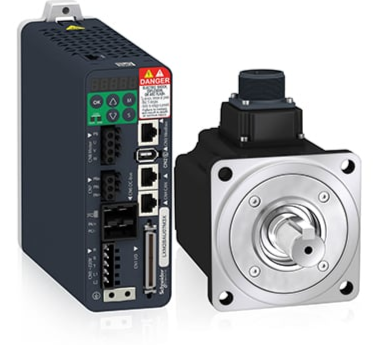
Servo motors are usually used in conjunction with drivers. Schneider Electric provides LXM28AU07M3X driver and BCH2LF0733CA5C 5000 rpm servo motor (Figure 1), both with a rated power of 750 W. The driver integrates CANopen and CANmotion communication interfaces and can operate with single-phase or three-phase power supply. The matching 80mm motor has a protection level of IP65 and a working temperature range of -20 ° C to+40 ° C.
Schneider Electric 750 W servo drive and IP65 motor pictures
Figure 1: Matching 750 W servo drive and IP65 motor. (Image source: Schneider Electric)
Straight lines and Cartesian motion
Linear motion can be used in various industrial processes, from coating materials, 3D printing to inspection systems, and has multiple implementation methods. Some designs are based on rotary stepper motors, while others use linear motors. Rotary stepper motors use threaded shafts to generate linear motion. There are two basic designs, namely the outer nut and the inner nut, sometimes referred to as non adaptive design.
The nut is installed on the threaded shaft of the externally threaded linear push rod. The two ends of the shaft are fixed. When the stepper motor rotates, the nut moves back and forth along the axis, carrying the object to be moved (payload). In non adaptive design, the payload is connected to the motor. The two ends of the shaft are fixed, and the motor carrying the payload moves along the shaft.
The linear motion platform adopts efficient iron core linear motors, magnetic tracks, and absolute encoder technology, which can provide repeatable sub micron accuracy and 5G acceleration. The motion speed in high-speed industrial applications can reach 5 m/s. Unlike threaded shaft designs, linear motors can provide higher positioning accuracy and faster motion speed.
The mechanical components of the linear motion platform can be encapsulated in highly enclosed structures to protect the environment. Omron provides linear motion platforms based on iron core motors, with effective magnet widths ranging from 30 mm for 3 coils to 110 mm for 15 coils. Its rated driving force ranges from 48 Newtons (N) to 760 N.
The R88L-EA-AF-0303-0686 linear actuator motor has two models: 230 V and 400 V. Its rated driving force is 48 N, with a peak of 105 N. It can be driven by R88D-KN02H-ECT servo drive, which includes EtherCAT communication function and can be integrated into industrial networks. Two linear motion platforms can be stacked together to achieve motion in the Cartesian coordinate system (Figure 2).