
- 4E, No.3 Shenfeng Road, Liuyao Community, Henggang Street, Longgang District, Shenzhen,China
- cc.shen@xypltd.com
- Call: +86 15112667855
News
What is the difference between thin film resistors and thick film resistors? This article will explain it to you in one go!
- 2026-11-24
The common feature of thin film resistors and thick film resistors is that they are resistive elements formed by coating a thin film like resistive material on the surface of a heat-resistant substrate. The most obvious difference between thin film and thick film is the thickness of this "film" (conductive layer). The thickness of thick film resistors can be thousands of times that of thin film resistors.
However, just understanding the difference in thickness of the "film" (conductive layer), we still don't know how to proceed when designing circuits and selecting resistors. Today, we will explain the differences between thin film resistors and thick film resistors from three aspects: accuracy and power, current noise, and temperature coefficient.
Differences in accuracy and power
In summary:
Thin films are mainly designed for precision.
Thick film, mainly designed for power.
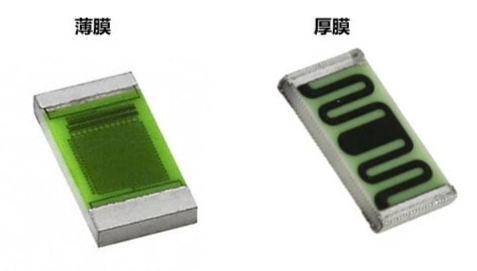
Figure 1: Patterns of Thin Film Resistors and Thick Film Resistors Presented Under a Translucent Shell
Thin film resistors are deposited with a conductive layer using vacuum deposition, known as sputtering. This forms a thin and uniform layer on the ceramic substrate, only a few micrometers thick. Then, the layer will undergo photolithography or laser etching processes. This determines the accuracy of the resistance value, with extremely fine tolerances that can be as low as 0.01%. This precision is what makes thin film resistors so useful.
The conductive layer of thick film resistors is printed in the form of paste on ceramic substrates. Its thickness can be thousands of times that of the thin film resistor conductive layer. This thickness has performance advantages in handling high-power applications, and the manufacturing cost is significantly lower than that of thin film resistors. However, its power advantage also reduces its predictability and accuracy, with a tolerance of up to 5%.
With the development of thin film resistors, the power gap between thin film resistors and thick film resistors is becoming smaller and smaller, which reflects the improvement of the performance of thin film resistors.
For example, TE's RN73 series 0805 resistor has a rated power of 0.1W according to the data manual (RN73 series data manual).
According to the data manual, the rated power of TE's new RP73P series 0805 resistor can reach 0.25WC.
Differences in current noise
Current noise is an unwanted wideband signal that can be superimposed on any useful signal, including DC signals. Like other passive components, resistors are also sources of noise to varying degrees, depending on the resistance value, temperature, applied voltage, and resistance type.
In summary, thin film resistors have an advantage over thick film resistors in terms of current noise.
Comparison of Current Noise between Thin Film Resistors and Thick Film Resistors
Below, we take Yageo RC resistors as an example to better illustrate the difference in current noise between thin film resistors and thick film resistors from a microstructural perspective.
Figure 2: Differences in Structure between Thin Film Resistors and Thick Film Resistors (Image Source: Yageo)
For thin film resistors, as shown in the above figure, from the microstructure of the resistance layer of the thin film resistor, only metal particles are stacked together to form a fine metal film. When electrons move in a conductive metal layer, they can transfer from one or more conductive lattices to another and form an electric current without any hindrance, which helps prevent noise from occurring.
For thick film resistors, as shown in the above figure, the material of the resistor layer is made of metal and glass materials. Glass materials are non-conductive, so electrons cannot pass through glass particles. The direction of the current changes due to these glass particles and becomes a source of current noise.
Noise measurement results of thin film resistors and thick film resistors
The following figure shows the noise measurement results of thin film resistors and thick film resistors (data sourced from Yageo). Thin film resistors have lower current noise than thick film resistors at different frequency noise levels.
Figure 3: Noise difference between thin film resistors and thick film resistors (Image source: Yageo)
For some audio amplification circuits, the low current noise characteristics of thin film resistors are an ideal solution because such circuits require lower distortion to achieve higher sound quality.
For more information, please refer to Vishay: Choosing Resistors for High end Audio Applications
Tip: Differences in the composition of different resistors
The size of carbon film resistors is usually large, the power is small, the tolerance is large, the temperature coefficient is also large, and noise is generated at high temperatures. On the positive side, they are cheaper than most resistors and typically perform well at higher frequencies.
Ceramic resistors have a high temperature coefficient and a medium operating temperature range, and are usually more expensive than most resistors.
Metal element resistors are commonly used in current sensing. They have high precision and relatively low resistance and tolerance.
Metal film resistors have good temperature stability, low noise, wide resistance range, and small tolerance.
Metal oxide film resistors are very similar to metal film resistors, but they can more effectively withstand surge currents and withstand higher temperature levels.
Thick film resistors have the characteristics of low noise, low surge tolerance, good temperature stability, and high rated voltage. They have multiple resistance values.
Thin film resistors have the characteristics of low noise, high lifetime stability, low temperature coefficient, and high resistance value.
Wire wound resistors are suitable for high-power and high current applications. On the other hand, they have high noise and low resistance values. The option of no sensation is also available.
If you are looking for the widest range of resistance values, thick film or thin film resistors will be your best choice. If it is a high-power application scenario, thin film and thick film resistors are worth considering.
For more tips, please refer to the differences in the composition of resistors