
- 4E, No.3 Shenfeng Road, Liuyao Community, Henggang Street, Longgang District, Shenzhen,China
- cc.shen@xypltd.com
- Call: +86 15112667855
News
What auxiliary products are needed to maximize the effectiveness of VFD and VSD? -Part 1
- 2026-10-10
The first part of this series of articles introduced various factors that should be considered when selecting motor connection cables, output reactors, braking resistors, line reactors, and line reactors. Part 2 continues to explore the differences between VSD/VFD and servo drives, introducing the uses of AC and DC rotary and linear servo motors, considering the application of soft start stop devices in industrial operation, and how DC converters can be used to power peripheral devices such as sensors, human-machine interfaces (HMI), and safety equipment.
To maximize industrial operational efficiency and sustainability, it is necessary to use variable speed drives and variable frequency drives (VSD/VFD), but this is not enough. In order to maximize the advantages of VSD/VFD, other components such as high-performance cables, braking resistors, line filters, line reactors, output reactors, etc. are also required.
The ubiquitous wiring plays a crucial role. If the cable specifications used to connect VSD/VFD and motor are up to standard, it will greatly reduce system performance. Other components such as braking resistors, filters, and reactors vary depending on their installation and are also crucial for successful deployment.
For example, some systems operate in areas where electromagnetic interference (EMI) needs to be controlled, and using line filters that comply with EN 61800-3 C2 standards is beneficial for these systems. Applications that require rapid deceleration require the use of braking resistors. Line reactors can be used to improve power factor and increase efficiency, while output reactors help to use longer cables.
This article first introduces some precautions when selecting connection cables for motors, as well as typical wiring options for LAPP and Belden. Then introduce various factors that affect the selection of output reactors, braking resistors, line reactors, and line filters. These devices include representative products from ABB, Schneider Electric, Omron, Delta Electronics, Panasonic, and Siemens.
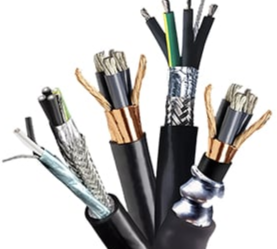
There are various configurations of motor cables that can meet specific application requirements. Normally, the motor is equipped with three main power wires, and the commonly used insulation material is cross-linked polyethylene (XLPE) insulation material. Some grounding wires do not have insulation measures. There are many types of signal lines, and various types of braided shielding layers and foil shielding layers can be selected. The entire cable assembly adopts a fully wrapped protective sleeve that is resistant to environmental corrosion (Figure 1).
VFD motor cables come in various configurations
Figure 1: VFD motor cables have multiple configurations. (Image source: Belden)
Even Belden Basics basic cables with part number 29521C 0105000 are complex components composed of conductors, shielding layers, and insulation layers. These cables include three 14 gauge copper conductors (7x22 strands) with XLPE insulation, as well as three 18 gauge copper grounding wires (7x26 strands) without insulation. These six conductors are all wrapped with double helix shielding tape and achieve 100% coverage, and to meet environmental requirements, the entire cable assembly is sheathed with polyvinyl chloride (PVC).
Belden Basic cables are suitable for use in Class 1, Division 2 hazardous locations as defined by the National Electrical Code (NEC) in the United States. Class 1 refers to facilities that handle flammable gases, vapors, and liquids. According to the regulations of Zone 2, these flammable materials usually do not reach a concentration that can ignite them.
Some series of cables, such as LAPP's Ö LFLEX VFD 1XL, come with or without signal lines. If the application requires signal lines, LAPP's 701710 cable can be used. This cable contains three power conductors, one grounding conductor, and a pair of signal lines. Among them, the power conductor specification is 16 AWG (26x30 twisted wire), XLPE (reinforced) insulation. The signal lines are individually shielded with foil.
The entire cable assembly uses insulation tape, three-layer foil tape (100% coverage), and tin plated copper braided tape (85% coverage) as shielding layers. The outer sheath of a cable is a thermoplastic (TPE) material made from a special formula, which can withstand disinfectants and is commonly used in food, beverage, chemical, and related fields.
In addition to being used for reliable and efficient processing of power and signals, VFD cables should also be able to handle high voltage spikes and electromagnetic interference (EMI) noise levels generated during high-frequency operation of the drive. Although VFD cables are designed to control and manage high voltage spikes and EMI, there are also limitations (Figure 2). At this point, the load reactor can be used to reduce high voltage spikes and EMI.