
- 4E, No.3 Shenfeng Road, Liuyao Community, Henggang Street, Longgang District, Shenzhen,China
- cc.shen@xypltd.com
- Call: +86 15112667855
News
Utilizing integrated MOSFETs to leverage the advantages of ideal diodes
- 2026-08-14
Ideal diode technology can bring many benefits to electronic applications, including reduced voltage drop, enhanced system control, and powerful protection functions. Product designers can fully utilize the potential of these advanced solutions to create more efficient, compact, and durable products. However, to choose the appropriate ideal diode for an application, a balance needs to be found between various factors such as electrical performance, heat dissipation, reliability, cost, and compliance.
The voltage drop of traditional diodes is between 0.6 V and 0.7 V, while the voltage drop of Schottky diodes is about 0.3 V. In high current applications, these voltage drops can cause severe power losses. The ideal diode (Figure 1) uses a low on resistance power switch (usually MOSFET) to simulate the unidirectional current flow characteristics of the diode, but without the voltage drop loss of the diode.
The difference between diode (top) and ideal diode circuit
Figure 1: This figure illustrates the difference between a diode (upper part) and an ideal diode circuit. (Image source: Analog Devices, Inc.)
For example, under a 1A load, the voltage drop of a 10 m Ω MOSFET is only 10 mV, while the voltage drop of a standard diode is usually 600 mV. The decrease in voltage drop also means a significant reduction in power consumption. The loss of a 10 m Ω MOSFET at 1 A load is 10 mW, while the loss of a regular diode is 600 mW.
By adding back-to-back MOSFETs and control circuits, the integrated ideal diode solution achieves more advanced functions, including priority source selection, current limiting, and surge limiting, while significantly improving the precision of power management. Traditionally, this requires different controllers, making achieving comprehensive system protection complex and cumbersome. However, in an ideal diode solution, adding back-to-back MOSFETs (Figure 2) can achieve comprehensive system control by enabling the on/off function of one or two MOSFETs, or limiting the current.
Ideal diode solution using back-to-back MOSFETs
Figure 2: Ideal diode solution for advanced functionality and control using back-to-back MOSFETs. (Image source: Analog Devices, Inc.)
Integrated solutions can provide powerful protection against common system failures, thereby reducing system downtime. The adjustable undervoltage lockout (UVLO) and overvoltage lockout (OVLO) thresholds, programmable current limiting, and thermal shutdown protection ensure that the system can maintain normal operation even under harsh conditions. Integrated solutions also help minimize the number of required components and circuit board space.
Replacing traditional Schottky diodes with integrated MOSFET solutions can significantly reduce power consumption, making it an ideal choice for redundant power OR ing in industrial power supplies, battery powered systems, and telecommunications and data center applications. This solution can also ensure reverse input protection and prevent damage caused by accidental polarity reversal.
The challenges faced when choosing an ideal diode
The integrated ideal diode solution aims to ensure reliable and efficient operation of applications.
However, designers face a series of challenges when choosing an ideal diode, including thermal management, current handling, rated voltage, integration complexity, cost, and component supply:
Although ideal diodes can reduce power dissipation, thermal management is still an important consideration. Designers must ensure that diodes can withstand thermal loads without affecting performance. Proper heat dissipation and thermal design are crucial for preventing overheating.
The current handling capability of diodes must be able to manage the expected current load of the application without exceeding the rated limit. This includes evaluating the RDS (ON) of the diode to ensure that it remains within an acceptable range under maximum load conditions.
The rated voltage of the diode must be sufficient to withstand the maximum voltage level in the application. Designers need to consider both forward voltage drop and rated reverse voltage to ensure reliable operation.
Although integrated solutions have numerous advantages, they can also complicate the design process. Designers must ensure that all integrated features (such as UVLO, OVLO, and current limits) are properly configured, which may require additional design and testing time.
Designers must weigh the benefits of integration against the added costs, and determine whether the added functionality is worth spending.
Designers must ensure that the selected diodes are always in stock and there are no supply chain issues that may affect production plans.
Utilize the advantages of comprehensive solutions
Analog Devices, Inc. (ADI) is a leading enterprise in the field of power management solutions, and its ideal diode controller product portfolio adopts MOSFET based design solutions. The company's integrated solutions can minimize power consumption, improve heat dissipation performance, and enhance system reliability, making them an essential choice for industrial, automotive, telecommunications, and battery powered applications.
The integrated solution integrates the ideal diode function with additional system protection functions such as overvoltage, undervoltage, hot swappable, and electronic fuse (eFuse) protection into one integrated circuit. Previously, these functions were provided by different controllers, making it more complex to achieve comprehensive system protection.
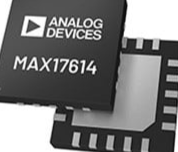
Ideal diode controllers from ADI, such as MAX17614 (Figure 3), have advanced reverse input protection, fast switching capability, and high voltage processing capability, enabling seamless power redundancy and improved energy efficiency. MAX17614 is a highly integrated solution that integrates a high-performance ideal diode and various other functions into a single integrated circuit, providing comprehensive protection for power systems.
The MAX17614 provides 140 ns of reverse current blocking protection, allowing for the use of smaller output holding capacitors in priority power selector applications to improve overall system efficiency. This device combines the ideal diode/priority power selector function with adjustable current limiting, hot swapping, electronic fuses, undervoltage (UV) and overvoltage (OV) protection functions.