
- 4E, No.3 Shenfeng Road, Liuyao Community, Henggang Street, Longgang District, Shenzhen,China
- cc.shen@xypltd.com
- Call: +86 15112667855
News
Using wide beam sensing technology to solve the problem of leading edge detection in material handling
- 2026-06-11
Today's material handling equipment is facing severe challenges, as it needs to process various packages at a faster speed while maintaining high detection accuracy. From thin letters to bulky irregular cardboard boxes, e-commerce handles a wide variety of packages, which indeed poses challenges for inspection work. Traditional narrow beam sensors cannot reliably keep up with this diversity. If the detection system cannot detect the package or issue an error alarm, it will result in missed shipments, diversion errors, and decreased throughput.
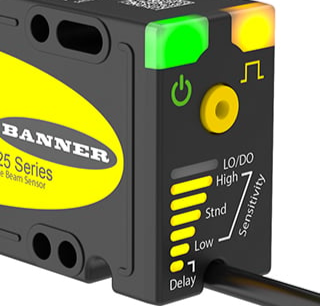
This article analyzes the reasons why narrow beam detection is difficult to play a role in material handling applications, explains how wide beam retroreflection technology solves these problems, and then introduces the practical steps of installing Banner Engineering's B25 wide beam retroreflection sensor in an automatic sorting environment.
The difficulty of package inspection in material handling
The working principle of a reverse reflection sensor is to send a beam of light from the sensor to a reflector, which then reflects the light directly back to the sensor's receiver. When an object passes between the sensor and reflector, it blocks the returning light, triggering the detection signal. This technology can work reliably in many industrial applications because it only requires one sensor installation position, with the reflector installed on the other side of the conveyor belt frame.
The challenge lies in the beam width. Traditional narrow beam anti reflection sensors can generate a focused detection point, typically only a few millimeters wide. Although this accuracy is good for consistent packaging, it poses a problem in material handling because during the material handling process, the equipment needs to handle various materials ranging from thin parcels to bulky irregular packaging boxes, and the positions and conditions of these materials are often different.
Narrow beam can cause some detection issues. The package not in the middle may only partially interrupt the beam, resulting in weak or inconsistent signals. Items with holes, damages, or gaps will allow the beam of light to pass through unobstructed, even if the package is clearly present, it will not be detected. Small objects such as envelopes or flat mail may completely slide over the narrow detection area, especially when moving along the edge of the conveyor belt.
The conveyor belt itself can also cause detection issues. Belt seams, surface changes, and normal belt oscillation can all cause erroneous excitation signals, making it difficult to distinguish between actual packages and conveyor belt abnormalities. The accumulation of dust and other environmental factors on sensors and reflectors will gradually reduce performance, while temperature fluctuations will affect the sensitivity of sensors.
These limitations manifest as missed detections, false triggers, and reduced system throughput. In automatic sorting systems, even minor inconsistencies in detection can cause serious operational interruptions. Mistriggering can lead to unnecessary system downtime, while missed detections can send packages to the wrong destination, resulting in additional processing costs and customer service issues.
The fundamental limitation is that narrow beam sensors can only generate one detection point in applications that require area coverage. The material handling operations in the real world require stronger detection capabilities to reliably handle various package types and positioning conditions.