
- 4E, No.3 Shenfeng Road, Liuyao Community, Henggang Street, Longgang District, Shenzhen,China
- cc.shen@xypltd.com
- Call: +86 15112667855
News
Using temperature controllers and micro PLCs to accelerate the speed of small automation projects
- 2026-09-28
Heating up. Heating is crucial in many industrial processes such as packaging sealing machines, plastic molding operations, solder reflow ovens, and semiconductor processing. Each process has specific requirements for temperature level and control accuracy.
Automation helps achieve maximum productivity and sustainability in Industry 4.0 facilities. Small machines and hot processing are no exception. But not all situations require large-scale, comprehensive solutions. With the help of relatively simple dedicated temperature controllers and small programmable logic controllers (PLCs), the performance of many applications can also be improved.
Machine designers can choose a range of options for simple automation projects, including heater controllers suitable for single-phase and three-phase power environments, heater controllers using a range of complex control algorithms, and PLCs optimized for small and medium-sized automation environments. Some small machines work in relatively isolated environments, while others are more beneficial when connected to large equipment.
This article introduces various options for power controllers and heater controllers, including hardware and software considerations. Finally, a brief introduction was given to the system integration issues related to sensor technology for temperature measurement and PLC optimized for small and medium-sized machines, as well as Omron's typical products.
From the curing of materials such as thermosetting resins and adhesives to the production of food and beverage products, industrial processes typically require temperature control to maintain efficiency and ensure quality. Industrial heaters are indispensable, but temperature controllers are the key.
There is more than one method to control the temperature of industrial heaters. The priority of system operation determines the selected method. When operating costs are the primary consideration and lower temperature control accuracy is acceptable, a simple voltage control system can be used.
By adjusting the power supply voltage of the heating element, the power consumption of the heater can be controlled and the heat output can be changed. The change in voltage can be quickly achieved and generate corresponding temperature changes, but its hysteresis varies with different system designs. Reducing voltage can lower energy costs and temperature. However, for many processes, the response time to temperature reduction may be too long and it is difficult to precisely control the temperature.
Beyond basic voltage control
For many applications, basic voltage control is not sufficient. In these cases, designers can use on/off control, periodic control, optimal periodic control, or phase control (Figure 1). Each technology has different performance characteristics:
Phase control can provide excellent controllability response, with excellent solution size and cost, and noise performance is acceptable in most applications.
Periodic control can provide excellent controllability response, with excellent solution size and cost, and equally excellent noise performance. In the "optimal" cycle control, the switch state is determined every half cycle.
The use of solid-state relays (SSRs) for on/off control has excellent controllability response, minimal solution size, reasonable cost, and excellent noise performance.
Image of power switch options for industrial heater control (click to enlarge)
Figure 1: Power switch options for industrial heater control. (Image source: Omron)
Implement phase control and optimal cycle control
Omron provides designers with multiple options to achieve on/off control, phase control, or optimal cycle control, including model G3PW-A245EU-S with a rated operating voltage of 100 VAC to 240 VAC; We also offer other models with operating voltages ranging from 400 VAC to 480 VAC.
These controllers have added heater burn detection function, which can extend the normal operation time of the system. An RS-485 communication port is used to set variables and monitor load current.
The G3PW controller supports total runtime monitoring and is suitable for constant resistance loads and variable resistance loads.
Multi channel power controller
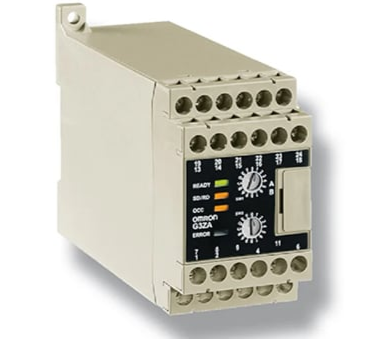
The G3ZA multi-channel power controller series has added three-phase optimal cycle control function to support three-phase heaters. When combined with zero crossing SSR, it can support low-noise power operation. A controller can control up to 8 SSRs. In addition, the lamp heater also has a soft start function (Figure 2).