
- 4E, No.3 Shenfeng Road, Liuyao Community, Henggang Street, Longgang District, Shenzhen,China
- cc.shen@xypltd.com
- Call: +86 15112667855
News
Using solid-state relays in factory automation to achieve high reliability, fast switching, and low EMI
- 2026-09-23
In order to avoid costly downtime, advanced diagnostic technologies and predictive maintenance are increasingly being applied in factory automation processes in many industries, such as food and beverage production, automated assembly, and other continuous processing systems, as well as HVAC, water purification, and power generation equipment. Reliable switch relays are crucial equipment in these automated industrial processes. This type of relay must be able to switch quickly, operate continuously under extremely challenging conditions, while minimizing contact wear and minimizing electromagnetic interference (EMI) that affects wireless sensors and control devices.
Solid state relays (SSRs) use innovative technology to improve reliability and durability, ensuring stable performance even in harsh environments, thus meeting the switching requirements of factory automation.
This article briefly discusses the switch requirements for factory automation. Then, take Littelfuse SSR product as an example to introduce and explain how to use the device to meet these requirements.
Define and meet the switch requirements for factory automation
The requirements of factory automation for switches include: achieving reliability at low cost, fast action time without contact vibration or arc, minimizing electromagnetic interference that affects nearby circuits or the increasing number of wireless sensors and networks in the factory, and being able to resist mechanical impact and vibration well.
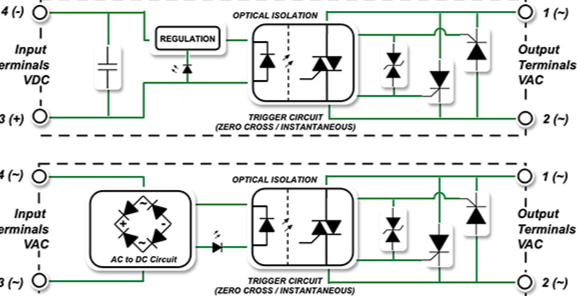
SSR uses semiconductor devices to perform switching operations to meet these requirements. This relay can be driven by AC or DC voltage, and each type of excitation has different models (Figure 1).
Functional block diagram of solid-state relay (click to enlarge)
Figure 1: The functional block diagram of these solid-state relays shows the key components of the DC (upper) and AC (lower) actuated models. (Image source: Littelfuse, Inc.)
The DC driven solid-state relay (top) can adjust the applied voltage. The communication driven solid-state relay (below) uses a full bridge rectifier to convert the excitation signal into direct current. Both types of solid-state relays isolate the actuation signal from the output through optical means. The active components of these SSRs are a pair of silicon controlled rectifiers (SCR). These SSRs include overvoltage protection function, which is in the form of connecting a transient voltage suppression (TVS) diode between the thyristor gates to protect the SSRs and prevent unexpected state changes in the event of transient electricity in the network.
The switch response utilizes the fast switching time of semiconductor devices and is controlled by trigger circuits. The switching action can be performed at the zero crossing point of the output voltage after applying the execution signal, or it can be randomly (instantaneously) performed together with the actuation signal (Figure 2).
Switch characteristic diagram
Figure 2: Select switch characteristics based on the expected application of SSR. (Image source: Littelfuse, Inc.)
Zero crossing conduction is suitable for high current applications such as industrial heaters, which can minimize small surge currents to the greatest extent possible. Instantaneous connection is used in situations where switching action must be achieved at high frequencies. Instantaneous switching can generate the highest possible switching frequency.
SSR Example
In order to meet the demand for more reliable and durable power switch relays in industrial and commercial machinery applications, Littelfuse Inc. has designed the SRP1 series of high durability solid-state relays. This series of relays is divided into two models: SRP1-CB high durability bare SSR and SRP1-CR high durability integrated SSR (with touch safety and overvoltage protection functions) (Figure 3, left and center).
Littelfuse SRP1-CB Bare SSR (left), SRP1-CR Touch Safe Solid State Relay (middle), and SRP1-CB... F
Figure 3: The SRP1-CB bare SSR (left), SRP1-CR touch safe SSR (middle), and SRP1-CB... F alternative quick connect terminals (right) are shown. (Image source: Littelfuse, Inc.)
The proprietary semiconductor devices designed by Littelfuse can effectively prevent performance degradation caused by heat generation and achieve optimal performance under harsh conditions. Both model series offer AC or DC actuation devices with output current ratings of 10 A, 25 A, and 50 A, and output voltage ranges from 24 VAC to 240 VAC or 48 VAC to 600 VAC. The difference between these two models is that SRP1-CR integrates protection and installation functions, including IP20 finger safety cover, TVS diode overvoltage protection, and pre installed thermal pad. The SRP1-CB... F version (Figure 3, right) also features quick connect terminals.
A relay is a single pole single throw (SPST) device connected in series with the output load (Figure 4).