
- 4E, No.3 Shenfeng Road, Liuyao Community, Henggang Street, Longgang District, Shenzhen,China
- cc.shen@xypltd.com
- Call: +86 15112667855
News
Using Silicon Carbide MOSFET to Reduce Losses in High Voltage Switching Mode Power Supply Systems
- 2026-09-04
The number and diversity of power electronics applications continue to increase, from electric vehicles (EVs) and photovoltaic (PV) inverters to energy storage and charging stations. These applications require higher operating voltages, higher power densities, lower losses, higher efficiency, and reliability, and the use of power devices based on wide bandgap (WBG) technology such as silicon carbide (SiC) can meet these requirements, and this technology is constantly improving.
Why choose SiC?
Compared with silicon (Si), WBG semiconductor materials such as SiC have unique properties, making them an ideal choice for the design of switch mode power supply systems. Band gap refers to the energy required to move electrons from the valence band to the conduction band of a material. The wide bandgap characteristics of SiC enable it to withstand higher operating voltages. In addition, there are other important characteristics, including thermal conductivity, on resistance, electron mobility, and saturation velocity.
Thermal conductivity measures the rate at which heat is conducted from a semiconductor junction to the external environment. The thermal conductivity of SiC is almost three times that of Si. This feature makes it easier for SiC devices to dissipate heat, thus having a higher rated temperature. Meanwhile, compared to equivalent Si devices with similar rated voltage, SiC semiconductors can be made thinner. Therefore, under the given same voltage and rated power, the size of SiC devices is smaller.
SiC enables designers to increase the current carrying area while maintaining the same chip size, thereby reducing device resistance. This characteristic contributes to the most significant advantage of SiC devices: achieving lower channel on resistance (RDS (ON)) under the same rated voltage conditions. A lower RDS (ON) means lower conduction loss and higher efficiency.
SiC semiconductors have higher electron mobility and can operate at higher frequencies compared to Si devices. When power circuits operate at higher switching frequencies, the size of passive components such as transformers, chokes, inductors, and capacitors required will be reduced, resulting in significant cost savings. This size reduction also reduces the volume of these components, thereby achieving higher overall power density.
The saturation velocity is the maximum velocity of electrons in a high electric field. In SiC semiconductors, the electron speed is twice that of Si semiconductors, resulting in faster switching time and lower switching losses.
Latest SiC MOSFET Example Products
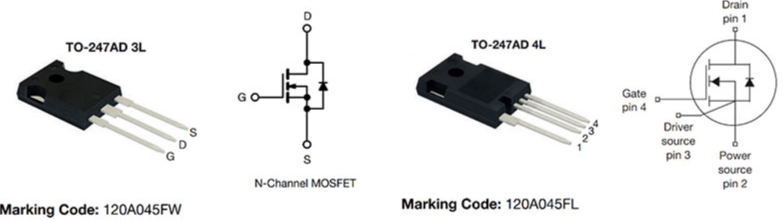
Based on the core advantages of SiC, Vishay has launched the 1200 V MaxSiC series SiC MOSFET. This series adopts proprietary MOSFET technology and provides RDS (ON) values of 45, 80, and 250 m Ω in standard packaging, suitable for industrial applications such as traction inverters, photovoltaic energy conversion and storage, car chargers, and charging stations. This series of products also has extremely fast switching speed and 3 µ s (SCWT).