
- 4E, No.3 Shenfeng Road, Liuyao Community, Henggang Street, Longgang District, Shenzhen,China
- cc.shen@xypltd.com
- Call: +86 15112667855
News
Using power quality mitigation solutions to protect the power infrastructure of water treatment plants
- 2026-08-10
The cost of electricity generally accounts for 40% of the operating budget of a water treatment plant, therefore, the plant must operate at maximum efficiency. However, the water pumps, motor drivers, lighting equipment, and compressors in the factory have been affected by power quality (PQ) issues such as harmonic distortion, voltage gaps, voltage dips and spikes, and electrical noise. These power quality issues can lead to low efficiency, downtime, and equipment damage.
The equipment for alleviating power quality issues can solve problems in water treatment plants. Products such as drive isolation transformers, hard wired voltage regulators, power line regulators, surge protection devices (SPDs), and active tracking filters can improve efficiency, prevent downtime, and protect valuable power assets from damage.
This article briefly introduces the power quality issues faced by electrical equipment designers in water treatment plants. Then, SolaHD's power quality mitigation devices were introduced, which can be used to alleviate these issues and maximize efficiency.
Power quality issues
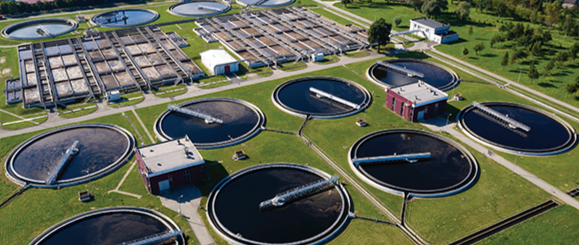
Although the energy supply of the water treatment plant (Figure 1) is generally reliable, power quality issues often arise. This type of problem manifests as unnecessary harmonic distortion, voltage dips and spikes, and electrical noise.
Picture of energy supply for water treatment plant
Figure 1: The energy supply of water treatment plants may be affected by power quality issues, resulting in low efficiency, downtime, and equipment damage. (Image source: SolaHD)
The power quality challenges of water treatment plants may come from external sources such as lightning, as well as internal sources such as electrical equipment itself. For example, when nonlinear loads consume current in a pulsed manner, low-quality variable speed drives will produce harmonic distortion (Figure 2). Harmonics force conductors to carry non-standard frequency currents beyond 60 hertz.
When nonlinear loads consume current in a pulsed manner, harmonic images will be generated
Figure 2: When a nonlinear load draws current in a pulsed manner and forces the conductor to carry non-standard frequency currents beyond 60 Hz, harmonics are generated. (Image source: SolaHD)
By generating nonlinear currents at specific points of the voltage sine wave (rather than the entire sine wave), electrical equipment produces harmonic frequencies that are integer multiples of the fundamental frequency. Low frequency harmonics (such as 180 Hz, 300 Hz, or 420 Hz) are caused by low-frequency current distortion and phase shift currents flowing through the power system. High frequency harmonics (1 kHz to 3 kHz) are caused by high current switches in high-power, nonlinear electronic switching loads.
Another harmonic phenomenon, namely voltage gap, is caused by current rectifier switches in water treatment equipment such as DC motor drivers, motor starters, and power supplies. Voltage gaps are usually caused by commutation operations in silicon controlled rectifiers (SCR). During the short period of time when current is transmitted from one conductive SCR to another SCR, a short circuit will occur. The new SCR begins to conduct, while the previous SCR continues to conduct briefly. This can cause a phase short circuit, typically lasting for a few microseconds (µ s), sufficient to reduce the voltage. The voltage gap may occur at any time during the AC half cycle, as the commutation angle is not constant and varies with changes in load requirements.
Although there are multiple external and internal sources of power quality issues, about 80% are caused by voltage dips. IEEE defines voltage sag as a voltage drop of 10% to 90% below the normal voltage of 60 Hz. The duration of a sudden drop event is generally less than 60 seconds (s), but can exceed 8 milliseconds (ms) (Figure 3).