
- 4E, No.3 Shenfeng Road, Liuyao Community, Henggang Street, Longgang District, Shenzhen,China
- cc.shen@xypltd.com
- Call: +86 15112667855
News
Using Nordic power management IC to reduce the number of components and achieve code free configuration
- 2026-10-13
The design requirements for the new rechargeable wireless application are simple: to make the device run longer and provide more functions. To achieve an appropriate balance between performance and power consumption, it is usually necessary to start with component selection and make multiple trade-offs between hardware and software issues.
Nordic Semiconductor is committed to simplifying this challenge through power management integrated circuits (PMICs) that integrate intelligent system management capabilities, eliminating the need for multiple discrete components and achieving codeless configurations.
Nordic's nPM1300 series is a multifunctional integrated PMIC that supports various Nordic and non Nordic host devices, suitable for applications such as wearable devices, handheld entertainment devices, IoT sensors, or personal medical devices.
The PMIC product portfolio includes a charger with a maximum current of 800 mA and adjustable voltage regulation of up to 500 mA. This IC also includes four individually controllable power rails: two configurable dual-mode buck regulators and two dual-purpose 50 mA LDO/100 mA load switches (which can be used as switches or linear regulators).
The nPM1300s also includes a power meter that allows the host device to read battery temperature, voltage, and current. Designers can leverage this advantage to obtain charging state estimates equivalent to Coulomb counters with lower power consumption.
8-in-1
Other integrated features include system level watchdog and hard reset. According to Nordic, designers using their PMIC products can integrate the functionality of eight chips and other components into a compact package, which are typically implemented as discrete components in low-power Bluetooth (BLE) embedded designs.
The onboard charger can charge lithium-ion, lithium polymer, or lithium iron phosphate batteries. The battery pack connected to the VBAT pin must include overvoltage protection, undervoltage protection, overcurrent discharge protection circuits, and temperature fuses to prevent overheating (unless there is an NTC thermistor). The nPM1300 series also supports USB-C, which can be used for power supply and data communication.
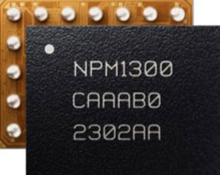
The nPM1300-CAAA-R (Figure 1) is packaged in a 3.1 x 2.4 mm WLCSP package. Other models, such as nPM1300-QEAA-R7, use a 5 x 5 mm QFN32 package.
Figure 1: Representative of Nordic Semiconductors nPM1300 power management IC. (Image source: Nordic Semiconductor)
Configure nPM1300
Designers can use the GUI of the nPM PowerUp application to configure all settings of the nPM1300, which Nordic provides in its nRF Connect desktop software. After configuration is complete, the settings can be exported as code to be implemented in MCU applications.
This configuration application can also be used with Nordic's nPM1300-EK evaluation board (Figure 2), which is designed to make evaluating and implementing nPM1300 easier. The male pin socket of the evaluation board supports access to all nPM1300 PMIC connections and external testing equipment; The implementation has three LEDs and four buttons for evaluating the GPIO and LED driver functionality of the nPM1300 PMIC.
Figure 2: The nPM1300-EK evaluation board is used for easier configuration and implementation of the nPM1300 power management IC. (Image source: Nordic Semiconductor)
Nordic also offers an nPM FG power meter board extension, which acts as a constant current injection device during battery analysis. PMIC、 The configuration software, evaluation kit, and power meter board extension can be used to analyze power sources and develop models that provide stable and accurate charging state predictions with typical errors of less than ± 3%.
The battery model generated by nPM PowerUP can be exported for use in any application that uses the Nordic energy meter algorithm. This algorithm can run on most Nordic hosts and is compatible with other non Nordic SoCs.