
- 4E, No.3 Shenfeng Road, Liuyao Community, Henggang Street, Longgang District, Shenzhen,China
- cc.shen@xypltd.com
- Call: +86 15112667855
News
Using light curtains to enhance security and measure objects
- 2026-10-13
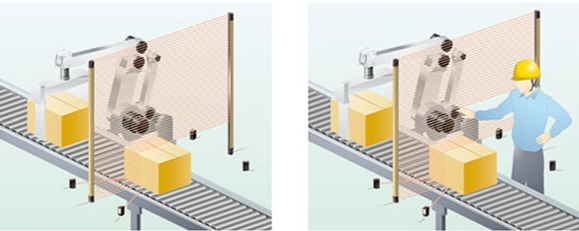
Light curtain is a universal technology. They are usually associated with security applications and have a wide range of uses, including machine protection and establishing protected areas; Object detection or size measurement during material handling; Ensure the correct positioning or alignment of objects in packaging and sorting applications; And intrusion detection and access control in restricted areas.
For a comparison between light curtains and safety laser scanners, as well as a review of scanner applications, please refer to the first part of this article series, 'How Safety Laser Scanners Protect Personnel and Machines'.
This article first introduces important specifications and performance standards for light curtains, providing examples of their applications in security and access control systems, as well as methods for measuring light curtains. In between, typical light curtain products from Panasonic, IDEC, Omron, and Banner Engineering are introduced.
Standard and type of safety light curtain
The International Electrotechnical Commission (IEC) 61496 (Safety of Machinery - Electrical Sensitive Protective Equipment (ESPE)) specifies four types of safety performance. The relevant types are 2, 3, and 4. Type 1 is not defined for use in secure light curtain applications.
IEC 61496 adds another layer of requirements to the Safety Integrity Level (SIL) and Performance Level (PL) defined in IEC 61508 and the International Organization for Standardization (ISO) 13849.
SIL levels are divided into 1 to 3 levels, with SIL 3 being the highest level; The PL level is divided into "a" to "e" levels, with PLe being the highest requirement. According to the classification in IEC 61496, light curtains generally belong to Class 2 and Class 4, but there are also a few devices rated as Class 3. The safety laser scanner meets Class 3 requirements. Some important classification factors of types include:
Class 2 equipment must comply with SIL 1 and PLc standards. They are suitable for low-risk applications where faults may result in collisions or bumps, knocks, minor cuts and abrasions, or pinch injuries, but will not cause compression. IEC 61496 requires equipment to perform regular self checks during start-up and operation. These devices lack redundant automatic self-test circuits for Class 4 light curtains. The effective aperture angle (EAA) for defining the field of view must be ± 5 degrees or narrower. This may cause light interference and errors.
Category 3 ESPEs (such as safety laser scanners and some light curtains) must comply with SIL 2 and PLd standards and be designed to be safe from a single fault, but can be dangerous due to the accumulation of faults. The electromagnetic compatibility (EMC) requirements for these devices are also stricter than those for Class 2 devices. Category 3 devices are suitable for applications with high safety requirements.
The design of Class 4 light curtains takes safety as the main consideration. They must comply with the highest standards of PLe and SIL 3. Its design will not pose a danger due to a single fault or the accumulation of faults. These light curtains have a small EAA of only ± 2.5 degrees, making them less susceptible to optical interference and making it easier to identify objects. They must meet the strictest electromagnetic compatibility requirements.
Due to the lower price of optical components and simpler fault detection circuits, the cost of Class 2 light curtains is 30% lower than that of Class 4 light curtains. The resolution range of the four types of light curtains is wider, including 14 mm (for finger recognition), 30 mm (for hand recognition), 50 mm (for leg recognition), and 90 mm (for body recognition). In contrast, Class 2 light curtains are generally limited to larger resolutions (Figure 1).
Schematic diagram of Class 2 and Class 4 light curtains (click to enlarge)
Figure 1: Compared to Type 2 light curtains, Type 4 light curtains typically have a smaller minimum resolution. (Image source: IDEC)
In addition to detecting objects of different sizes, the beams in the light curtain can also be individually controlled to achieve more advanced functions such as shielding, blanking, and measuring the size and quantity of objects.
Shielding and blanking light curtain
Light curtain shielding and blanking refer to the closure of all or part of the light curtain under specific circumstances. Shielding is an automatic process that suspends all or part of the light curtain protection, usually occurring in non hazardous parts of the machine cycle. It can allow materials to enter the work area without stopping any hazardous activities. Once the material enters the workspace, the light curtain will restart all protection functions.
Typical applications of blocking include:
Enable pallets to enter and exit between two operations of the stacker crane
Allow materials to move between different areas in the automated production process while still protecting personnel safety during machine operation