
- 4E, No.3 Shenfeng Road, Liuyao Community, Henggang Street, Longgang District, Shenzhen,China
- cc.shen@xypltd.com
- Call: +86 15112667855
News
Using electric vehicle charging cables for industrial applications
- 2026-08-10
With the rapid popularity of electric vehicles (EVs), a thriving and standardized charging infrastructure market has emerged, particularly in the field of charging cables. Although electric vehicle charging cables are designed to meet automotive requirements, they can also be used for many other applications that require reliable high-power connections.
This method has numerous advantages. The investment in electric vehicle technology in the automotive industry has accelerated innovation while also reducing costs. In addition, the development of connector standards means that electric vehicle charging cables provide simplified design options that ensure interoperability.
The GlobTek EV charging cable illustrates this point very well. This type of cable has multiple characteristics that make it attractive in non electric vehicle applications:
In both AC and DC configurations, the current capacity is large and the power level can reach several hundred amperes (A)
Durable and sturdy, able to withstand various extreme environmental conditions including humidity, temperature fluctuations, and mechanical stress
Adopting standardized connectors, compatible with globally recognized charging interfaces, ensuring seamless integration into various systems
These properties make this type of cable very suitable for many medium voltage applications that require frequent plugging and unplugging operations. Typical applications include fields similar to electric vehicles, such as electric forklifts and dock shore power systems, where mobile devices require frequent access to charging ports. In addition, this type of cable is also suitable for applications that require temporary power infrastructure, such as outdoor activities, emergency rescue devices, etc.
This type of cable can also be used for permanent installation, simplifying integration. For example, these types of cables can provide standardized connectors for robot applications, making it easier to deploy automation equipment without the need for special power cords.
GlobTek charging cables include Type 1 (SAE J1722-2012), Type 2 (IEC62196-3:2014), and NACS (SAE J3400/UL2251) configurations, which can meet the needs of various applications and charging infrastructure. The cable specifications are shown in Table 1.
Table 1: GlobTek EV charging cables have numerous advantageous characteristics suitable for industrial environments. (Table source: Kenton Williston)
Special cable for interoperable charging points
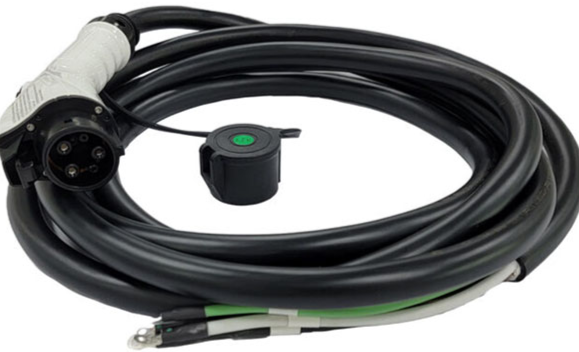
Typical products include EVC250A040EA31B50002W cable (Figure 1). This 5-meter-long cable has a Type 1 male plug on one end and four circular terminals on the other end. The rated voltage is 250 V AC (VAC), 40 A, and supports high-power transmission. This cable reaches IP55 level and has UL94V-0 flame retardant resistance, making it suitable for long-term installation in harsh environments. Insertion force less than 100 Newtons (N), insertion frequency greater than 10000 times, suitable for frequent plugging and unplugging operations.
Figure 1: EVC250A040EA31B50002W has a Type 1 male connector designed specifically for permanent installation. (Image source: GlobTek)
This cable can be used to create industrial charging points, provide interoperability solutions, and eliminate critical pain points in industrial environments. Nowadays, each type of electric device may have its own charging infrastructure. For example, forklifts and pallet jacks may have similar charging requirements, but their connectors are incompatible with each other. By adopting standardized solutions, various devices can share a charging point, significantly reducing the cost and implementation complexity of transitioning to battery powered devices.
Detachable power cord
Another example is the EVE480A032UA28B5000FW cable shown in Figure 2. The characteristic of this 5-meter-long cable is that one end is a type 2 male plug and the other end is a type 2 female plug. Its electrical specifications are 480 VAC and 32 A, and the insertion force is between 50 and 100 N. Like EVC250A040EA31B50002W, it has reached IP55 and UL94V-0 levels.
Figure 2: EVE480A032UA28B5000FW is a detachable type 2 cable. (Image source: GlobTek)
This type of cable design can be used as an extension cable to accommodate charging ports at different distances. For example, this type of cable can be used on docks to accommodate ships of different sizes and configurations. This type of power cord can also be used as a temporary connection, such as for outdoor activities.
Built in power socket
GlobTek also offers sockets that can be installed inside the casing, such as in forklifts or other heavy equipment. ESH1V0D350RA37A12001C belongs to this type of socket (Figure 3). The socket is equipped with an NACS female socket on the panel and comes with a 1-meter cable to connect exposed wires. The rated voltage of this socket is 1 kilovolt (kV), the rated current is 350 A, and it can operate at temperatures ranging from -30 ° C to 50 ° C.