
- 4E, No.3 Shenfeng Road, Liuyao Community, Henggang Street, Longgang District, Shenzhen,China
- cc.shen@xypltd.com
- Call: +86 15112667855
News
Using edge AI technology to extend the battery life of wireless motor monitoring
- 2026-08-10
Artificial intelligence (AI) has always been a topic of great concern. Edge applications are one of the many AI applications that can enhance state based monitoring (CbM) of robots, rotating machinery, and their motors. With wireless reporting, edge AI can analyze critical data related to machine health and performance for predictive maintenance and issue alerts when necessary. Performing monitoring functions at the edge can reduce power consumption and latency, while optimizing the use of available bandwidth.
For an effective system to achieve this edge AI CbM functionality, it is necessary to carefully select and integrate a set of components that support multiple sensor inputs, including accelerometers, AI processors, and power management.
This article will explore the challenges in sports monitoring. Then, introduce an edge AI example that utilizes analog, digital, and mixed signal integrated circuits from Analog Devices to achieve this functionality. Taking a battery powered system using a wireless vibration assessment kit as an example, the design, functionality, and implementation of the system are fully demonstrated.
Motor Monitoring Challenge
Targeted predictive maintenance in the early stages of the machine lifecycle can reduce the risk of production downtime. This will improve reliability, significantly save costs, and increase factory productivity.
Vibration is the most common and valuable parameter among most monitored rotating machine parameters. Although vibration is not difficult to measure, meaningful use and reporting of this data requires data analysis, advanced algorithms, and effective connectivity schemes. All of this must be done with minimal power consumption to maximize battery life.
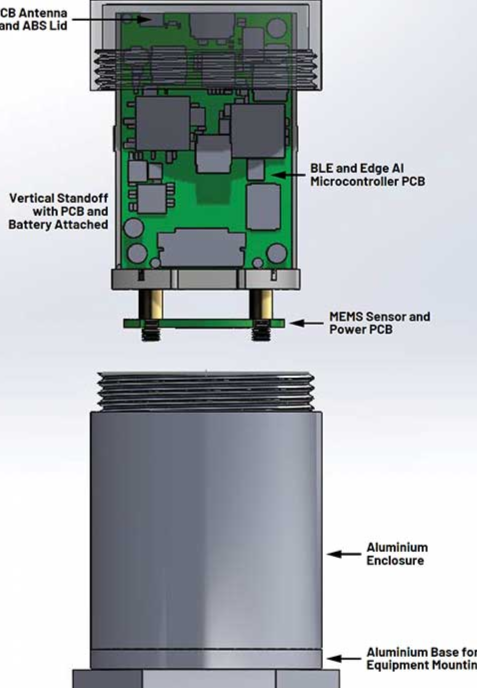
For this purpose, Analog Devices has developed the EV-CBM-VOYAGER4-1Z Voyager4 wireless vibration assessment kit (Figure 1). This kit provides a complete low-power vibration monitoring platform, allowing designers to quickly deploy wireless solutions on machines or testing devices. The platform uses edge AI algorithms to detect abnormal situations in motors and trigger machine diagnosis and maintenance requests.
Analog Devices' EV-CBM-VOYAGER4-1Z Voyager4 Wireless Vibration Assessment Kit
Figure 1: Using the EV-CBM-VOYGER4-1Z Voyager4 wireless vibration assessment kit, designers can quickly deploy wireless edge AI monitoring solutions on machines or testing devices. (Image source: Analog Devices)
The diameter of Voyager4 is 46 mm and the height is 77 mm. There is an M6 threaded hole on the base for installing screws or bonding the motor housing. This kit features an aluminum base and a wall mounted casing. To avoid shielding the antenna of the Bluetooth Low Energy (BLE) link, this kit uses an ABS plastic casing.
BLE and edge AI microcontroller unit (MCU) printed circuit board (PC board) are installed vertically, and the battery is fixed on the bracket. The microelectromechanical system (MEMS) sensor and power circuit board are placed on the base, close to the vibration source to be monitored.
In a typical wireless motor monitoring system, the duty cycle of the sensors is very low. The sensor will be awakened within a predetermined time interval, and then measure relevant parameters such as temperature and vibration, and transmit the data back to the user end for analysis in order to take corresponding measures.
In contrast, the Voyager4 system utilizes edge AI detection technology to limit the use of high-power radios. When the sensor is awakened and measures data, the MCU will only send the data back to the user when it detects an abnormality. In this way, the battery life can be extended by at least 50%.
The core component of the Voyager4 system is the ADXL382-2BCCZ-RL7, a 16 bit, 8 kHz three-axis digital MEMS accelerometer integrated circuit (Figure 2, left) specifically designed for collecting vibration data.