
- 4E, No.3 Shenfeng Road, Liuyao Community, Henggang Street, Longgang District, Shenzhen,China
- cc.shen@xypltd.com
- Call: +86 15112667855
News
Understand supercapacitors and their relationship with batteries
- 2026-10-20
With the rise of large-scale applications such as the Internet of Things (IoT), Industrial Internet of Things (IIoT), portable electronic products, and industrial plants and data centers, the demand for reliable energy storage resources is rapidly increasing. Batteries can directly supply power to smaller devices, while in larger applications, batteries are often used as a backup power source in the event of a main power outage.
Small devices typically rely on lithium-ion (Li ion) batteries or alkaline button batteries to achieve a compact appearance and minimal maintenance. Lithium ion batteries need to pay attention to charging cycle limitations and safety. The battery used as a backup power source will quickly deplete after fast charging and must be replaced. These batteries also require complex battery management systems, and there is still a possibility of thermal breakdown, which can lead to safety issues.
Double layer capacitors (EDLC) or supercapacitors are a complementary technology to batteries. The power supply time of batteries is relatively long, while supercapacitors can quickly supply power in a short period of time. Supercapacitors are environmentally friendly, will not experience thermal breakdown, and can operate reliably for up to 20 years. Supercapacitors can serve as the sole energy storage method, can also be used in conjunction with batteries, and can be used as hybrid devices to optimize power transmission.
This article briefly introduces the relationship between supercapacitors and batteries. Then, some typical standalone applications and applications combined with batteries were reviewed. Taking Eaton's supercapacitor as an example for illustration.
The difference between supercapacitors and batteries
Supercapacitors are energy storage devices that have abnormally high specific power capacity compared to electrochemical energy storage devices such as batteries. The power supply function of batteries and supercapacitors is similar, but their operating modes are different. The working principle of supercapacitors is similar to that of traditional capacitors, and the discharge curve under constant discharge current indicates that the voltage decreases linearly. Unlike batteries, supercapacitors store energy electrostatically, so there will be no chemical changes in the device, and the charging and discharging operations are almost completely reversible. This means that supercapacitors can withstand more charge and discharge cycles.
Batteries store energy electrochemically. The discharge curve of lithium-ion batteries is flat; Before the battery is almost completely discharged, it exhibits almost constant voltage characteristics. Due to the degradation of chemical mechanisms, the number of charge and discharge cycles of lithium-ion batteries is limited. Factors such as temperature, charging voltage, and discharge depth can all affect the reduction of battery capacity.
Lithium ion batteries are prone to thermal runaway, spontaneous combustion, and even explosion. Due to the chemical reaction that occurs during the charging and discharging process of resistance heating, heat generation is inevitable. In view of this, it is necessary to monitor the temperature of the battery to ensure user safety.
Comparison of specifications between supercapacitors and lithium-ion batteries
Batteries have high energy density. Supercapacitors have lower energy density than batteries, but higher power density because they can discharge almost instantly. The electrochemical process in the battery requires more time to provide energy to the load. Both devices have functions suitable for specific energy storage needs (Figure 1).
Functional Comparison Table of Supercapacitors and Lithium ion Batteries
Figure 1: Comparison of characteristics between supercapacitors and lithium-ion batteries. (Image source: Eaton)
The difference between these two devices is most significant when comparing energy density in watt hours per liter (Wh/L) and power density in watts per liter (W/L). This will also affect the discharge time; The purpose of supercapacitors is to provide energy in short time intervals (instantaneous events), while batteries power long-term events. Supercapacitors can discharge in just a few seconds or minutes, while batteries can provide energy within hours. This characteristic affects their respective applications.
Compared to batteries, supercapacitors have a wider operating temperature range. Their almost lossless electrostatic process also helps improve efficiency and charging speed.
Example of supercapacitor
Eaton has launched a reliable full range of supercapacitors for energy storage applications that require high power density and fast charging. The physical packaging of its supercapacitors is sometimes similar to that of batteries (especially button batteries). They can also be packaged in traditional cylindrical capacitors (Figure 2).
Eaton TV1030-3R0106-R and KVR-5R0C155-R capacitors
Figure 2: The supercapacitor is packaged in a standard cylindrical capacitor with radial leads; Some of the packaging matches the button type lithium-ion battery format. (Image source: Eaton)
The Eaton TV1030-3R0106-R shown in Figure 2 (left) is a 10 F supercapacitor with a maximum operating voltage of 3 V. The device is packaged in a cylindrical can shape with radial leads. The diameter of the tank is 10.5 mm (0.413 in). The height is 31.5 mm (1.24 in). The operating temperature range of this device is -25 ° C to+65 ° C. When the rated voltage is reduced to 2.5 V or below, the operating temperature range expands to -25 ° C to+85 ° C. The device can store 12.5 mW/hr of energy with a peak output power of 86.5 W. The rated charging/discharging times of this device are 500000 times.
Supercapacitors can replace button batteries in many applications, such as backup power for storage. Eaton KVR-5R0C155-R (Figure 2 on the right) is a 1.5 F supercapacitor with a rated maximum operating voltage of 5 V. The packaging size of the capacitor is similar to a 20 mm button battery, with a peak power of 0.208 W, an operating temperature range of -25 ° C to+70 ° C, and a rated charge/discharge cycle of 500000 times.
Improve the energy density of supercapacitors
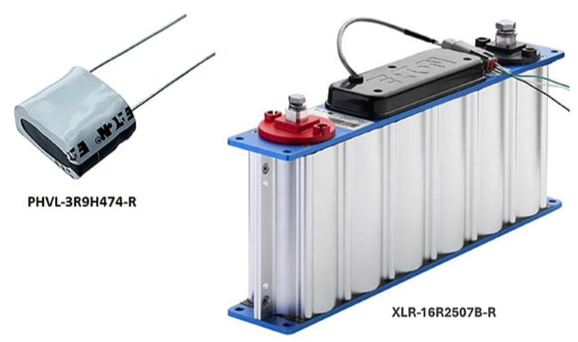
The energy stored in supercapacitors is proportional to the square of their capacitance and charging voltage. Therefore, energy density can be improved by increasing the number of parallel cells. By manufacturing supercapacitor modules with high capacitance and higher operating voltage, higher energy density can be achieved (Figure 3).