
- 4E, No.3 Shenfeng Road, Liuyao Community, Henggang Street, Longgang District, Shenzhen,China
- cc.shen@xypltd.com
- Call: +86 15112667855
News
To successfully manage the supply chain, human-machine collaboration is necessary
- 2026-09-30
Technology craze
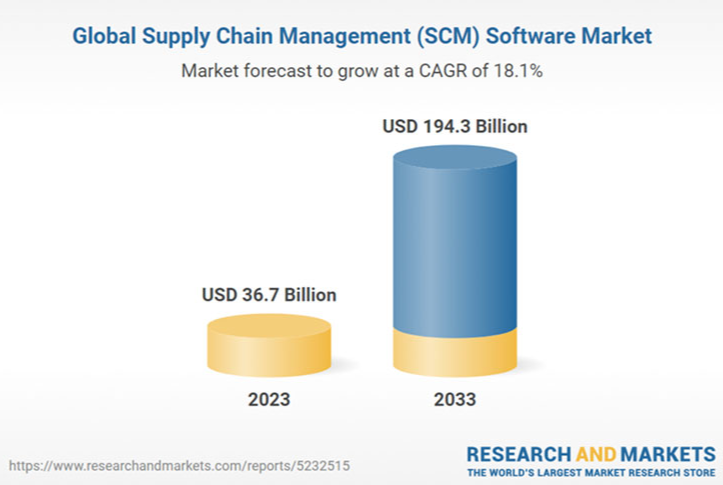
From any perspective, people's thirst for supply chain technology is endless, and analysts believe that this technology is the strongest and fastest-growing enterprise software field. According to data provided by Research and Markets, the global supply chain management (SCM) software market is expected to be worth nearly $36.7 billion in 2023. With a compound annual growth rate (CAGR) of 18.1% from 2023 to 2033, the market size is expected to reach $194.3 billion (Figure 1).
People & Machines Must Collaborate for Successful Supply Chain Management
Figure 1: It is expected that the SCM software market size will reach $194.3 billion by 2033. (Image source: Research and Markets)
Supply chain themes continue to emerge
I read with great interest a list of supply chain technology trends for 2024 released by Gartner. Even in the past five years, this list has undergone significant changes. At that time, the focus was on blockchain, the Internet of Things (IoT), and digital twins. Artificial intelligence (AI) is also on the list, but apart from the "automation" of large enterprises, almost all of us have a clear concept of its applications. Since then, artificial intelligence has become applicable and affordable, even for small businesses.
For Gartner, artificial intelligence has evolved into a clearer category that includes various subcategories and encompasses artificial intelligence vision systems, composite artificial intelligence, and next-generation humanoid work robots. At the same time, IoT has also entered a new category - machine customers. Gartner also identified several trends surrounding supply chain protection and control, including cyber ransomware, supply chain data management, and end-to-end sustainable supply chain (Figure 2).
People & Machines Must Collaborate for Successful Supply Chain Management
Figure 2: Gartner categorizes artificial intelligence as a clearer category and divides it into multiple subcategories, covering artificial intelligence vision systems, composite artificial intelligence, and next-generation humanoid robots. (Image source: Gartner)
Smarter AI and IoT
In terms of AI, we are transitioning from automation to hyper automation utilizing advanced Industrial Internet of Things (IIoT) technologies. For example, AI based machine vision systems combine 3D cameras, computer vision (CV) software, and pattern recognition technology using advanced AI. Like any emerging technology, even for complex large-scale production operations, this remains a daunting task. Based on the real-time unstructured images seen by the visual system, these solutions are capable of autonomous capture, interpretation, and inference. The most common uses of machine vision are visual inspection and defect detection, localization and part measurement, as well as product recognition, classification, and tracking.
The combination of AI technology and IoT may also alleviate some manufacturers' difficulties, such as labor skills and labor shortages. The Enhanced Connected Workforce (ACWF) program enables new employees to acquire skills faster through the use of intelligent technology, workforce analysis, and skill enhancement. When the system provides real-time information access for workers, enables seamless collaboration, and promotes immersive training experiences, it can improve human capabilities and productivity.
Another emerging category is composite AI, defined by Gartner as the "comprehensive application of multiple AI technologies" used to solve business problems that can improve supply chain performance. These analytical techniques may include:
Machine Learning (ML)/Deep Learning (DL)
Natural Language Processing (NLP)
CV
descriptive statistics
knowledge graph
However, the widespread applicability of such technologies remains to be observed. Enterprises must clearly define which performance improvements are crucial to their effectiveness. At present, there is no universal solution for applying composite AI.
At least one clear trend that has been widely applied today is machine customers. These non-human actors can autonomously acquire goods and services in exchange for compensation. According to another report by Gartner, approximately 13 billion IoT products have been deployed and can serve as customers. Usually, this technology is most suitable for inexpensive and widely used components such as capacitors or resistors, rather than those specifically designed for new products.
Security and Governance
With the increasingly advanced supply chain technology, the importance of data security and governance will also increase. AI technology that contributes to the future development of the supply chain may also become a arsenal for cybercriminals. Through AI, it is possible to develop complex malware and ransomware to attack unsuspecting supply chains.
In the past five quarters, the Lehigh Busines Supply Chain Risk Management Index has listed cybersecurity as the most important risk in the minds of supply chain managers (Figure 3). The index has increased by 5.5 percentage points compared to the previous quarter and is 12 percentage points higher than the average level. In the third quarter of 2024, there was a slight decrease, but the attention remained high. The risks include network attacks, data corruption, data theft, system viruses, and security platform control. Enterprises will have to work closely with their IT departments to resist cybercrime.