
- 4E, No.3 Shenfeng Road, Liuyao Community, Henggang Street, Longgang District, Shenzhen,China
- cc.shen@xypltd.com
- Call: +86 15112667855
News
TLVR uses dual coil power inductors to overcome the limitations of multiphase devices
- 2026-10-20
Semiconductor processors play an increasingly important role in high-performance systems that handle artificial intelligence, big data, and IoT applications. The continuous miniaturization of processor transistors and the continuous decrease in power supply voltage have brought many challenges to product designers in terms of power circuit configuration, but these problems can be solved through cross inductance voltage regulators (TLVR).
In order to squeeze more advanced technologies into CPUs, GPUs, and FPGA processors, semiconductor manufacturers have created many incredible records. The power supply voltage continues to decrease, while the current consumption and total power consumption continue to increase, but the low voltage power supply has extremely low tolerance for voltage fluctuations. According to electronic component manufacturer TDK, if the core voltage needs to be provided with an accuracy of ± 3%, the voltage of 1 V needs to be strictly controlled within an accuracy of ± 30 mV.
A multi-phase voltage regulator with multi-phase duty cycle adjustment function can manage sudden high current loads, but it must operate at high frequency to shorten the response time of phase switching. Due to the demand for data centers exceeding the limitations of existing multiphase voltage regulator configurations, designing circuits that can operate at higher frequencies has become a challenge for server power supply designers.
The multi-phase TLVR circuit configuration was first proposed in 2019 and quickly adopted to handle high-speed load fluctuations in low voltage and high current applications. TLVR provides high response performance while minimizing power loss to the greatest extent possible. TLVR can also reduce the value of output capacitors, thereby reducing system costs and occupying space.
Simultaneously providing current to multiple inductors
In the TLVR circuit, each phase switch is connected to an inductor with an additional secondary winding, and each secondary winding is connected in series with a compensating inductor. In order to adapt to the surge in current demand, this circuit can provide current from all inductors simultaneously without significantly reducing the power supply voltage.
TDK's VLBUC series dual coil power inductors are designed for TLVR to improve regulator load response. They comply with the regulator specifications of VR14 servers and can operate reliably under variable current demands.
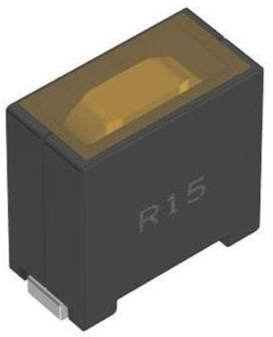
The company's VLBUC12060120R15LF3 (Figure 1) is one of the series of double wound, ferrite core coil power inductors that can handle high currents. Adopting a proprietary electrode structure, unique magnetic materials, high saturation magnetic flux density, and optimized for high-frequency switching, this series achieves low loss. This inductor ensures a voltage withstand capability of 100 VDC between two coils.
Figure 1: Schematic diagram of VLBUC12060120R10LF3 dual coil power inductor used by TDK for TVLR. The specific specifications should be based on the product specification sheet. (Image source: TDK)
The VLBUC12060120 series has dimensions of 12 mm x 6 mm and a height of 12 mm. It offers versions with primary coil inductance ranging from 70 nH to 200 nH and saturation current ranging from 58 A to 155 A. Working temperature range: -40 ° C to+125 ° C.
TDK compared the output voltage changes of 8-phase multiphase VR and TLVR during load transients using a circuit simulator. Assuming a switching frequency of 800 kHz and a conversion from 12 V to 1.8 V, using an output smoothing capacitor value of 1850 μ F, when the load changes from 240 A → 360 A → 240 A, the load voltage fluctuation in multiphase VR is ± 0.3 V relative to 1.8 V. In contrast, the output fluctuation of TLVR is less than ± 0.1 V, and the time required for voltage stabilization is significantly reduced. In addition, the value of the output smoothing capacitor can be reduced to about 230 μ F, or approximately one eighth of its original value.