
- 4E, No.3 Shenfeng Road, Liuyao Community, Henggang Street, Longgang District, Shenzhen,China
- cc.shen@xypltd.com
- Call: +86 15112667855
News
The use of micro molded inductors can save space, reduce losses, and improve power integrity and efficiency
- 2026-09-30
Inductors are key components in the design of voltage converters and regulators. Due to their energy storage and recovery capabilities, these devices are present in almost all power regulating circuits. As applications tend towards smaller and more compact designs, and energy efficiency must be continuously improved, designers need to be more cautious when selecting inductors to adapt to the trend and handle larger currents.
Reducing power loss and improving efficiency largely depend on the design of inductors and magnetic core materials. For example, using micro molded inductors can reduce the volume of inductors while retaining all the advantages of traditional inductors, enhancing electromagnetic interference (EMI) shielding, increasing power density, and reducing core losses.
This article first briefly introduces inductors and inductors. Next, introduce Abracon LLC's miniature molded inductors and discuss their selection and application.
Inductors and inductors
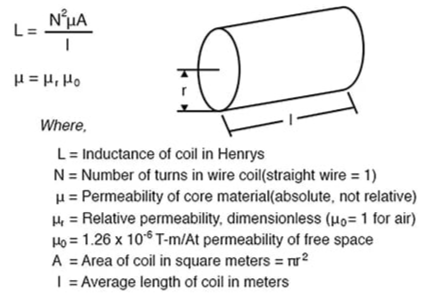
Inductors are double ended passive components that store and recover energy in the form of magnetic fields. Its appearance is usually an insulated wire wrapped around a coil. When a current is applied to an inductor, a magnetic field proportional to the current is generated inside the coil. If the applied current changes, a time-varying magnetic field will be generated, which will generate an electromotive force (EMF) in the conductor. The polarity of the induced voltage is opposite to the change in current that generates that voltage. The characteristic of an inductor lies in its inductance value, which is the ratio of the induced voltage to the rate of change of current. The unit of inductance is Henry (H), which can be increased by increasing the number of coil turns, increasing the cross-section, shortening the coil length, or using a magnetic core with higher permeability (Figure 1).
Picture of factors determining coil inductance
Figure 1: Factors determining coil inductance. (Image source: Abracon)
Magnetic permeability is a magnetic characteristic, and the higher the magnetic permeability of the magnetic core material, the greater the magnetic flux density generated, which can store more energy. Therefore, the inductance is also directly proportional to the magnetic permeability of the inductor core material. High permeability magnetic cores can reduce the size and weight of inductors without reducing their inductance value, achieving smaller and lighter overall packaging.
Magnetic core materials include air, iron, steel, iron powder, metal powder, ceramics, and ferrite. Ferrite is a ceramic material that combines with iron oxide powder and/or other metal powders to form a high permeability magnetic core material. Powder magnetic cores are made by mixing magnetic metal powder with binders and coatings. The choice of metal and binder, and even the content of bubbles in the mixture, can affect the magnetic permeability of the final magnetic core material.
Inductor specifications
There are several key specifications for inductors used in power applications, including inductance, DC resistance (DCR), saturation current, temperature rise current, rated current, self resonant frequency (SRF), and quality factor (Q).
DCR, sometimes also known as coil loss, is the measured resistance of a DC power inductor. Due to the different lengths and cross-sectional areas of the wires, the variation of DCR is proportional to the inductance. The DCR of power inductors is usually several tens of m Ω to ensure lower conduction losses. In most cases, DCR will be designated as the maximum rated value.
As the current through the inductor increases, the magnetic field will also increase proportionally until it reaches saturation; At this point, the magnetic permeability begins to decrease. When the current increases beyond this limit, it will cause the inductance to decrease. Saturation current refers to the current at which the nominal inductance value decreases by a specific value due to resistance. Power inductors typically use a 10% to 30% decrease in inductance value as the specification limit.
The temperature rise current refers to the direct current when the temperature of the inductor casing rises by 40 ° C.
The rated current is defined as the lower of the saturation current or temperature rise current, allowing the inductor to operate below the lower of the two limits.
SRF refers to the frequency at which the reactance of the parasitic capacitance of an inductor is equal to the inductive reactance. At this point, the inductor operates as a parallel resonant circuit. The net reactance is zero, and the impedance is extremely high and completely resistive impedance. In power applications, the operating frequency of inductors is usually lower than their SRF.
The Q value of an inductor is a measure of its efficiency, which is the ratio of its inductance to resistance at a given frequency. The higher the Q value, the lower the loss, and the closer the behavior of the inductor is to the ideal inductor.
Molded power inductor
Molded power inductors are surface mount devices (SMD) that utilize molding technology to encapsulate the inductor coil. Unlike traditional wound inductors, the magnetic powder material used to mold inductors is pressed into a mold surrounding the coil of the conductor. Molded composites, usually metal powders and binders, determine the magnetic permeability of inductor cores. Compared with ferrite fillers, the saturation response of metal powder fillers is softer. It can also provide efficient magnetic shielding, thereby reducing magnetic flux leakage. Molded inductors are solid components suitable for harsh environments, with moisture-proof, dust-proof, shock resistant, and vibration resistant characteristics. Because there is no laminated magnetic core, molded inductors do not emit noise. The simple integrated structure has excellent mechanical stability, and is compact and lightweight.
Abracon's miniature molded inductors come in small packages of 3mm or less, providing all the advantages of molded inductors. In addition to its compact size, micro molded inductors also have characteristics such as high power density, low magnetic core and conduction loss, and excellent EMI shielding.
The inductance range of AOTA-B1412 and AOTA-B2012 series miniature molded inductors is 0.11 to 2.2 µ H, with package sizes ranging from 1.4 x 1.2 mm (0.055 x 0.047 inches) to 2.0 x 1.2 mm (0.079 x 0.047 inches), and a maximum height as low as 0.65 mm (0.026 inches). These inductors can handle rated currents ranging from 1.9 to 6.4 A and have a rated operating temperature range of -40 ° C to+125 ° C.
An example of the AOTA-B2012 series is the Abracon AOTA-B201208SR11MT, which is a 0.11 µ H SMD miniature molded inductor with a rated current of 5.6 A and a saturation current of 10 A (Figure 2). Its DCR is 13 m Ω and SRF is 185 MHz. The device is packaged in a 2.0 mm x 1.2 mm (0.079 inch x 0.047 inch) package and installed at a height of 0.8 mm (0.031 inch).