
- 4E, No.3 Shenfeng Road, Liuyao Community, Henggang Street, Longgang District, Shenzhen,China
- cc.shen@xypltd.com
- Call: +86 15112667855
News
The clever design of micro switches perfectly balances traditional contradictions
- 2026-08-10
The current dilemma of car limit switches
Instant contact switches and self-locking switches are basic single function devices that have been popular for many years and their design and manufacturing seem simple. However, developing a switch that can meet various electrical and mechanical requirements, has reliable performance, and can be mass-produced is not an easy task. For this purpose, such switches must meet a series of requirements related to size, contact rating, operating force, operating angle, etc.
This is the challenge faced by Omron Corp. designers when developing a small switch that can indicate the status of car door switches. The doors of modern cars are thinner than ever before and have many other functions, so whether the appearance is compact is crucial.
Therefore, the button action distance is only a few millimeters, which ensures that the switch structure can prevent the actuator from contacting the button; Otherwise, the normal closing action will damage the switch. The reliability and IP67 waterproof and dustproof rating in harsh operating environments make the problem even more complex.
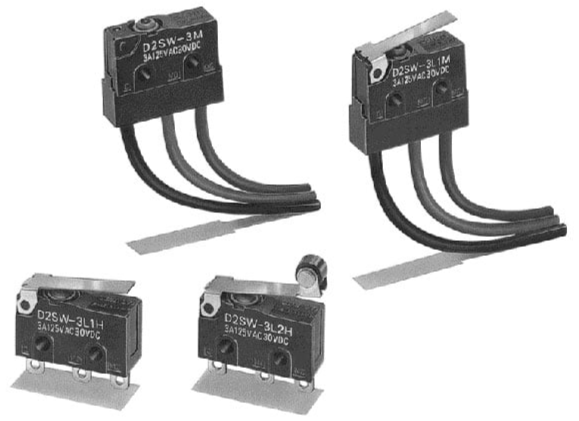
The type of switch required here is called a quick action limit switch. This type of switch has a limited internal travel, sensitive response, and provides various styles such as adjustable plunger/push rod, toggle, swing rod, roller, cone, spring, rotary drive, spring, micro touch rod, and cable. Today's ultra miniature sealed switches, such as the Omron D2SW series (Figure 1) switch, are the successor products of classic micro switches developed in the 1930s and are still widely used today. The internal design and operating mechanism of this series are different from the "on/off" switches used in household appliances or desktop instruments.
Figure 1: The D2SW series, as a classic example of fast acting limit switches, has been favored by designers for decades due to its excellent performance. (Image source: Omron Corp.)
The Omron team evaluated the configuration of existing switch triggering mechanisms, including swing rod horizontal triggering, rodless direct acting triggering, and angled cam triggering structures. Each configuration scheme has its own advantages, but there are unavoidable defects in key parameters such as switch button pressing angle deviation, mechanism volume, and persistent wear points.
New ideas point the way
In response to the stringent requirements for miniaturized and reliable limit switches in applications such as car doors, Omron designers have adopted innovative methods in their D2EW series normally open (NO) and normally closed (NC) switches (Figure 2), such as NO D2EW-B03H and complementary NC D2EW-B02L. These compact sealed switches can be operated in multiple directions and angles.
Figure 2: Innovative design enables D2EW series ultra small sealed switches to operate from multiple driving angles. (Image source: Omron Corp.)
The Omron team realized that triangular buttons can achieve horizontal operation without the need for space occupying levers. Then, they determined the optimal angle for the button tilt to achieve a shape that can be reliably pressed from above. This allows this switch to be turned on and off with minimal travel, without the need for tilted horizontal cams and related space and complexity.
This button design enables operation from multiple angles even without leverage. This design only requires a few millimeters of travel to horizontally connect and disconnect contacts (Figure 3 (top)), and can also perform vertical pressing operations (Figure 3 (bottom)).
Figure 3: The button design of the D2EW switch minimizes size and travel (above), and can be operated from above at a certain angle and from the left or right side (below). (Image source: Omron Corp.)
Compliant with IP67 standard
Undoubtedly, this new button shape has brought new problems. This unusual triangular button is extremely difficult to seal. Traditional circular buttons use hot melt sealing technology, with resin reinforcement ribs biased towards the button body and interlocked with rubber sealing caps to achieve a secure seal. However, the volume of the D2EW button is about four times that of a circular button, thus increasing the size of the rubber cap and leaving no space to accommodate the resin wall.
This solution combines analysis with trial and error methods. The designers chose to seal the housing and rubber cap through a snap fit connection, with the rubber cap clamped between the housing and cover, providing sufficient pressure to meet IP67 requirements. However, unlike circular lids that can uniformly apply pressure in all directions, the elliptical base of this lid can cause a change in tightness. To overcome this issue, the team designed a shape that makes the button as close to a circle as possible. They also adjusted the shape and thickness of the rubber cap to compensate for load changes. After several months of trial and error, they finally found the best shape.
The button has also undergone internal changes. The D2EW device adopts a slider button, with the slider located at the bottom of the button. When the button is pressed, the slider will slide to the side. Unlike traditional buttons and sliders, the button and slider of this switch move simultaneously. Integrating multiple contact surfaces into a single surface achieves a structure that can close and open contacts with minimal components and is easy to assemble.