
- 4E, No.3 Shenfeng Road, Liuyao Community, Henggang Street, Longgang District, Shenzhen,China
- cc.shen@xypltd.com
- Call: +86 15112667855
News
The best practice for selecting sturdy and durable connectors
- 2026-09-07
To ensure the flow of data, signals, or power between different components of the system, it is necessary to connect important equipment to each other through connectors. For example, the output of a microphone is connected to an amplifier through a connector. Similarly, connecting power to radar and other communication systems, and connecting sensors to data processors to transmit analog or digital signals, are just two of the many common uses of connectors.
With the use of these important components, connector technology is also constantly evolving. Although it is expected that the military sector will still be one of the largest markets for connectors in the future, the demand for connectors is not limited to this field alone. According to Lucintel's market research, it is expected that the global market for rugged connectors will steadily grow at a compound annual growth rate of 3.5% by 2030.
Progress in connector technology
The connector technology has a long history, starting with the circular connector designed for the Douglas DC-1 aircraft in the 1930s. James Cannon from ITT Cannon developed this product. Since then, connector technology and the widespread application of these products have continued to develop to meet industry demands. By tracking these new developments in connector technology, we can glimpse many industrial application cases of connectors.
Specially designed to cope with high temperatures
Conducting military operations or space missions under extreme weather conditions requires connectors to not only withstand extreme cold and heat, but also quickly cycle between two completely different temperature states. The advancement of connector technology ensures that the material composition can withstand these harsh conditions without affecting performance.
Lightweight materials
In aerospace applications, weight is always an important consideration as every ounce of weight affects aerodynamics and fuel requirements. Now, with the application of connectors in auto drive system, electric vehicles (EV), robotics and industrial automation, this topic has entered the research field again. For heavy loads and battery life, it is a trade-off between fish and bear's paw, which means that connectors need to use lightweight composite materials to meet engineering and design constraints.
Modular Design
The demand for infrastructure often changes, and feasible solutions today may become outdated tomorrow. In this case, disassembling and replacing components as a whole is both wasteful and expensive. Modular connectors can selectively replace components, thereby solving this problem. Users can also mix and match various configurations to enhance flexibility and meet customization needs.
Miniaturization of components
The use of sensors in various applications, including automotive systems, is driving the demand for larger connectors. Miniaturization helps design engineers develop compact circuits that can be installed in smaller spaces, which has become crucial in various applications ranging from military to aerospace.
The rise of sturdy and durable connectors
The growing demand for robust and durable connector technology may coincide with the rise of networked machines within the industry. Industrial Internet of Things requires data collection from sensors, which may have to withstand various harsh conditions.
It is easy to imagine that data centers are the hub of computing and real-time information, and data-driven decision-making is the cornerstone of most modern operations. Military, railway, aerospace, oil and gas, agriculture, factory automation, and robotics technologies all rely on real-time data - on-site operations and environmental conditions are far from ideal. The device may need to withstand extreme temperatures, dust, and storms without damaging signal integrity or affecting signal speed. All hardware devices, from connectors used for on-site communication, networking, data, and power transmission, must be sturdy and durable.
Strict specifications for sturdy and durable connectors
Not all sturdy and durable connectors are the same; Different working conditions determine that connectors have various characteristics. Some best practices when choosing connectors include:
End use: for medical environments, military theaters, or underwater applications, this is crucial. When used in medical environments, connectors may need to withstand disinfection processes. For example, ITT Cannon's CA/5015 connector is a robust and durable interconnect device designed specifically for demanding applications. These connectors comply with MIL-DTL 5015 (SAE-AS50151) standard, originally developed for commercial aviation and now widely used in military, transportation, industrial, and heavy equipment fields.
The weight of the final system: Weight will affect the performance of the connector as it increases the pressure on both ends, causing wear and tear. For battery powered systems such as robots or semi-automatic machines, weight is equally important because the power required to drag additional weight can shorten battery life. The weight also determines the material of the connector housing. Lightweight aluminum casing can reduce the final weight.
Network security and stealth requirements: Military operations particularly require systems that can avoid being discovered by the enemy. This requires the use of special shielding technology on sturdy and durable connectors. The all metal back shell can protect electronic signals and prevent electromagnetic interference. ITT Cannon's CA/5015 series offers a variety of back shell options, connected using shielded or unshielded single wires or sheathed cables.
Connector shape: There are various shapes of connectors, including circular, rectangular, shovel shaped, or modular. Circular connectors are the most common variant for transmitting power, signals, or data. It is easier to align the pins during insertion, and the circular design provides compact sealing. Circular connectors have many pins or contacts arranged in a specific grid pattern to meet various connection requirements such as power or data.
Types of locking systems
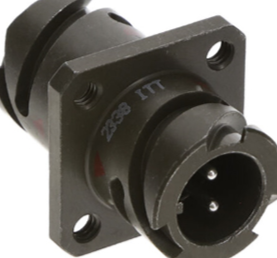
Once the connector connects two systems, it needs to be locked in place to prevent loose connections that could affect power, data transmission, or signal quality. The most common locking system includes a threaded connection mechanism, which is used to firmly secure the connection in place; In addition, it also includes a push-pull locking system that locks the connection when pushed and releases the connection when pulled. Connectors like ITT Cannon's TBF10SL-4PS-B (Figure 1) use a bayonet mechanism, where the pins and grooves can be locked into place by twisting.
Among them, the threaded connection mechanism has excellent vibration resistance, especially suitable for aerospace and military applications.