
- 4E, No.3 Shenfeng Road, Liuyao Community, Henggang Street, Longgang District, Shenzhen,China
- cc.shen@xypltd.com
- Call: +86 15112667855
News
Technical supply chain requires exquisite procurement skills
- 2026-10-12
Nowadays, the supply chain has basically been digitized, and artificial intelligence (AI) and data intelligence have gradually become crucial priorities. Major organizations have invested heavily to maintain technological leadership. An equally pressing challenge that deserves attention is how to train personnel to use these systems to make strategic procurement and supply chain decisions.
gap analysis
For decades, talent cultivation has been a constant topic in various industries. Despite significant progress in addressing talent shortages, with more and more colleges offering supply chain majors and major associations and industry organizations increasing their training efforts by providing ongoing training, the problem has changed.
Until recently, people were still considering how to recruit more talent into the supply chain team, fearing that there might not be enough manpower. Now, with the changing and evolving demands, both existing and new personnel must strive to learn new skills. What we need to focus on is how to enable everyone to quickly understand how to leverage transformative technologies and ensure that they know how to utilize the data provided by the system to provide recommendations that align with the organization's future strategic direction.
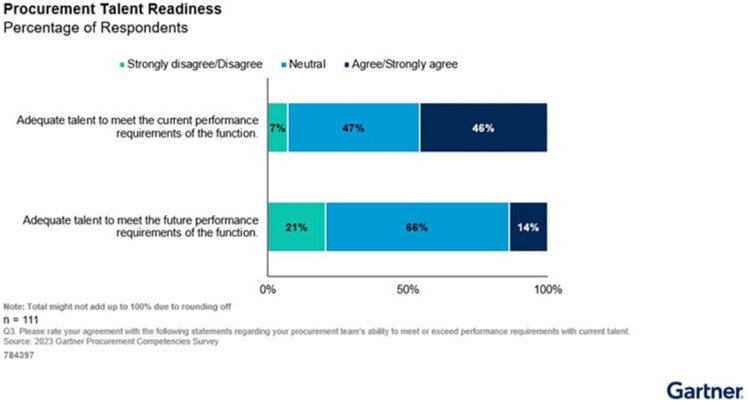
A study released by Gartner in 2023 found that only 14% of surveyed procurement leaders believe they have enough talent to meet upcoming demands (Figure 1). 1Partner expects that over time, this will become a bigger issue.
Technical Supply Chain Demands Refined Procurement Skills
Figure 1: Less than half of procurement leaders believe they have the talent to meet the requirements of the procurement function. (Image source: Gartner)
More than two-thirds (69%) of respondents indicated that business acumen has become increasingly important in the past year. Meanwhile, an equal number (68%) of respondents indicated that technical and data skills have become more important. Procurement professionals need to utilize technology to obtain better data, while also understanding how to transform this data into actionable business strategies and plans. This is a daunting task. Only about a quarter of people believe that traditional skills have become more important.
Open up a new path
In order to meet the constantly changing demands, procurement organizations must spend time defining these new capabilities to help find new talent and enhance the skills of existing employees. Organizations can combine the work of improving existing data with the acquisition of skilled personnel, freeing up time to focus on other key measures.
Although the improvement measures traditionally taken by procurement organizations, such as category management and strategic procurement, are still crucial, The Hackett Group's "2024 Procurement Key Issues" study reveals that these two types of measures are complementary (Figure 2). two
Technical Supply Chain Demands Refined Procurement Skills
Figure 2: Technology and talent are the top two dominant factors, as companies strive to ensure that personnel and data work together to leverage strategic advantages. (Image source: The Hackett Group)
As expected, related skills also dominate the 2024 skill ranking. The career guidance website Teal provides a list of the most basic skills for supply chain workers this year, with over half of them including these technical and personnel quality requirements: 3
Strategic planning and systems thinking: This skill requires an understanding of how the various elements of the supply chain work together and the ability to optimize the entire system.
Operational and technical proficiency: Supply chain managers must have knowledge of logistics, procurement, inventory management, and the technologies that support these areas.
Global and cultural awareness: It is necessary to understand international trade regulations, customs, and different business practices, as well as sensitivity to cultural differences.
Analyze and solve problems: This profession requires the ability to collect, analyze, and interpret large datasets to make strategic decisions, identify potential issues, and develop creative solutions to complex supply chain challenges.
Leadership and Relationship Management: Relationship management skills are crucial for motivating and coordinating teams, as well as establishing and maintaining strong partnerships with suppliers, customers, and internal stakeholders.
Gartner believes that ability driven interviews will be an important tool. By asking potential job applicants how they handle (or preferably have already handled) specific issues, tasks, or challenges, it is more likely to find job candidates who are capable of handling the job.
The second equally important task is to help employees improve their skills and knowledge levels, and maximize the use of digital technology.
Technology and talent are both important. In order to achieve the future development prospects of the supply chain, OEMs need to combine human and digital capabilities to achieve more effective goals than using any single method. Like technology, humans also need to constantly develop and 'upgrade' in order to better integrate into the digital environment and make the best supply chain decisions.