
- 4E, No.3 Shenfeng Road, Liuyao Community, Henggang Street, Longgang District, Shenzhen,China
- cc.shen@xypltd.com
- Call: +86 15112667855
News
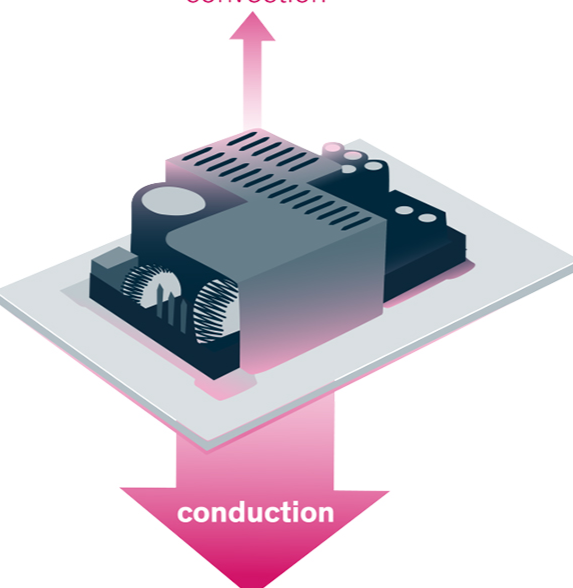
Switching power supply using mixed conduction and convection cooling
- 2026-08-18
Electronic applications generate heat, and excessive heat can lead to reduced efficiency, shortened component lifespan, and even thermal failures. Fan cooled power supplies are favored in many applications, but not in those that require high efficiency, quietness, and reliability.
In order to maintain the optimal working temperature, we have adopted various cooling methods, but each method has its own advantages and disadvantages. Traditional power sources rely on forced air cooling or passive convection cooling. The former uses a fan to actively blow air through the heating components, while the latter relies on heat sinks and airflow to dissipate heat. Other optional cooling methods include conduction cooling and liquid cooling.
TRACO Power provides a range of fanless power solutions for industrial, medical, and telecommunications applications. The company's TCI series can enhance thermal management, reduce energy losses related to heat, and make the system operate more reliably and continuously. The company provides conduction cooling power solutions using appropriate substrates and offers convection cooling or forced air cooling options, making it suitable for a variety of applications.
Classify through different options
Each cooling method requires a balance between efficiency, size, cost, and reliability. When designing cooling systems for electronic devices, the following factors should be considered:
Power dissipation requirements
space constraints
Reliability requirements
Cost and complexity
By selecting appropriate cooling strategies, designers can improve the efficiency, reliability, and performance of various electronic applications. The following are typical cooling methods that should be considered when developing applications:
Convection: Convection cooling relies on the natural movement of rising warm air being replaced by cooler air, without the need for any active components to achieve heat dissipation. This cooling method has low cost and reliable performance, but its effectiveness is limited, especially in enclosed spaces with limited airflow. Passive convection cooling has high reliability, but is not suitable for high-power applications that generate a large amount of heat.
Forced air cooling: Forced air cooling uses a fan to actively blow air through heating components to improve heat dissipation. This method is commonly used in industrial power supplies, computing systems, and high-power electronic devices. Fans consume electricity, generate noise, and introduce potential fault points, but they can effectively prevent equipment overheating and thermal throttling, thereby maintaining system stability in harsh environments.
Heat sink: Heat sinks use thermal conduction to transfer the heat of components to a larger surface area, allowing the heat to dissipate into the surrounding air. Most heat sinks adopt fin design to maximize surface area and enhance cooling effect through natural or forced convection. Although thin heat sinks can be used for compact applications, high-power heat dissipation typically requires larger heat sinks.
Cold plate: The cold plate uses a thick metal substrate to conduct heat away from the components, allowing the heat to be distributed over a larger area.
Liquid cooling: Liquid cooling relies on a closed-loop system, where the coolant absorbs heat from the components and transports it to a radiator or heat exchanger for heat dissipation. This method is commonly used in high-power applications such as aerospace, automotive, and high-performance computing, where relying solely on fans and radiators for heat dissipation is not enough. However, liquid cooling requires additional engineering design, which increases complexity and maintenance work.
Thermal conductive compounds: Thermal conductive compounds such as thermal paste or thermal grease can reduce the thermal resistance between electronic components and cooling surfaces, but they do not have the ability to dissipate heat themselves. By filling tiny air gaps, these compounds can improve thermal conductivity efficiency, ensuring that heat sinks, cold plates, or radiators can effectively function. Some thermosensitive compounds can also be used as adhesives to fix cooling components without mechanical fasteners.
TRACO Power's hybrid design
The TCI series switching power supply from TRACO Power adopts a hybrid housing design that supports both convection and conduction cooling (Figure 1), making it highly versatile in different thermal management strategies.
TRACO Power hybrid housing design
Figure 1: The hybrid housing design of TRACO Power provides designers with both conduction and convection cooling options. (Image source: TRACO Power)
In terms of conduction cooling, the metal casing ensures effective heat transfer to the connected base plate, heat sink, or chassis, thereby achieving passive heat dissipation. This may be the preferred cooling method for sealed enclosures, as using fans to generate forced airflow is neither realistic nor feasible.
The components sealed inside the casing achieve thermal connection, which optimizes heat dissipation and removes excess heat through natural convection. When installed outdoors, hybrid design can still achieve passive cooling in many cases without the need for additional radiators.
The TCI series combines the best features of both conduction cooling and convection cooling housings, with excellent heat dissipation performance. Within the same external dimensions as traditional power supply designs, this series can generate much higher power without the need for a fan. According to TRACO Power, the TCI series provides up to 100% of its rated maximum output power in conduction cooling settings, making it an ideal choice for fanless applications.
By using appropriate substrates and special potting compounds, the hybrid design of the TCI series achieves efficient thermal connections between independent components, resulting in optimal heat transfer performance. This advanced composite material enables various components to operate at the highest efficiency, which is difficult to achieve with traditional designed power systems.
The TCI series is designed specifically for conduction cooling solutions that require power ranging from 130 W to 500 W, making it particularly suitable for fanless applications. With the appropriate base plate, this series can operate safely at up to 100% rated power.
The 130 W TCI 130-124-J (Figure 2) is a conduction cooled AC/DC sealed power supply that achieves excellent constant temperature cooling performance while maximizing efficiency. The efficiency of this device is as high as 92%, with a working temperature range of -30 ° C to+50 ° C (without derating), and can reach up to+80 ° C under derating or forced cooling. Its storage temperature range is -30 ° C to+80 ° C, and its dimensions are 80 mm x 59.7 mm x 43.2 mm (3.15 "x 2.35" x 1.7 ").