
- 4E, No.3 Shenfeng Road, Liuyao Community, Henggang Street, Longgang District, Shenzhen,China
- cc.shen@xypltd.com
- Call: +86 15112667855
News
Simplify healthcare and industrial IoT design using a combination of low-power microcontroller products
- 2026-09-24
Low power design and development personnel for industrial, healthcare, and various Internet of Things (IoT) applications face a continuous demand for microcontroller based solutions that provide rich functionality without compromising tight power budgets. As development progresses, they often have to take risks to cross the maximum power threshold in order to meet specialized functional requirements.
This article introduces how Analog Devices' ultra-low power microcontroller product portfolio meets these requirements.
Meet the requirements of professional applications
Designers must meet a series of core requirements for high performance and low power consumption in order to effectively respond to customer expectations. In various application fields such as healthcare, industry, and the Internet of Things, these core requirements typically dominate design decisions and guide the development of hardware platforms, which are essentially indistinguishable. Therefore, designers can quickly apply the hardware and software design experience gained in one application field to meet the basic needs of another application field.
As the demand for increasingly complex products in these fields continues to grow, designers need to meet the special requirements of professional applications without sacrificing the ability to meet core requirements, which has become increasingly difficult. The application segmentation market has begun to rapidly differentiate, placing unique demands on connectivity, security, and artificial intelligence (AI).
Driven by these constantly changing demands, the concept of a universal hardware platform has been developed, enabling designers to meet the core requirements of high performance and low power consumption by relying on a familiar processor set that enhances specialized functionality.
A processor foundation platform customized for specialized functions
Analog Devices' ultra-low power microcontroller product portfolio includes ultra-low power Arm with floating point unit (FPU) ® Cortex ®- M4 serves as the core, providing designers with a familiar platform that can meet the core power consumption and performance requirements.
In order to meet the unique requirements of different application fields, Analog Devices has customized this basic platform using the dedicated functions of four members in the product portfolio, including:
MAX32655: Mainly aimed at applications that require low-power Bluetooth (BLE) connectivity and longer battery life, while providing sufficient memory and performance.
MAX32690: Mainly aimed at applications that require BLE, powerful performance, and large capacity memory.
MAX32675C: Mainly aimed at applications that require mixed signals for industrial and medical sensors.
MAX78000: Can meet the emerging demand for intelligent edge devices.
Resolve connection issues
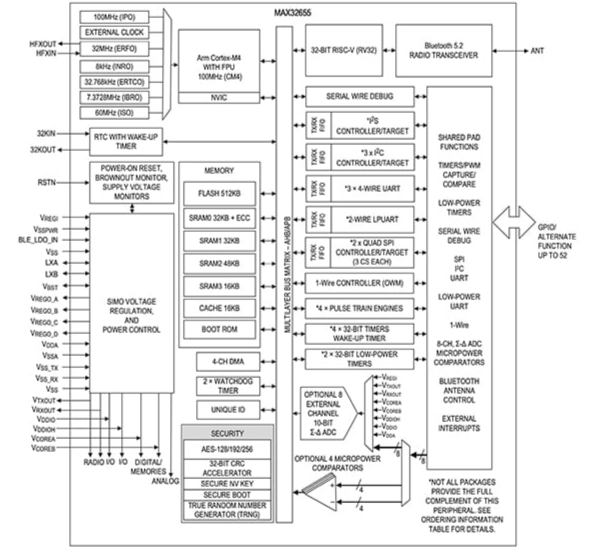
The MAX32655 microcontroller from Analog Devices integrates a 100 MHz Arm Cortex-M4 with FPU, 512 KB flash memory, 128 KB static random access memory (SRAM), and 16 KB instruction cache, providing an effective combination of processor performance and memory required for typical low-power applications. In addition to this processing subsystem, the device also adds a complete set of functional modules to provide security functions, power management functions, timing functions, and digital and analog peripherals commonly required for asset tracking devices, wearable devices, and healthcare monitoring devices (Figure 1).
MAX32655 microcontroller image from Analog Devices (click to enlarge)
Figure 1: The MAX32655 microcontroller integrates a large number of peripherals and can support various applications that require Bluetooth connectivity, high-performance processing, and optimized power consumption. (Image source: Analog Devices)
In order to meet the various Bluetooth connection requirements of different applications, MAX32655 provides dedicated hardware and software to support the full range of Bluetooth 5.2 functions. In addition to the Bluetooth 5.2 radio, the microcontroller also integrates a dedicated 32-bit RISC-V coprocessor for processing timing critical Bluetooth processing tasks. This Bluetooth subsystem can meet emerging performance requirements, supporting high-throughput modes of 2 MB/s and long-range modes of speeds of 125 KB/s and 500 KB/s. Two device pins allow developers to easily connect off chip antennas in Bluetooth enabled designs. In order to improve the Bluetooth 5.2 functionality and provide application support, the Bluetooth protocol stack of this device can be extended to Arm Cortex-M4, RISC-V, and radio with FPU during runtime (Figure 2).