
- 4E, No.3 Shenfeng Road, Liuyao Community, Henggang Street, Longgang District, Shenzhen,China
- cc.shen@xypltd.com
- Call: +86 15112667855
News
Quickly add machine vision to applications through easy-to-use camera modules
- 2026-08-14
Vision is by far the most important sensory experience. About 80% of the information we rely on in our daily work comes from vision - our eyes. The processing speed of visual information is extremely fast. As early as 2014, neuroscientists at the Massachusetts Institute of Technology (MIT) discovered that the brain can form a complete image based on what the eyes see in just 13 milliseconds (ms).
It is not surprising that many people hope to add visual sensors to machines because vision is so important. Adding machine vision to a product can provide a plethora of features that are difficult or impossible to achieve through other means. For example, inspection machines on assembly lines that can detect defects early in the manufacturing process, or warehouse robots that can check product expiration dates.
The challenge of adding visuals lies in mimicking the stereoscopic, high-definition color vision of the human eye. Fortunately, most industrial applications do not require such powerful performance. For example, suppose you want a machine to check barcodes. At this point, there is no need for sensors to have high pixels or view colors. The lens can be simple, without the need for a wide or deep field of view, and without the need for the system to process information at high speed. Therefore, one can choose from numerous commercial visual systems that are suitable for the task and are inexpensive and reliable.
To supplement the shortcomings of the human eye, sensors that are sensitive to electromagnetic wavelengths outside the visible spectrum can be chosen. For example, adding infrared (IR) functionality is relatively simple, allowing machines to see things that the human eye cannot see.
Choosing active sensors is just one step, a complete visual system requires more components, including lenses and brackets, electrical connections from sensors to application processors, as well as auxiliary electronic devices and software to make it work properly. Therefore, matching and testing various sensor and lens alternatives can be time-consuming and costly, such as ultra wide angle lenses for wide scene capture or general-purpose lenses for more traditional settings.
Compact and perfect appearance
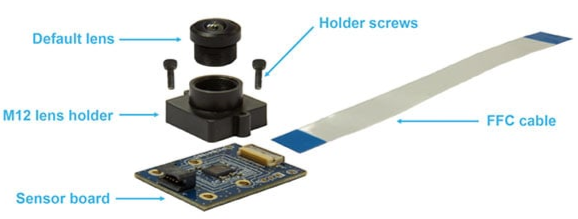
STMicroelectronics launches CAM-55G0/CAM-56G3/CAM-66GY camera Promodules to make the development process easier. The development module is specifically designed for development and includes the required image sensor, lens mount, lens, and plug and play flat flexible cable (FFC) (Figure 1). After you complete the development, STMicroelectronics will recommend that you collaborate with them to seek commercial solutions.
Figure 1: The CAM-55G0/CAM-56G3/CAM-66GY development module includes a lens, lens holder, sensor board, and FFC cable. (Image source: STMicroelectronics)
The volume of the development module is very small, occupying an area of 5 or 6.5 square millimeters (mm2). This module is based on a compact low-power image sensor with dimensions of 2.73 x 2.16 mm (Figure 2). The sensor package is suitable for devices with limited size, such as augmented reality/virtual reality (AR/VR) glasses or personal electronic devices, and operates in visible and near-infrared spectra with a resolution of 644 x 604 pixels (0.38 million pixels (MP)).
Figure 2: The size of the optical sensor used to develop the module core is only 2.73 x 2.16 millimeters. (Image source: STMicroelectronics)
The development module uses MIPI Camera Serial Interface 2 (CSI-2), a widely adopted high-speed protocol for transmitting static and video images from sensors to application processors. The sensor also has functions such as automatic dark calibration, defect pixel correction, and analog and digital gain.
Viewing machine vision through different lenses
STMicroelectronics allows you to easily try different machine vision options. At present, there are several development module reference designs available, equipped with various lenses and optical settings. These pre research modules are equipped with focusing lenses for bonding and testing in a clean room environment, as well as the same flexible printed circuit (FPC) to board connectors and pin arrangements. In this way, it is possible to quickly plug and play configure development modules equipped with different lenses using the same development tools and optical parameters.
There are two options for development work. You can use the STEVAL-EVK-U0I1 USB kit (Figure 3) and connect it to the STEVAL-55G1MBI1 S-board (the board used to secure the installed camera components) (Figure 4), or you can use the STEVAL-CAM-M0I1 P-board to connect it to your favorite embedded processing platform. P-board requires you to purchase development modules separately. EVK with S-board can be connected to PC through USB connection, while development using P-board is completed from embedded processing platform.