
- 4E, No.3 Shenfeng Road, Liuyao Community, Henggang Street, Longgang District, Shenzhen,China
- cc.shen@xypltd.com
- Call: +86 15112667855
News
Overcoming the design challenges of USB Type-C PD applications
- 2026-08-07
When users can easily and seamlessly charge their devices using USB Type-C Power Transfer (PD) technology, product designers can feel gratified by the successful completion of the project. This is because they are already able to cope with various complex challenges of USB PD charging.
USB PD is designed for scalability and is widely used in laptops, smartphones, peripherals, and IoT devices, reducing the need for dedicated power adapters. This is a disruptive technology equipped with forward and reverse plug-in connectors that can flexibly perform high-power charging and data transmission.
This connector can handle various levels of voltage (5 V to 20 V) and power (up to 100 W or higher). In addition, this connector supports switching between the power supply and receiver to improve power management efficiency. Therefore, it achieves fast charging, multi device compatibility, and efficient energy transmission, and provides integrated safety protection such as overvoltage and overcurrent protection.
For users, although USB PD achieves faster charging speed and higher power transfer, its design is complex. Specific applications must be able to convert between the power supply and receiver, ensuring compliance with the USB PD 3.0 standard, and may require firmware to manage power configuration files.
Devices that use these connectors, such as laptops, tablets, and power banks, must be able to charge through USB-C, wall adapters, batteries, etc. while maintaining high efficiency. Some designs may be limited to buck or boost charging, which makes them inefficient in handling variable input voltages.
Other issues include minimizing heat generation during power conversion, ensuring compatibility between multiple devices and different chargers and accessories, and improving power efficiency in compact designs.
Simple constant power applications may not require firmware, but dynamic or multi role USB PD applications typically require it. Many advanced USB PD controllers require firmware to manage power negotiation, role switching, and other security features.
Simplify and optimize USB PD power transmission
Renesas Electronics Corporation has launched a USB-PD Extended Power Range (EPR) solution. This solution integrates a Type-C port controller and a buck boost battery charger, which work together to reduce complexity and optimize power transmission, helping to create efficient and reliable USB-PC designs.
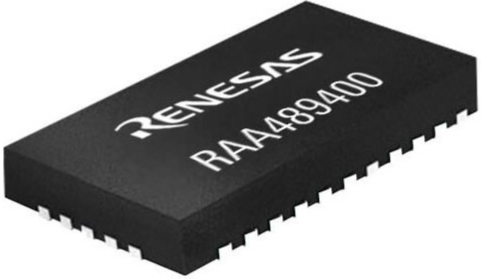
The Renesas RAA489400 USB Type-C port controller (Figure 1) integrates key USB PD 3.0 features, including power negotiation, role switching, and security protection, thereby reducing firmware complexity that may otherwise require significant development time and cost. Although the controller can autonomously control power transmission, it may require an MCU to achieve advanced strategy control or custom power configuration.
Figure 1: The Renesas RAA489400 port controller integrates critical USB PD 3.0 functionality. (Image source: Renesas Electronics Corporation)
RAA489400 can simplify the USB PD compliance process, handle power role conversion, power protocol negotiation, and fault protection. This device can support high-power applications up to 240 W, suitable for battery powered mobile devices, power banks and desktops, electric bicycles and drones, industrial systems, as well as household appliances such as vacuum cleaners.
The controller has a built-in analog-to-digital converter that can accurately monitor VBUS voltage and current, thereby optimizing power transmission in real-time. SMBus/I ² C communication supports seamless integration with Type-C Port Manager (TCPM), ensuring compatibility with multi port systems and simplifying firmware development.
The Renesas RAA489118 buck boost charger (Figure 2) is an efficient battery charger that can be used to manage power transmission at various input and output voltages while ensuring optimal battery performance.
Figure 2: The RAA489118 buck boost battery charger ensures seamless switching between different power inputs. (Image source: Renesas Electronics Corporation)
This charger can increase or decrease voltage as needed and supports applications that require charging from multiple power sources, such as USB Type-C adapters, solar panels, or directly connected batteries. Regardless of whether the input voltage is higher or lower than the required charging level of the battery, RAA489118 will make corresponding adjustments to ensure a stable and efficient charging process. This charger does not require multiple discrete power management components, thereby reducing PCB complexity and overall development costs.