
- 4E, No.3 Shenfeng Road, Liuyao Community, Henggang Street, Longgang District, Shenzhen,China
- cc.shen@xypltd.com
- Call: +86 15112667855
News
Optimizing Industry 4.0 communication architecture using multi protocol I/O hubs and converters
- 2026-09-28
Communication protocols are crucial for supporting real-time data transmission and control in Industry 4.0 and Industrial Internet of Things (IIoT) networks. Sensors, actuators, motor drivers, and controllers all have their own specific communication requirements. The 'omnipotent' communication protocol does not exist.
Although there is no protocol that can meet the needs of every application, connections are usually required between different devices. Sensors must be connected to controllers, which must be connected to various system components using different protocols such as IO Link, Modbus, and various forms of Ethernet.
In many cases, the entire machine needs to be connected to the cloud. This leads to a complex communication architecture and numerous protocols. To address this challenge, machine designers can adopt multi protocol input/output (I/O) master devices, hubs, and converters.
This article first reviews common Industry 4.0 communication protocols and their positions in the network hierarchy. Then, a series of I/O master devices, hubs, and converters from Banner Engineering were introduced, and the working modes of these devices were discussed, as well as how they support complex Industry 4.0 and IIoT communication architectures.
What is the OSI seven layer model?
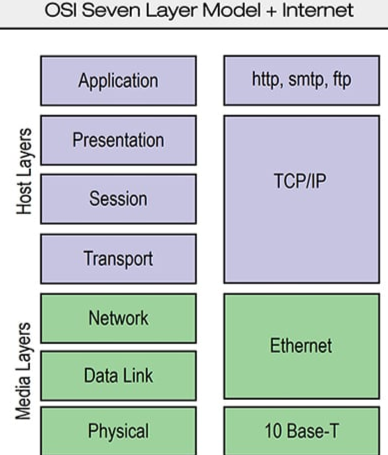
Network communication protocols are typically described in the context of the Open Systems Interconnection (OSI) seven layer model. The model first has three media layers that handle hardware issues such as physical connections, data link connections, and network connections.
The next three layers focus on data addressing, including transmission, session, and presentation processes.
The seventh layer of the model is the application layer, which provides an interface between users and the network. Modbus and PROFINET protocols are both located at this layer. The relationship between the OSI model and other protocols such as EtherNet/IP is more loose.
In terms of EtherNet/IP, the application layer includes processes such as network access (HTTP), email (SMTP), file transfer (FTP), etc. The three host layers execute the Transmission Control Protocol/Internet Protocol (TCP/IP) process, which is used to establish sessions and correct errors. The media layer includes physical 10 Base-T connections, as well as the implementation of Ethernet data links and network connections (Figure 1).
Picture of the Relationship between EtherNet/IP and OSI Seven Layer Model
Figure 1: The relationship between EtherNet/IP and the OSI seven layer model. (Image source: Banner Engineering)
Where is IO Link suitable for use?
IO Link is a single drop digital communication interface (SDCI) suitable for small sensors, actuators, and similar devices, capable of extending bidirectional communication to various devices in the factory workshop. This protocol complies with the IEC 61131-9 standard and is designed to be compatible with industrial network architectures based on Modbus, PROFIBUS, EtherNet/IP, etc.
IO Link uses a master device to connect IO Link devices to higher-level protocols such as Modbus, which provide connections to data consuming devices such as programmable logic controllers (PLCs), human-machine interfaces (HMIs), and cloud data services (CDS). At the lowest level, IO Link uses a hub to aggregate multiple devices and feed data up to the master device. In addition, analog sensors can be added to the IO Link network using the analog voltage of the IO Link converter (Figure 2).