
- 4E, No.3 Shenfeng Road, Liuyao Community, Henggang Street, Longgang District, Shenzhen,China
- cc.shen@xypltd.com
- Call: +86 15112667855
News
NXP provides Arm ® Cortex ®- M33 Development Ecosystem
- 2026-10-20
Arm ® Cortex ®- The M33 core processor is a low-power, high-performance microcontroller (MCU) series with stronger security and digital signal processing capabilities. This series is suitable for various IoT and embedded applications, but designing products using these MCUs can be extremely challenging, especially for developers who are not familiar with the Arm architecture. NXP Semiconductors is a leading supplier of Arm based microcontrollers, and its MCUXpresso development platform is designed to enable developers to easily tackle this challenge.
Arm's Reduced Instruction Set Computing (RISC) processors dominate in niche markets such as smartphones and consumer electronics, where low power consumption and high performance are crucial.
The Cortex-M33 processor adopts a high-efficiency design and provides a low-power mode, which can reduce active and sleep current consumption, and can be used for various applications such as industrial control, smart homes, wearable devices, and the Internet of Things. These processors provide developers with high flexibility and scalability, but also require careful optimization to achieve a perfect balance between performance, power consumption, and footprint.
The Cortex-M33 MCU supports Arm Embedded Application Binary Interface (EABI), ensuring binary compatibility with other Cortex-M processors, allowing it to run existing Cortex-M code without modification. With this compatibility, existing software tools, libraries, and middleware can be accessed.
NXP's MCX product portfolio
NXP is one of the top manufacturers of Arm based MCUs (including general and automotive industry specific products). The company has positioned its MCX product portfolio as the foundation for energy-efficient edge devices in the industrial and IoT markets, providing stronger scalability and breakthrough product features.
MCX MCU includes two different product series:
The MCX N series industrial and IoT MCUs adopt dual Cortex-M33 cores, with a working frequency of up to 150 MHz, and are equipped with the company's eIQ ® The Neutron neural processing unit (NPU) is capable of accelerating machine learning (ML). These high-performance, low-power microcontrollers integrate intelligent peripherals and accelerators, providing multitasking capabilities and efficient performance.
The MCX A Essential series is an optimized single core Cortex-M33 MCU product line that provides critical features for applications that prioritize advanced analog functions such as high-precision data converters, cost constraints, and rapid time to market.
This article will focus on introducing the MCX A MCU (Figure 1) and its development tools. The MCX A series supports numerous applications in various markets, including industrial communications, smart metering, automation and control, sensors, as well as low-power and battery powered devices. With the help of a universal kernel and peripherals, developers can fully utilize the advantages of simplified software development, easy migration, and upgrades.
NXP's MCX A series microcontroller image
Figure 1: Schematic diagram of NXP's MCX A series microcontroller. (Image source: NXP)
Each MCX A-series device includes a range of intelligent peripherals that can operate independently of the CPU, allowing the CPU to run at lower frequencies and power consumption. These peripherals enable designers to adopt smaller packages, simpler circuit board designs, and lower system bill of materials (BOM) costs.
Peripherals include:
Serial communication module with built-in buffer, programmable data collection range, and DMA
Mixed signal analog-to-digital converter (ADC)
Digital to Analog Converter (DAC)
Operational amplifier with built-in intelligent functions for average and peak detection
FlexPWM (pulse width modulator) with no-load time control and encoder for motor applications
The MCX A MCU is also equipped with a Power Management Unit (PMU) that enables Dynamic Voltage and Frequency Regulation (DVFS) and Adaptive Power Control (APC) to optimize power consumption based on workload and operating conditions. The device includes 64 KB or 128 KB flash memory and 16 KB or 32 KB SRAM, and all RAM data can be retained in deep power down mode.
The 4 KB low-power cache controller (LPCAC) connected to the Cortex-M33 code bus ensures low latency provision of data and instructions. Due to the fact that processor performance can be freed from the constraints of system memory performance, the bus availability of other peripherals is also improved. This feature can help developers achieve excellent I/O and processing performance in sensing and control applications.
The operating frequency of MCX A devices is 48 MHz (A14x series) and 96 MHz (A15x series). MCX A adopts a non capacitive LDO power supply subsystem, with a working voltage of 1.7 V to 3.6 V. These devices have low power consumption characteristics in various modes:
59 µ A/MHz (3 V,+25 ° C), running Coremark in active mode from internal flash memory
6.5 µ A deep sleep, 10 µ s wake-up, full SRAM retention, 3 V,+25 ° C
Less than 400 nA during deep power failure, with a wake-up time of 2.78 ms
The MCX A device includes a full speed USB device controller with onboard PHY, which enables connection with PCs and other devices. The USB subsystem can be programmed in the system (ISP) through boot ROM, and the product can be updated on-site using the USB interface.
Depending on the model, developers can utilize 26 to 52 general-purpose input/output (GPIO) pins. The serial communication interface includes one I ² C, two SPI, and three UART. This includes three 32-bit timers that can generate complementary PWM pairs with dead zone insertion, as well as a low-power timer. The range of power supply voltage is 1.71 V to 3.6 V, and the operating temperature range is -40 ° C to+125 ° C.
For example, the A14x series MCXA143VLH has 52 GPIO pins, operates at a frequency of up to 48 MHz, is equipped with 128 KB flash memory and 32 KB SRAM, and is packaged in LQFP64. The 15x series MCXA152VFT has 52 GPIO pins, operates at a frequency of up to 96 MHz, is equipped with 64 KB flash memory and 16 KB SRAM, and is packaged in QFN48.
Utilizing MCUXpresso
These MCUs achieve a balance between cost, performance, and energy efficiency. Due to the support for more GPIO pins, designers can utilize smaller packages and simpler circuit board designs.
This series leverages the advantages of MCUXpresso Developer Experience to accelerate the design cycle through software, tools, and security configurations, helping developers create, debug, and optimize applications, making the development process smoother. The MCUXpresso platform includes:
MCUXpresso IDE - an integrated development environment that supports code editing, compilation, debugging, and Flash programming
MCUXpresso Config Tools - a set of graphical tools that help developers configure pins, clocks, peripherals, and security features
MCUXpresso SDK - a software development toolkit that provides a range of drivers, middleware, libraries, and examples
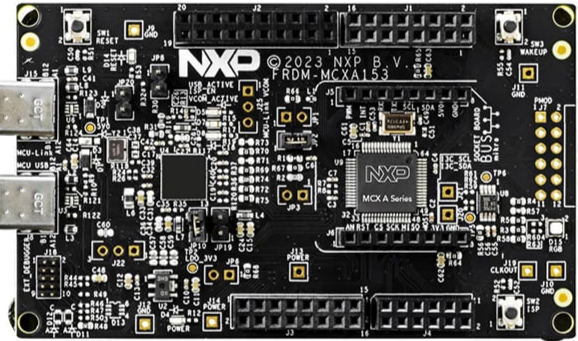
NXP's MCX A-series development board includes FRDM-MCXA153 (Figure 2), designed specifically for rapid prototyping and application development using A14x and A15x microcontrollers.