
- 4E, No.3 Shenfeng Road, Liuyao Community, Henggang Street, Longgang District, Shenzhen,China
- cc.shen@xypltd.com
- Call: +86 15112667855
News
Numerous options for screening proximity and distance sensor technologies
- 2026-09-29
The use of proximity and distance sensors can detect the presence and location of items without physical contact, which is crucial in controlling material handling, agricultural machinery, manufacturing and assembly operations, as well as industrial processes such as food, beverage, and pharmaceutical packaging.
These sensors use various technologies such as optoelectronics, laser, induction, capacitance, magnetism, and ultrasound. When determining the optimal choice for a specific application, factors such as range, size, accuracy, sensitivity, resolution, and cost need to be considered.
A key factor in many applications is the material of the object being tested. Some sensors perform differently on hard surfaces and fiber surfaces, while others are affected by object color or reflectivity.
This article will review common non-contact proximity sensor technologies and introduce their working principles, basic performance characteristics, and SICK example sensors, as well as some expected applications.
photoelectric sensor
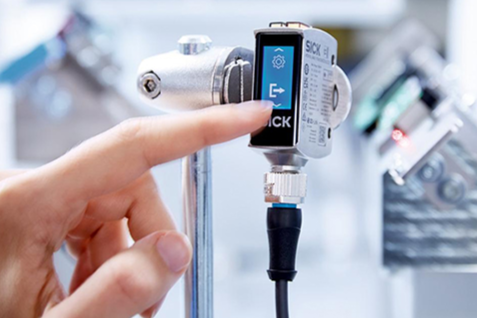
Photoelectric sensors, such as SICK's W10 photoelectric proximity sensor, are not only easy to use and install, but also have a series of characteristics suitable for various applications. The W10 sensor features a robust design, making it suitable for precise object detection in challenging environments. The integrated touch screen can accelerate parameter settings and sensor deployment speed (Figure 1).
Touch screen image on SICK photoelectric sensor
Figure 1: The touch screens on these photoelectric sensors can accelerate debugging and deployment speed. (Image source: SICK)
With the provided tutorials, designers can adjust these sensors according to specific application requirements. In addition, the integration of speed settings, standard and precision measurement modes, as well as foreground and background suppression, means that a sensor can be used for multiple applications. This sensor series includes four models, each with different working distances and installation methods.
Background suppression
The photoelectric proximity sensor with background suppression (BGS) function adopts triangulation method between the transmitting element and the receiving element. The signal of objects behind the set sensing range will be suppressed. In addition, SICK's BGS technology can ignore highly reflective objects in the background and cope with complex environmental lighting conditions.
If the target object and the background (such as a conveyor belt) have similar reflectivity, or if the background reflectivity changes unpredictably, it may interfere with detection, then background suppression is particularly useful.
Prospect suppression
A photoelectric proximity sensor with prospect suppression (FGS) function can detect objects within a specified distance. All objects between the sensor and the sensing distance (set as background) will be detected. To ensure reliable sensing, the background needs to be relatively bright and the height should not change.
When an object is located on a reflective surface such as a white or light colored conveyor belt, foreground suppression can improve detection performance. Sensors do not detect objects by detecting the reflected light, but by detecting whether the reflected light from the conveyor belt disappears.
Retro reflective type
In a reflective sensor, the emitted light is directed onto the reflector, and the sensor evaluates the reflected light. Using polarizing filters can minimize errors. Transparent stretch film and plastic packaging can interfere with these sensors. Reducing sensor sensitivity can help overcome these challenges. In addition, replacing standard infrared emitters with lasers can achieve a larger sensing range and higher resolution.
The use of switch hysteresis below normal values can improve the performance of reflective sensors. In these designs, even the slightest light attenuation between the sensor and reflector, such as that caused by glass bottles, can be reliably detected. SICK also offers a monitoring system called AutoAdapt, which can continuously adjust and modify switch thresholds to address the gradual accumulation of pollutants that may cause sensing system failure.
Shooting style
Unlike reflective sensors, reflective sensors use two active components: a transmitter and a receiver. Targeted sensing can achieve a wider sensing range. Replacing infrared emitters with laser diodes can further expand the sensing distance while maintaining high resolution and precise sensing.
optical fiber
Fiber optic sensors are a variant of the reflective design. In fiber optic optoelectronic sensors, the transmitter and receiver are encapsulated together in a single housing. The transmitter and receiver use different fiber optic cables respectively. These sensors are particularly suitable for high-temperature applications as well as hazardous and harsh environments.
Optoelectronic sensor array
The RAY26 Reflex Array series photoelectric sensor (such as model 1221950) can not only reliably detect flat objects, but also achieve fast debugging. When used in conjunction with reflectors, this photoelectric sensor can also detect small, flat, transparent, or uneven objects as small as 3 mm. In a uniform light array with a height of 55 mm, the sensor can detect the leading edge of an object. This means that even perforated objects can be reliably detected without the need for complex switching operations (Figure 4).