
- 4E, No.3 Shenfeng Road, Liuyao Community, Henggang Street, Longgang District, Shenzhen,China
- cc.shen@xypltd.com
- Call: +86 15112667855
News
Minor precautions for connectors in harsh and extreme environments
- 2026-10-20
Connectors used in Industry 4.0 production, robotics, logistics equipment, heavy machinery, transportation systems, and oil and gas production operations are typically exposed to harsh and harsh environments such as water and salt spray, dust, moisture, severe impacts and vibrations, extreme temperatures, and environments that require maintaining electromagnetic compatibility (EMC). To meet these extreme requirements and ensure high reliability, specific types of connectors are needed.
According to different applications, these connectors need to meet a series of standards established by organizations such as the International Electrotechnical Commission (IEC), the United States Council for Automotive Research (USCAR), the Society of Automotive Engineers (SAE), and the German AK Group.
This article first introduces some subtle precautions, such as the difference between weather resistance and waterproofing, as well as different levels of waterproofing performance. Then the differences between USCAR-2 and German LV 214 vibration testing were discussed. Finally, a series of Amphenol connectors were introduced, such as wire to board USB Type-C ®、 Ix, M12 push-pull, filtering sub-D design, and pluggable battery solutions, these connectors are designed to meet the requirements of harsh and extreme environments.
Weather resistance and waterproofing
Some connectors claim to be "weather resistant". According to the definition of the National Weather Service in the United States, "weather refers to the atmospheric state at a certain time and place, which is related to variables such as temperature, humidity, wind speed and direction, and air pressure." Weather resistance has different meanings in the fields of meteorology and connectors.
There is no mention of weather resistance in the technical standards for connectors. Connector specifications generally do not discuss various wind speed levels or air pressure. The meteorological definition of weather does not involve dust or other particulate matter that may affect the performance of connectors, but these are included in standards such as IEC 60529 Degrees of Protection for Enclosures (IP Code) applicable to connectors.
IP rating system
Generally speaking, weather resistant connectors are designed for outdoor use and exposure to various weather conditions. The protection level of these devices is usually IP65 or above, made of anti ultraviolet (UV) materials, and can be exposed to sunlight for a long time. The IP rating of waterproof connectors is IP67 or higher. Although labeling connectors as weather resistant or waterproof can be helpful, it is still best to determine their specific IP rating.
The minimum protection level is IP11. This level means it can prevent objects up to 50mm (such as hands) from entering, but water can enter. The IP rating of connectors is usually much higher. For example, IP65 rated weather resistant connectors exposed to dust for 2 to 8 hours will not reduce performance and can also prevent water spray, allowing only limited water intrusion.
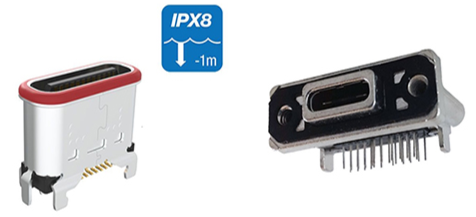
IP67 rated waterproof connectors have dust-proof capabilities and can be immersed in water up to 1 meter deep for 30 minutes without getting wet. For applications with higher requirements, there is also a higher IP waterproof rating (Figure 1).
Image of intrusion protection level definition
Figure 1: Definition of Intrusion Protection Level. (Image source: Amphenol)
Vibration difference
To ensure reliable operation, connectors need to have sturdy contacts. In high vibration environments such as industrial systems, heavy equipment, and transportation applications, achieving this can be quite challenging. The two commonly used vibration standards for connectors are LV214 and USCAR-2.
Both standards refer to the SR (System Requirements) series of IEC 60068 for environmental testing, covering a range of conditions including sine, random, and impulse excitations, as well as extreme hot and cold conditions. Reference was also made to IEC 60512-1-1, which specifies visual inspection during testing. Although LV214 and USCAR-2 have many similarities, there are also some differences.
German car manufacturer AK Group has developed LV214. It focuses on using a crimping force monitor to detect the quality of the terminals. The terminal must comply with specific compression force characteristic standards. The crimping force monitor is used to measure the pressure applied during the crimping process to ensure compliance with standard requirements.
The scope of USCAR-2 is broader. It includes testing at all stages of development, as well as on-site analysis of terminals, connectors, and other components in high-voltage (60 V to 600 V) automotive applications.
Both standards classify vibration into five intensity levels. In LV214, the vibration levels are S1 to S5, where S1 represents the most severe vibration, usually occurring near the tires, and S5 represents the lightest vibration, usually occurring in the cabin. S2 level appears in positions such as the battery pack of electric vehicles. USCAR-2 level includes V1 chassis vibration curve and more severe V2 engine vibration curve, as well as higher vibration test levels that require thermal cycling during testing. (Table 1).