
- 4E, No.3 Shenfeng Road, Liuyao Community, Henggang Street, Longgang District, Shenzhen,China
- cc.shen@xypltd.com
- Call: +86 15112667855
News
Minimize CO2 emissions by utilizing a single pair of Ethernet
- 2026-10-10
The global goal of net zero carbon dioxide (CO2) emissions will affect all industries. Given the large number and low energy efficiency of various buildings, this goal is extremely challenging for buildings. For many installed control and communication systems, their monitoring and data processing capabilities are limited, and they often lack advanced data analysis and control functions to optimize energy efficiency.
To achieve net zero CO2 emissions, it is necessary to use automated systems based on artificial intelligence (AI) analysis and control. The key to this improvement lies in the ability to easily deploy sensors throughout the entire building using long-distance, high data rate single pair Ethernet (SPE) in accordance with the 10BASE-T1L standard. Higher data transmission rates will minimize latency and achieve real-time control of building systems.
This article briefly introduces the connection requirements for CO2 net zero emission buildings. Then, taking Analog Devices' 10BASE-T1L device as an example, demonstrate how SPE supports improvements in communication and control while enhancing sustainability.
The limitations of traditional architectural design
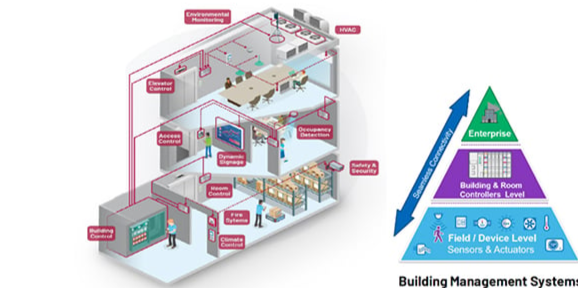
Traditional architectural design uses Building Management Systems (BMS) for overall structural control, while building subsystems typically operate in isolation. The limitations in communication interactivity and available power sources prevent buildings from achieving maximum energy efficiency, resulting in losses and ultimately affecting the environment. Consider the grading structure of standard buildings (Figure 1).
Classification of traditional building systems (click to enlarge)
Figure 1: The traditional building system is hierarchical, but it can also be divided by function. (Image source: Analog Devices Inc.)
The field/device level at the bottom of the BMS pyramid in Figure 1 includes local sensors and actuators for various systems. The controller level of buildings and rooms will integrate data from the site and equipment, and control the devices. Enterprise level monitoring of the entire building and coordination of controller operation through BMS.
Traditional building systems, such as heating, ventilation, and air conditioning (HVAC) systems, have vertical control levels but operate in isolation from occupancy detection systems. This means that regardless of the occupancy rate, the HVAC systems on each floor still require energy consumption for operation.
The reason for adopting this vertical isolation structure is that the performance of existing data interfaces is limited. Lower level analog interfaces, 4 mA to 20 mA current loop interfaces, RS485 serial interfaces, as well as higher-level interfaces such as bus addressable remote sensors (HART) and Fieldbus, have relatively slow speeds ranging from 1200 b/s to 31.25 Kb/s. This limits the amount of data transmission within a certain period of time.
The 10BASE-T1L (IEEE 802.3gg) Ethernet interface standard was introduced in 2019, significantly increasing data transmission rates to 10 Mb/s compared to SPE. This standard can also provide higher power through the same data transmission line, ranging from 36 mW using a 4-20 mA current loop with HART to 500 mW (non isolated) or up to 60 W (Table 1).
Protocol maximum cable length, bit rate, power transmission capacity, number of wires, higher-level Ethernet connections
4 mA to 20 mA, with HART<1500 m 1200 b/s and (36 mW) 2 through gateway
Fieldbus 1900 m 31.25 Kb/s with (limited) 2 through gateway
10BASE-T1L 1000 m 10 Mb/s with (500 mW non isolated, maximum 60 W) 2 direct
Table 1: Main characteristics of some common building data interface networks. (Table source: Art Pini, using data from Analog Devices, Inc.)
The slower data interface also limits access to field level sensors and actuators, which means these devices can only be reconfigured on-site. 10BASE-T1L is compatible with all existing Ethernet implementation schemes and can seamlessly communicate with all BASE-T Ethernet network devices (including 10/100/1000/2.5G/5G/10G BASE-T variants) without the need for a gateway.
The function of 10BASE-T1L
10BASE-T1L is part of the larger Ethernet 802.3 standard. This name summarizes its characteristics. 10 "represents a transmission rate of 10 Mb/s, and" BASE "represents a baseband signal, meaning that only Ethernet signals can be transmitted through the medium. T "indicates that the medium is twisted pair," 1 "indicates a transmission distance of 1 km, and" L "indicates length.
The medium specification of 10BASE-T1L does not specify a specific twisted pair cable. On the contrary, this standard specifies the return loss and insertion loss of wiring. This allows for the reuse of existing installed cables, such as Fieldbus A-type cables.
10BASE-T1L supports full duplex communication using two amplitude modes: 2.4 VP-P (peak to peak) with a transmission distance of 1000 meters, and 1.0 VP-P with a reduced transmission distance of 200 meters, suitable for hazardous environments.
The Ethernet standard specifies that power is supplied through twisted pair cables used for data communication. In the 10BASE-T1L standard, power is controlled based on environmental characteristics. 500 mW is suitable for intrinsically safe (i.e. hazardous) areas where spark discharge power must be limited. The upper limit of power in the safe area is 60 W.
Advantages of 10BASE-T1L
The biggest advantage of 10BASE-T1L, apart from a transmission distance of 1 km, is its compatibility with various Ethernet BASE-T networks. This eliminates the need to establish conversion gateways between different data network standards. This standard connects the channels from on-site to enterprise and cloud level, reducing costs, complexity, and power requirements.
Due to its transmission speed of up to 10 Mb/s, 10BASE-T1L can transmit basic measurement process values as well as other configuration parameters, status data, and even software or firmware updates to sensors and actuators. Sensors and actuators can be remotely accessed through IP addresses. Due to the fact that devices compatible with 10BASE-T1L do not require gateways and protocol converters, device configuration is simpler. Additional data processing capabilities help with more comprehensive daily system diagnosis and troubleshooting.
The higher data transmission rate brings more data capacity, which can also be used to connect building systems for data exchange. Artificial intelligence based analysis and control can achieve complementary regulation, thereby achieving the most efficient joint operation. Imagine what this would be like in a building equipped with 10BASE-T1L (Figure 2).