
- 4E, No.3 Shenfeng Road, Liuyao Community, Henggang Street, Longgang District, Shenzhen,China
- cc.shen@xypltd.com
- Call: +86 15112667855
News
Medical devices require 'harmless' power supply
- 2026-09-30
The innovation speed of electric medical equipment is astonishing, and with the integration of artificial intelligence, the innovation speed may further accelerate. Continuous improvement is needed in medical diagnosis, monitoring, and treatment, creating an eye opening market that is expected to exceed $542 billion by 2024.
However, as such medical devices become increasingly complex, purchasing power supplies and adapters that meet the specific needs of each application may face many challenges. In addition, developers in this field must strictly adhere to medical grade standards and regulatory requirements.
A market with less regulation usually favors suppliers who can withstand high risks and have a short product launch time, while medical devices must minimize risks, adopt strict testing and quality control processes, comply with regulations that affect various stages of the development process, and significantly improve patient treatment outcomes.
As the medical proverb "Do not harm first" requires, medical applications must first meet safety requirements. In this regard, the equipment must comply with both the "Patient Protection Measures" (MOPP) and "Operator Protection Measures" (MOOP) regulations to protect the safety of practitioners, technicians, and their patients.
Scope of IEC 60601-1 standard
The IEC 60601-1 standard is a compliance standard for medical power supplies. This standard has a history of 40 years and is currently in its third edition, the second revised edition (60601-1, 3.2), covering a wide range of equipment types from home healthcare to cardiac care. The United States has adopted this standard, and other regions are also in different stages of adoption.
This standard specifies the isolation, allowable leakage current, and insulation requirements between AC input and DC output. The operator's 1x MOOP protection level requires a basic insulation layer and can withstand 1500 VAC isolation testing, with a minimum creepage distance of 2.5 mm between conductive components; 2x MOOP protection requires double-layer insulation and requires double isolation and creepage requirements.
The requirements for patients are slightly different: 1x MOPP also requires basic insulation layer and 1500 VAC isolation, but the creepage distance is increased to 4 mm; 2x MOPP's creepage distance and insulation requirements are doubled, and the isolation voltage is increased to 4000 VAC.
Low leakage is crucial for medical grade equipment, which is not surprising, as it can be ground leakage, shell leakage, or current flowing through the patient's body in direct contact with one or more application components.
Application components are divided into three categories:
Type B: This is the basic level of medical bed ventilators and other equipment, with no electrical contact with patients
BF type: This type is relatively strict and suitable for applications including ultrasound and electrocardiogram (ECG) imaging. It may come into electrical contact with patients but will not form invasive connections to the cardiovascular system
CG type: This type is the most stringent and covers devices that may directly come into contact with the patient's cardiovascular system, such as surgical electrocauters and pacemakers
Suppliers must also be aware of the accompanying standard IEC 60601-1-2, which covers electromagnetic compatibility in the presence of external electromagnetic interference and electromagnetic interference generated by medical equipment.
For personnel creating home healthcare applications, the IEC 60601-1-11 standard specifies more safety requirements, reflecting the challenges and risks faced when using medical grade applications in non clinical environments (including use outside the home). This standard divides Class I applications that are permanently installed by certified electricians in household environments and Class II applications that do not rely on grounding.
Navigation device approval
In the United States, the Food and Drug Administration is responsible for ensuring that medical devices follow established development paths to ensure their safety and effectiveness. The institution classifies medical equipment into a three-level classification system based on risk:
The risk of Class 1 equipment is minimal, from tongue depressors to oxygen masks and surgical tools, all are controlled according to general rules, including good production processes, standards, adverse event reporting, product registration, and general record keeping.
The second category of equipment refers to high-risk devices such as blood glucose monitors, which require more control, including product labeling requirements, mandatory performance standards for specific devices, and testing requirements for specific devices. Developers may submit a pre listing notice stating that the new device is comparable to one or more similar devices that have already been legally listed.
Class 3 devices refer to devices used to support or maintain life, implant or potentially cause unreasonable disease or injury risks, such as pacemakers, defibrillators, blood transfusion devices, and electric wheelchairs. Due to the high risk, manufacturers must comply with pre-market approval procedures aimed at demonstrating safety and effectiveness, including submitting clinical and non clinical research reports, inspecting production facilities and laboratories.
The US Food and Drug Administration also provides "re approval" for devices that have never been marketed in the United States but whose safety and technology have been reasonably understood. For devices that diagnose or treat diseases or conditions with less than 4000 patients per year, humanitarian device exemptions can also be obtained.
After approval, the FDA will continue to monitor device performance to identify new safety issues. This may include inspections of production facilities and plans to allow manufacturers, medical professionals, and consumers to report issues with previously approved equipment.
Entering the market
Meeting US and international regulatory requirements is not an easy task. By utilizing power sources that clearly comply with the latest standards and regulations, the path to product launch can be simplified.
MEAN WELL was founded in 1982 and provides the latest medical grade power supply comprehensive product portfolio certified by the IEC60601-1 safety standard. These products are suitable for a range of applications, including diagnostic and therapeutic analysis, testing equipment, home healthcare devices, as well as rehabilitation and assistive devices.
Not only does it achieve BF level, 2x MOPP or MOOP isolation level, but the entire medical power supply product portfolio also complies with various international safety regulations: UL, CUL, TUV, CB, CE and FCC. These products have higher insulation levels, excellent electromagnetic compatibility, high reliability, and longer service life.
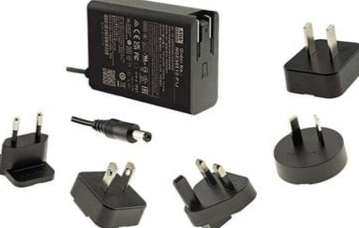
The company's NGE series wall mounted interchangeable AC adapters are suitable for medical, consumer, and industrial applications, with output power ranging from 12 W to 90 W; Moreover, fixed US plugs, fixed EU plugs, or globally certified interchangeable AC plugs can be selected.
The 90 W NGE90U18-P1J adapter for the United States is equipped with fixed plug-in input and barrel plug output connectors. The input voltage range of this adapter is 80 VAC~264 VAC, the output voltage is 18 V, and the working efficiency is as high as 92%. The corresponding international market product NGE90I18-P1J includes an international multi plug (Figure 1). Multiple inserts for other models in the NGE series need to be purchased separately.