
- 4E, No.3 Shenfeng Road, Liuyao Community, Henggang Street, Longgang District, Shenzhen,China
- cc.shen@xypltd.com
- Call: +86 15112667855
News
i. MX 8M Plus system level module DVFS supports CPU frequency control
- 2026-09-24
Dynamic Voltage and Frequency Regulation (DVFS) is a complex power management technology that is crucial for optimizing the performance and energy efficiency of embedded systems. DVFS can dynamically adjust the voltage and frequency of the processor according to workload requirements, effectively reducing power consumption and heat generation. This is particularly important in battery powered and heat limited environments, where energy efficiency and thermal management are key factors.
The working principle of this technology is to reduce the frequency of the processor, thereby directly reducing power consumption and heat generation. Meanwhile, by adjusting the voltage, the processor can maintain stable and reliable operation in various performance states. This dynamic adjustment has several main advantages:
Energy efficiency: DVFS can significantly reduce power consumption, thereby extending the battery life of portable devices. This makes it an important feature for mobile and Internet of Things (IoT) devices that rely on limited power sources.
Thermal management: By reducing heat generation, DVFS helps maintain the reliability and performance of equipment. Effective thermal management can prevent overheating, which can lead to hardware failures or performance degradation.
Performance optimization: DVFS achieves a balance between performance and power consumption by providing necessary computing power when needed, while saving energy when performing tasks with low requirements. This balance ensures efficient operation of the equipment without affecting power efficiency.
The implementation of DVFS on the i.MX 8M Plus System Level Module (SoM) highlights its importance, operational mechanism, and the steps required to utilize this feature for optimal performance and power efficiency. By understanding and utilizing DVFS, developers can improve the energy efficiency and reliability of their embedded systems, making them more robust and powerful in various applications.
i. Overview of MX 8M Plus System Level Modules
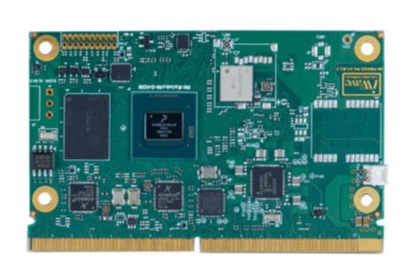
i. The MX 8M Plus System Level Module (SoM) (Figure 1) is centered around the NXP i.MX 8M Plus application processor. The processor uses a powerful quad core Arm Cortex-A53 CPU with a running speed of up to 1.6 GHz, complemented by an Arm Cortex-M7 core designed specifically for real-time task processing. i. The MX 8M Plus has a prominent feature: the integrated neural processing unit (NPU) can provide 2.3 trillion operations per second (TOPS), significantly accelerating the speed of machine learning inference tasks.
Figure 1: iWave i.MX 8M Plus SoM. (Image source: iWave)
This SoM aims to meet the diverse needs of modern applications by providing a wide range of multimedia, connectivity, and AI functionalities. These features make it suitable for applications ranging from industrial automation and robotics to smart home devices and consumer electronics.
Main features and functions:
Processing ability:
Four core Arm Cortex-A53 processor, running at a frequency of up to 1.6 GHz
Cortex-M7 core, used for processing real-time processing tasks
AI and machine learning:
Integrated NPU, providing 2.3 TOPS computing power to accelerate machine learning inference process
Connection options:
Wireless:
Supports Wi Fi 6 for high-speed wireless connectivity
Bluetooth 5.0 enables stable and efficient wireless communication with peripheral devices
wired:
Dual CAN-FD (Controller Area Network with Flexible Data Rates) interface for reliable real-time communication in industrial and automotive applications
Ethernet connectors provide high-speed, deterministic network solutions
Peripheral Connection:
USB 3.0 and USB 2.0 ports, connecting various peripherals to ensure flexible and diverse connection options are provided
PCIe 3.0 slot for high-speed data transfer and expansion options
Multimedia and Display:
Dual LVDS (Low Voltage Differential Signaling) interface, used to connect multiple displays
HDMI 2.0a TX output, used for high-definition video output, supports 4K resolution
Multiple MIPI interfaces:
2 MIPI CSI (Camera Serial Interface) ports for advanced camera solutions, enabling high-quality image and video capture
1 MIPI DSI (Display Serial Interface) port for advanced display solutions, ensuring high-performance visual output
i. The MX 8M Plus SoM combines powerful processing capabilities, a wide range of connectivity options, and advanced multimedia capabilities, making it a versatile solution for developers to implement complex, high-performance applications in various industries. Whether used in industrial control systems, smart home devices, or advanced multimedia applications, the i.MX 8M Plus SoM provides the flexibility and performance needed to meet today's demanding technological requirements.
How to use i.MX 8M Plus to reduce CPU frequency
Using i.MX 8M Plus to reduce CPU frequency involves modifying the op table in the Device Tree Source (DTS) file. The DTS file defines the hardware configuration of the system, including the available CPU operating points, which determine the possible CPU frequencies and corresponding voltage levels. By adjusting these operating points, you can control the maximum and minimum operating frequencies of the CPU (Figure 2 and Listing 1).