
- 4E, No.3 Shenfeng Road, Liuyao Community, Henggang Street, Longgang District, Shenzhen,China
- cc.shen@xypltd.com
- Call: +86 15112667855
News
How to quickly design and deploy IIoT ready machines
- 2026-10-10
Quickly designing and deploying machines that can be directly integrated into the Industrial Internet of Things (IIoT) is not an easy task. IIoT ready machines must be able to provide fast debugging support for machine to machine, machine to factory, and machine to cloud communication and coordination.
This requires a comprehensive solution. This solution should include a complete set of control, interface, and communication modules. Scalability is essential. It should also support easy installation to achieve rapid deployment. Finally, it must be able to easily integrate into multi vendor environments to provide support for legacy devices.
The reward of doing so is to improve operational efficiency at all levels of the enterprise organization and throughout the entire lifecycle of the machines.
This article will review how Schneider Electric's motor control solution provides end-to-end automation solutions for designers, and introduce the characteristics and advantages of Altistart soft starters, Altivar drivers, Modicon Ethernet switches and programmable logic controllers (PLCs), Harmony control relays, and PowerPacT circuit breakers.
Subsequently, a detailed explanation will be provided on how TeSys island system components support a comprehensive solution to support older machines and can be easily integrated with Rockwell Studio 5000 and Siemens TIA Portal environments. Finally, we discussed how Schneider Electric's EcoStruxure Machine Expert software can accelerate the development, configuration, and debugging of IIoT ready machines.
Motion is a fundamental characteristic of industrial machines. There are various ways to implement it, from simple motion curves in systems such as pumps, conveyors, and cranes, to complex motion curves in processes and assembly operations, as well as in robotics technology.
Machines with simple motion curves can benefit from the functionality of soft starters such as the Altistart soft starter series. The Altistart soft starter supports the following functions:
Controlling acceleration can reduce mechanical impact, which increases wear and tear, leading to increased maintenance requirements and machine downtime
Limit surge current and reduce energy consumption
Protect the motor from potential surge effects during startup and extend its lifespan
Improve reliability by detecting faults such as motor stalling, underload, or grounding errors and issuing alerts to machine operators
Basic machines that do not require high starting torque can use the ATS01 series soft starter. By activating the BOOST logic input, a boost equivalent to 100% of the motor's nominal voltage can be applied for 200 ms to overcome the initial mechanical friction within the system. After this boost, the programmed voltage boost begins.
The ATS01N232RT soft starter can be used for soft starting and stopping of three-phase asynchronous motors with a power of up to 15 kW (20 HP), with acceleration and deceleration times of 1 to 10 seconds. This starter is optimized for simple belt drive applications, such as pumps, compressors, and fans with operating voltages ranging from 440 VAC to 480 VAC. The control device is located on the front panel and can set the start time, initial voltage, and stop time for easy installation and debugging.
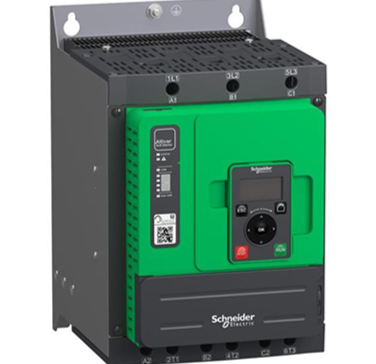
For process and infrastructure machines with higher requirements such as mixers, crushers, and conveyors, designers can use Altivar ATS480 series soft starters. Although the simpler soft starter uses a voltage ramp, the ATS480 soft starter uses a gentler torque ramp and can achieve braking function.
The working voltage of ATS480C11Y soft starter is 208 VAC to 690 VAC (Figure 1). Depending on the motor voltage, it can be used for motors ranging from 22 to 90 kW (25 to 100 hp). This starter is equipped with a Modbus serial communication port and an RJ45 connector. Profibus, PROFINET, Modbus TCP/Ethernet/IP, and CANopen communication cards can be optionally selected.
Picture of Schneider Electric's Altivar Soft Starter
Figure 1: This Altivar soft starter is designed for asynchronous motors ranging from 22 to 90 kW. (Image source: DigiKey)
Drive more advanced machines
The complex motion curves in advanced machines can be supported by variable frequency drives (VFDs), such as the Altivar 320 series, with rated power ranging from 0.18 to 15 kW (0.25 to 20 hp), suitable for applications such as material handling, packaging, textile, lifting, mechanical actuators, and material processing. The rated power of ATV320U75M3C is 7.5 kW, and the operating power supply voltage is 200 VAC to 240 VAC.
To speed up configuration and debugging, these drivers offer 150 features and come in standard and customizable configurations. This includes specialized functions for applications such as material handling, textiles, lifting, and mechanical actuators.
The Altivar 320 VFD provides high-performance control for asynchronous motors and permanent magnet motors, including torque and speed accuracy at extremely low speeds, as well as dynamic motion through flux vector control without the need for sensors. When used for three-phase synchronous and asynchronous motors, these VFDs have the following characteristics:
Support high-speed motors
Realize static speed accuracy of open-loop synchronous motor
Flexible system integration options, including Ethernet, CANopen, Profibus, EtherCAT, DeviceNet, etc
Integrated security features that meet functional safety standards
The protection levels of compact and book style drives range from IP20 to IP66 and can be integrated into different types of cabinets (Figure 2)
Picture of Schneider Electric's Altivar 320 VFD
Figure 2: The Altivar 320 VFD has multiple external dimensions that simplify installation and maximize space utilization in equipment cabinets. (Image source: DigiKey)
High performance multi axis machine
Modicon Ethernet switches and programmable logic controllers (PLCs) can support high-performance designs, from single independent axis machines to high-performance synchronous multi axis machines that require high-speed precise positioning and motion, such as robots.
These IIoT native edge controllers can directly connect to cloud platforms using Message Queuing Telemetry Transport (MQTT), Open Platform Communications Unified Architecture (OPC UA) servers and clients, and Transport Layer Security (TLS) encryption technology, and have embedded security and network security features. Dual Ethernet ports can support Ethernet/IP and Modbus TCP protocols. In addition, it is equipped with RS232 and RS485 ports, USB ports, and SD card slots.
The TM262L controller can be used for logic control of various input/output devices, including four fast digital inputs and four fast digital outputs. The execution speed of the TM262L10MEE8T controller is 5 ns per instruction. The dual core processor can effectively manage parallel applications and communication (Figure 3).