
- 4E, No.3 Shenfeng Road, Liuyao Community, Henggang Street, Longgang District, Shenzhen,China
- cc.shen@xypltd.com
- Call: +86 15112667855
News
How to protect the safety of personnel and machines with a secure laser scanner
- 2026-10-13
Safe laser scanners contribute to the safety of industrial and logistics facilities. This type of scanner can protect personnel's safety during unsafe interactions between humans and machines, as well as protect machines from unexpected human interference.
To maximize the effectiveness of a safe laser scanner, several factors need to be considered. Firstly, it is necessary to determine whether the laser scanner is the best solution or whether other technologies such as light curtains are more suitable.
After determining that the scanner is the best choice, some important decisions need to be made, including:
Choose the best security protection zone and zone combination
Use International Organization for Standardization (ISO) standards such as 13855 to locate security measures when personnel approach.
Select the correct multiple sampling values
Select the scanner with the optimal feature set
This article first introduces the factors that affect the selection of scanners and light curtains. Then, provide important selection criteria for using scanners and introduce representative products of safe laser scanners from companies such as IDEC, Omron, SICK, and Banner Engineering.
Choose scanner or light curtain?
One of the first issues to consider is what kind of space scanner and light curtain need to be protected to protect personnel from harm and machines from interference. Although there is some overlap in the protective functions of scanners and light curtains, they are typically suitable for different applications, such as:
Operation point protection refers to the active area where work is carried out on the machine. The reason why Guangxu is suitable for this application is that it can be placed in the optimal position, set its resolution to detect fingers, hands, or feet/legs, and provide the required level of protection. Due to its long response time, scanners usually need to maintain a minimum distance from danger and are generally not used for operating point protection.
Boundary protection can protect multiple sides of the machine. Like operation point protection, light curtains are also very suitable for providing compact protection solutions for boundary protection. If someone crosses the line, a shutdown signal will be issued, causing the machine to stop running. Although both light curtains and scanners can be used for boundary protection, safety light curtains are more commonly used for boundary protection, while scanners are more commonly used for area protection.
Access control and area protection can be achieved through the use of light curtains or scanners according to specific application requirements. Light curtains are suitable for situations where there is only one entrance. For example, monitoring and evaluating each beam of light separately can enable the light curtain to distinguish between "tall" people and "short" material carriers (such as trays that exceed a threshold), and modify their response accordingly.
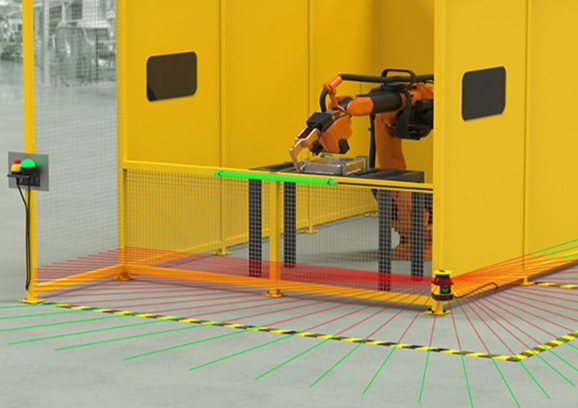
After setting up, the scanner can monitor the 275 ° area to create a user-defined two-dimensional protected area (Figure 1). The scanner can also establish multiple protection zones based on the distance between personnel and protected machines, and slow down its operation speed or shut it down according to specific situations.
The safety laser scanner shown in the picture can monitor an area of 275 °
Figure 1: The safety laser scanner shown in the figure can monitor an area of 275 ° to create a two-dimensional protected zone, and issue an alarm when personnel or objects accidentally enter the area (red line area). (Banner Engineering provides pictures)
Using multiple scanners helps with mobile systems such as Autonomous Mobile Robots (AMRs) and Automated Guided Vehicles (AGVs). These scanners can be powered by batteries and can work together after installation, while monitoring dozens of safe areas around the vehicle. Different areas can be activated based on changes in vehicle speed, position, and expected direction. The encoder and other sensor inputs on the wheels can supplement the data from the scanner, thereby supporting AMR navigation.
What is the security level?
After determining the actual space that needs to be protected, the next step is to consider the required security level. In addition to having different application advantages, light curtains and safety laser scanners also support different safety levels specified by various international standards. For example, ISO 13849-1 defines the reliability of safety control functions using performance levels (PLs) ranging from "a" to "e", where PLe represents the highest level.
The safety laser scanner meets the PLd standard and is suitable for applications with high safety requirements. The PLd level is applicable to systems that may experience hazardous failures every 1 million to 10 million hours (141 to 1141 years of continuous operation). The light curtain has multiple security level options ranging from PLc to PLe.
IEC 62061 Mechanical Safety Standard: Another important standard is the functional safety of electrical, electronic, and programmable electronic control systems. This standard is based on risk assessment and risk reduction strategies for safety control functions such as light curtains and safety laser scanners. This standard includes functional requirements specifications and safety integrity level (SIL) requirements.
Functional requirements include operating frequency, response time, operating mode, duty cycle, operating environment, fault response function, etc. The range of SIL values obtained from this is 1 to 4 (Figure 2).