
- 4E, No.3 Shenfeng Road, Liuyao Community, Henggang Street, Longgang District, Shenzhen,China
- cc.shen@xypltd.com
- Call: +86 15112667855
News
How to protect power line communication (PLC) systems: two technologies that need to be understood
- 2026-11-25
Smart energy infrastructure devices such as smart grids, smart meters, and smart streetlights all require reliable, economical, and secure communication. Although wireless technology can be effective, its vulnerability, cost, and coverage limitations pose significant challenges. Power line communication (PLC) technology can transmit data through existing power lines and is a good foundational technology for achieving critical communication.
Although the definition of PLC is clear and widely used, designers still need to pay attention to some issues that may disrupt communication, such as signal attenuation, noise, and transient voltage. To solve these problems, practical and effective solutions are needed to ensure optimal performance. PLC transformers and GMOV overvoltage protectors are two of the solutions.
The PLC transformer has been optimized to minimize insertion loss in narrowband (NB) applications. They can also reduce electrical isolation and electromagnetic interference (EMI), improve signal quality and reliability. GMOV is a hybrid overvoltage protection component that combines gas discharge tube (GDT) and metal oxide varistor (MOV). Its design overcomes the limitations and fault issues of standard MOVs, as they are prone to degradation and thermal breakdown in harsh and uncontrolled environments.
This article briefly reviews the working principle of PLC and the reasons why it is suitable for intelligent infrastructure. Then, the example devices of PLC transformers and GMOV protectors provided by Bourns were introduced, their working principles were explained, and some factors that should be considered when selecting and applying them were introduced.
PLC operation, application, and challenges
In a PLC system, the data to be transmitted needs to be modulated into a carrier signal before being injected into the power line. The details of different applications vary greatly, but IEEE 1901.2 is a global grid standard. This standard specifies a maximum narrowband communication rate of 500 kilobits per second (Kb/s) for low-frequency (≤ 500 kilohertz (kHz)) communication, suitable for applications such as smart grids, smart meters, and smart street lighting.
Although PLC technology has been proven to be a useful solution for smart energy infrastructure designers, it is not without challenges. Design obstacles include signal attenuation, noise, and transient voltage, all of which greatly reduce communication quality and reliability. Specifically:
Signal attenuation is a problem because the lines used for PLC signals are designed for transmission, not for data. The impedance characteristics of these lines can cause significant attenuation, especially over long distances. The resulting decrease in signal strength will reduce the effective range and may lead to data loss or errors.
There are multiple sources of noise, such as electronic devices connected to power lines, power supply variations, and external EMI. The frequency of PLC data signals is relatively high, making them particularly susceptible to the influence of these noise sources in unshielded power grids.
Lightning strikes or inductive load switches may cause transient voltage. This transient can generate high voltage on the power line and may damage the PLC modem.
When addressing the challenges faced by PLC systems, designers can adopt two key technologies: PLC transformers and GMOV protectors. These two components play a crucial role in ensuring the reliability, performance, and safety of PLC systems.
Design Review: PLC Transformer and GMOV in Coupled Circuit
To illustrate the problems that PLC transformers and GMOVs can solve, please refer to the coupling circuit shown in Figure 1. This circuit must isolate the PLC modem (ZModule) from the power line (ZLine) and provide a path for data signals. During this process, the coupling circuit must simultaneously handle high-frequency, low-power communication signals and low-frequency, high-power alternating current.
Simplified coupling circuit image with surge protection
Figure 1: The simplified coupling circuit with surge protection function is shown, which can isolate the PLC modem (ZModule) from the power line (ZLine) and provide a path for data signals. (Image source: Bourns)
The PLC transformer (T1) provides electrical isolation between the PLC modem and the power line, helping to separate the PLC from the AC power grid. These transformers have an important feature of minimal insertion loss, which reduces signal distortion and attenuation. For example, Figure 2 shows the performance of Bourns' PFB series PLC transformer, suitable for narrowband applications below 500 kHz. In addition, the ability of PLC transformers to suppress electromagnetic interference also helps to reduce noise, thereby improving the reliability and efficiency of communication.
PFB series PLC transformer insertion loss frequency relationship diagram (click to enlarge)
Figure 2: The insertion loss frequency relationship diagram of the PFB series PLC transformer customized for narrowband applications below 500 kHz is shown. (Image source: Bourns)
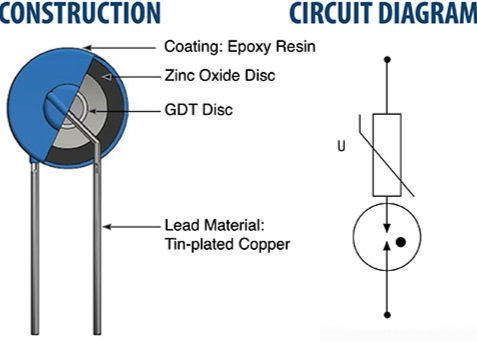
In Figure 1, the transient voltage is also processed by the GMOV protector (Figure 3). This new type of device is a hybrid overvoltage protection component that integrates the fast response of MOV and the high surge current handling capability of GDT. This combination can provide strong protection against transient voltage damage caused by lightning strikes or switch events in the electronic circuits of the PLC system.
In GMOV, MOV and GDT components are capacitively coupled in series configuration. Under low frequency conditions, the voltage limit of GMOV components is equal to the sum of the voltage limits of MOV and GDT components.