
- 4E, No.3 Shenfeng Road, Liuyao Community, Henggang Street, Longgang District, Shenzhen,China
- cc.shen@xypltd.com
- Call: +86 15112667855
News
How to measure water flow rate to improve treatment efficiency and effectiveness
- 2026-09-24
To improve the efficiency and sustainability of power plants and energy factories, agriculture and mining industries, industrial and municipal water supply and wastewater treatment facilities, food and beverage processing, and similar businesses, it is necessary to monitor and measure water flow and volume.
Water system designers can use several tools to quantify available water and its flow rate. These tools minimize or eliminate direct contact with water to maintain its purity. Electromagnetic flowmeter (magnetic flowmeter) provides a non-contact method for quantifying flowing water. The water level in the storage tank can be measured using non-contact sensors, such as designs based on ultrasound and radar. The third option is to use a sealed static pressure level measurement sensor certified for drinking water applications.
This article reviews the principles and advantages of magnetic flow meters and static pressure sensors, and compares the principles and applications of Endress+Hauser's non-contact liquid level sensors based on ultrasonic and radar designs. Then, taking the food and beverage processing production line as an application example, we discussed how the data manager can record, display, and monitor the operation, as well as how IO Link can quickly and efficiently integrate a complete water monitoring system.
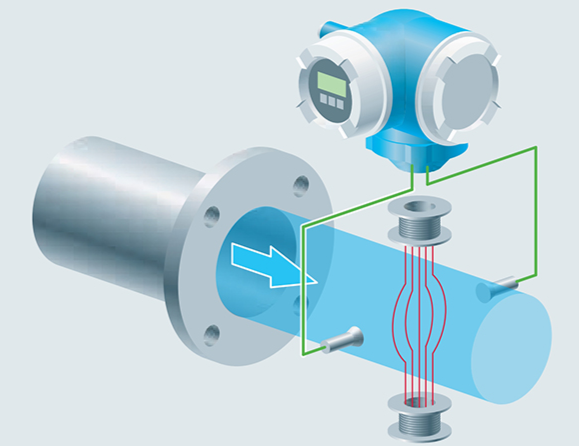
Faraday's law of electromagnetic induction describes the working principles of transformers, inductors, generators, and magnetic flux sensors. In a magnetic flowmeter, charged particles in the measured fluid will flow through two magnetic field coils to generate a magnetic field and induce a voltage. This induced voltage is measured by two measuring electrodes (Figure 1).
Schematic diagram of Endress+Hauser magnetic flowmeter
Figure 1: In a magnetic flowmeter, charged particles (blue arrows) in the liquid flow between two magnetic field coils (red lines), and the probe measures the induced voltage (green lines). (Image source: Endress+Hauser)
The induced voltage is proportional to the flow rate and flux. Pulse direct current (DC) voltage generates a magnetic field. By alternately changing the polarity of the DC voltage, a stable zero point can be established, making flow measurement insensitive to low conductivity or uneven liquids.
The Picomag DMA50 series magnetic flowmeter is suitable for various applications. The 1.4-inch TFT color display screen with backlight can automatically rotate according to direction and flow, simplifying installation. These instruments can simultaneously measure flow rate, temperature, and conductivity. It can achieve a flow measurement accuracy of ± 0.5% within a wide range of flow rates.
The measurement range of DMA20-AAACA1 type is 0.1 to 50 L/min, with a maximum pressure of 232 PSI. It uses a three-quarters inch connector and operates within a temperature range of -10 ° C to 60 ° C. Like all Picomag DMA50 series magnetic flow meters, this model has IO Link connectivity. Enabling Bluetooth through Endress+Hauser's SmartBlue application simplifies and accelerates operation, maintenance, and debugging even in challenging locations (Figure 2).
Picture of Endress+Hauser Picomag DMA50 series magnetic flowmeter
Figure 2: Example of Picomag DMA50 series magnetic flowmeter capable of measuring flow rate (L/min) and conductivity (µ S/cm). (Image source: Endress+Hauser)
The DMA20-AAACA1 model uses fluorine rubber (FKM) O-rings that are resistant to chemical corrosion and overheating conditions, and supports in place cleaning (CIP) and in place sterilization (SIP) automation processes. It can clean and sterilize machinery, containers, or pipelines without disassembly.
DMA50-AAABA1 and other models of EPDM O-rings can resist ozone, sunlight, and weather aging. Typical applications of Picomag magnetic flow meters include:
Industrial oven, in which the cooling water flows through multiple cooling pipelines to cool it down
The dual water jacket food processing system must measure the flow rate of heating and cooling water in it
The cleaning of bottle containers and the pasteurization process benefit from monitoring water temperature, water supply, and drainage to maximize water efficiency
Ultrasonic and Radar ToF Liquid Level Sensing
Ultrasonic and radar level sensors measure time of flight (ToF) based on the speed of sound and light, respectively. Ultrasonic waves reflect through density changes between air and the surface of the material being tested. Radar sensors are sometimes referred to as free space radars, and their emitted microwaves reflect based on the offset from low dielectric (low ε r) media (such as air) to high dielectric materials.
In applications such as pump controllers and liquid level alarms, the Prosonic FMU30 series ultrasonic liquid level sensor is designed for non-contact measurement of fluids such as drinking water and wastewater, pastes, and coarse bulk materials. Due to the use of non-contact technology, the maintenance requirements for these sensors are extremely low. They are insensitive to the dielectric constant, density, or environmental humidity of the material.
The measurement range of FMU30 sensor depends on the size of the sensor. They come in two sizes: 1/2-inch sensors (such as FMU30-AAHEAAGGF) have a fluid measurement range of 5 meters and a bulk material measurement range of 2 meters, while 2-inch sensors have a fluid measurement range of 8 meters and a bulk material measurement range of 3.5 meters.
The working temperature range of FMU30 sensors is -20 ° C to+60 ° C. They use the ToF principle to measure distance. However, the speed of sound (and therefore, ToF) varies with temperature. The FMU30 ultrasonic sensor integrates a temperature sensor that can automatically compensate for temperature changes, ensuring measurement accuracy and repeatability.