
- 4E, No.3 Shenfeng Road, Liuyao Community, Henggang Street, Longgang District, Shenzhen,China
- cc.shen@xypltd.com
- Call: +86 15112667855
News
How to ensure the reliability and safety of UWB applications through frequency control
- 2026-10-12
Ultra wideband (UWB) was developed during World War II for secure communication and radar systems, but was later banned for commercial use and has not been fully utilized for decades. The US federal regulations released in 2002 allow for the widespread use of UWB. Subsequently, this technology has achieved significant development in an increasing number of commercial applications such as industry, consumption, communication, and automotive. These applications all utilize the precise positioning and location tracking capabilities of this technology, as well as the high-speed data transmission and minimum power consumption brought by this wireless protocol.
Like other short-range wireless communication protocols such as Bluetooth and Wi Fi, a personal area network (PAN) can be created through UWB to interconnect electronic devices and facilitate data transmission around individuals. PAN does not send data through LAN or WAN, but transmits information between devices near individuals.
However, UWB differs from other transmission technologies in several key aspects, which has also driven its use in an increasing number of mainstream wireless applications.
UWB security, wide frequency range, and precise detection
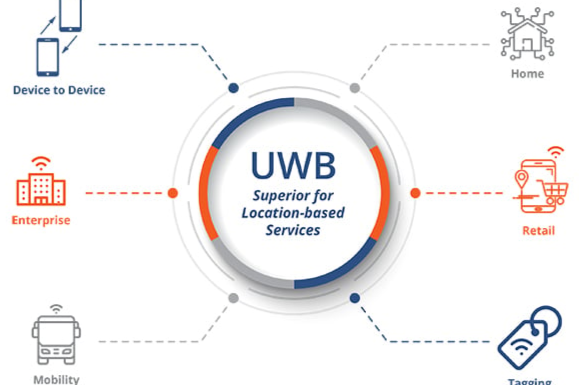
Figure 1: The security, wide frequency range, and precise detection capabilities of UWB make many mainstream wireless applications possible. (Image source: Aker Technology)
UWB operates at a very high frequency and does not interfere with other wireless protocols. This technology helps to achieve features such as spatial audio, smart home integration, and contactless payment systems, and is particularly useful in automotive, mobile, and consumer devices such as smartphones and tag devices. This technology helps to achieve advanced features such as secure hands-free access, indoor navigation, contactless payments, credential sharing, and item tracking.
Advantages brought by UWB
Although Bluetooth and Wi Fi have already established themselves in the field of wireless communication, UWB will dominate applications in the 10-20 m range due to its faster speed, greater security, and extremely high accuracy. This is mainly due to the measurement of Time of Flight (ToF).
Wi Fi Bluetooth UWB
Spectrum Band 2.4/5 GHz 2.4/5 GHz 3.1 GHz~10.6 GHz
Nominal range 250 m 100 m 10 m~20 m
Accuracy 2 m~3 m 1 m~5 m 10 cm~30 cm
Data rate 600 Mbps 24 Mbps 460 Mbps
Intermediate Intermediate Advanced Safety
Table 1: UWB has a frequency range of 3.1~10.6 GHz, which makes Wi Fi and Bluetooth, which only have a frequency range of 2.4~5 GHz, pale in comparison. Due to its higher operating frequency range and wider bandwidth, UWB can securely transmit more data, making it an ideal choice for high-speed and short-range data transmission. (Image source: Aker Technology)
By accurately measuring the time required for signal transmission between devices, the ToF function of UWB makes it more difficult for external attackers to access or manipulate UWB communication, thanks to its encryption features, random number generation, and other security technologies.
In addition to high security, UWB technology also has advantages such as low power consumption, strong noise resistance, precise positioning and position tracking, and easy signal penetration through various materials. UWB can transmit a large amount of signal energy without interfering with traditional narrowband and carrier transmission within the same frequency band.
Wireless speed (real-time data, precise timing): Although Wi Fi has slightly higher data transmission rates than UWB, at 600 Mbps and 460 Mbps respectively, UWB's radar like detection capability makes it an effective choice for wireless applications. The data transmission rate of Bluetooth is 24 Mbps, for reference only. In addition, UWB has a nominal distance smaller than Bluetooth or Wi Fi, making it most suitable for short-range applications that require precise timing and real-time data transmission.
Accuracy (positioning, location tracking): UWB's accuracy over short distances is unmatched by other wireless technologies, ensuring more precise device positioning. Due to the absence of interference from other wireless transmission and burst technologies, UWB can effectively measure distance with an accuracy of up to 10 cm to 30 cm, far superior to the measurement range of Wi Fi (2 m to 3 m) and Bluetooth (1 m to 5 m).
Security (data integrity, secure transmission): UWB pulse transmission technology has the characteristics of anti noise and anti reflection, so it has high security in various applications. Two devices can be directly connected and their characteristics can be accurately measured, enabling UWB to connect in real-time and verify the legitimacy of the device without the occurrence of radio waves being recorded or forwarded.
Power efficiency (low leakage, optimal consumption): UWB has fast transmission speed and well-defined timing frames, making it more energy-efficient than most short-range protocols. This technology supports multiple low-power modes, including sleep mode, which can further optimize power consumption. For small battery powered devices, such as those in UWB environments, power consumption is a key factor.