
- 4E, No.3 Shenfeng Road, Liuyao Community, Henggang Street, Longgang District, Shenzhen,China
- cc.shen@xypltd.com
- Call: +86 15112667855
News
How to choose and apply radar sensors in harsh environments
- 2026-09-28
Remote sensing technologies such as ultrasonic sensors may be subject to interference in outdoor and industrial applications, as well as other harsh environments. Adverse weather, dust, debris, and complex sensing environments are all issues that may affect standard sensors.
Radar sensors can address these challenges by detecting moving and stationary targets under various environmental conditions. This article discusses in which scenarios radar is superior to other options, and introduces several radar sensors from Banner Engineering, their applications, and design considerations to remember when selecting sensors.
Why use radar sensors?
When facing rainwater, dust, and other common airborne substances, radar performs robustly and is equally effective in bright and unlit spaces, unaffected by temperature changes and wind. Radar can detect surfaces with various coatings, geometries, and colors, and can also penetrate non-conductive materials, allowing radar sensors to explore the interior of containers.
In addition, radar can be used at relatively long distances and has strong anti-interference ability, making it advantageous in short-range applications where sensors are densely deployed.
How does radar work
The working principle of radar is to emit electromagnetic waves to target objects and receive reflected signals, and determine the distance based on the round-trip time of the signals. Radar sensors mainly use two technologies: frequency modulated continuous wave (FMCW) and coherent pulse radar (PCR).
FMCW radar emits continuous radio waves, which can continuously monitor moving and stationary targets. PCR sensors send radio waves in pulse form, typically using low-power transmitters. Therefore, PCR sensors are more suitable for short-range applications.
The working frequency also has a significant impact on the detection range and material sensitivity. Low frequency signals are more suitable for remote detection and are particularly suitable for materials with high dielectric constants such as metals and water. The higher the frequency, the higher the accuracy, and the more suitable it is for detecting smaller targets and a wider variety of materials.
Beam pattern and induction zone
After optimization, radar sensors can focus on specific areas of interest and track one or more targets. The key parameters include beam pattern, induction zone, and blind spot.
Radar sensors emit radio waves with specific shapes determined by horizontal and vertical angles. Narrow beam patterns can achieve precise detection and longer detection distances, while wide beam patterns can cover larger areas and better detect irregularly shaped targets.
Many radar sensors support configuring multiple sensing zones within their beam pattern. By utilizing this feature, more complex detection scenarios can be achieved, such as setting different parameters for the near and far zones in collision prevention applications.
Blind zone refers to the area immediately in front of the sensor where detection is unreliable. The higher the frequency of the sensor, the shorter the blind zone is usually.
Determining the optimal radar sensor: starting from the basics
There are many factors to consider when choosing a radar sensor. In addition to basic operating parameters, radar sensors also have various characteristics that affect cost, durability, and usability. Figure 1 provides a flowchart, using Banner Engineering's radar sensor as an example, to illustrate some of the decision points involved.
Flowchart image illustrating the process of selecting radar sensors (click to enlarge)
Figure 1: Flowchart illustrating the process of selecting radar sensors. (Image source: Banner Engineering)
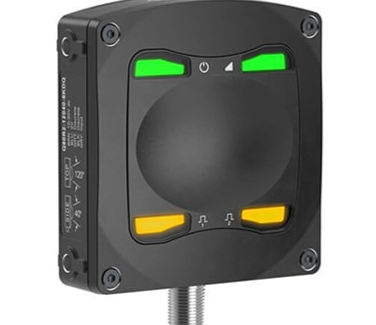
Banner Engineering's Q90R series is a great entry-level choice. These FMCW sensors operate at a frequency of 60 GHz, balancing detection range, accuracy, and material detection capability. Its sensing range is 0.15 m to 20 m, with a blind zone of 150 mm, and can be configured with two sensing zones.
One use case of these sensors is to detect when trucks arrive at the loading and unloading area. In this example, the relatively wide 40 ° x 40 ° beam pattern makes it easier for users to locate the installation location, ensuring that the loading and unloading area is always within line of sight.
Q90R2-12040-6KDQ (Figure 2) adds a configurable wide field of view (120 ° x 40 °) and the ability to track two targets on top of these features, making it capable of handling more complex detection scenarios.