
- 4E, No.3 Shenfeng Road, Liuyao Community, Henggang Street, Longgang District, Shenzhen,China
- cc.shen@xypltd.com
- Call: +86 15112667855
News
How to choose a 48V connector for automotive grade medium voltage power supply architecture
- 2026-10-12
The requirements of various governments to reduce CO2 emissions and the demand of consumers for automotive electronic products have led to the transition of automotive systems from a 12V power architecture to a more efficient 48V architecture. These medium voltage architectures can achieve higher power output and lighter weight, lower cost wiring harnesses.
The problem faced by designers is to ensure that the connectors meet the rigorous electrical, safety, reliability, and physical requirements of the 48V system while meeting cost and time to market constraints. Therefore, before selecting a suitable supplier, it is necessary to first understand the operational, regulatory, and safety requirements of automotive grade medium voltage architecture.
This article introduces the advantages of the 48V architecture and outlines the challenges faced when selecting appropriate connectors. Then introduce the suitable solutions provided by Molex and explain how to use these applications in practical scenarios.
The advantages of automotive grade 48V architecture
Automakers can achieve mild hybrid systems that can recover energy during braking and coasting by adopting a medium voltage architecture. Automakers can also deploy enhanced start stop systems to reduce fuel consumption during urban driving and traffic congestion. In addition, due to the high voltage, lighter and smaller sized wires can be used to provide the same power at lower currents, thereby reducing the weight of the vehicle through a 48 V system. All these factors can save a lot of fuel, especially for small vehicles.
In addition, more powerful wiring harnesses are required to accommodate the electrification of components such as power steering and air conditioning, as well as the adoption of advanced driver assistance systems (ADAS) such as adaptive cruise control and lane keeping assistance. Transitioning the power architecture to a 48 V architecture can meet this requirement, avoiding the cost and complexity associated with high voltage systems (i.e. 400 V and above) used in fully hybrid electric vehicles (HEVs) and pure electric vehicles (BEVs).
The 48V voltage architecture is also a bridge to achieve greater automotive electrification, gradually integrating hybrid technology without the need for comprehensive electrical system upgrades. Even in pure electric vehicles, these medium voltage systems will still play an important role, as demonstrated by the applications in designs such as Cybertruck.
Cost considerations for 48V connectors
The answer to the question of which electrical connection system to use for the 48V architecture can be found in the technical challenges brought about by voltage rise.
The use of high-voltage connectors specifically developed for electric and hybrid vehicles is technically feasible, but due to its cost and packaging space, this approach is not advisable. In contrast, transforming the 12V connector into a medium voltage architecture is very attractive in terms of cost and size.
It is worth noting that not all vehicle systems will transition to a voltage of 48 V. Some small devices with lower power consumption will maintain a voltage of 12V. Therefore, it is very important to use connectors that can maintain consistency in both 12V and 48V systems, as this can simplify the training of tools and technicians.
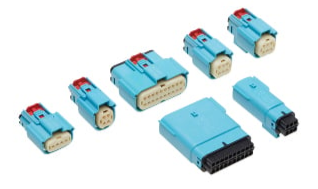
Molex's MX150 medium voltage connector system (Figure 1) embodies these design principles. These connectors have the same external dimensions as the low-voltage MX150 connectors that have been verified on site. Due to adopting the same packaging size and housing design as the 12V connector system, the MX150 medium voltage connector can be directly upgraded to a 48V wiring architecture with minimal design engineering.
Molex MX150 Medium Voltage Connector System
Figure 1: The connectors of the MX150 medium voltage connector system have the same external dimensions as the low-voltage MX150 connectors that have been verified on site. (Image provided by Molex)
The MX150 medium voltage connector system is currently divided into five different configurations, as shown in Table 1. This includes dual row 33482 blade connectors and corresponding dual row 300361 sockets, as well as single row 300363 connectors.
Technical specification details
Circuit specification single row: 4
Double row: 4, 6, 20
Voltage (maximum) 60V
Current (maximum) 22.0 A
Contact resistance 8 m Ω
Industry Compliance USCAR-2, USCAR-21, GMW3191
Working temperature -40 ° C to+125 ° C
Sealed IP67 and USCAR-2 level 2 seal
Table 1: Main specifications of MX150 medium voltage connector system. (Table source: Molex, modified Kenton Williston)
Safety precautions for 48V connectors
Although 12V voltage is a good starting point for medium voltage connectors, transitioning to 48V faces significant challenges. The issue of electric arcs is particularly concerning.
In a 12V system, small arcs typically extinguish quickly when the circuit is disconnected. However, at a voltage of 48 V, the arc lasts longer and may cause serious damage to the terminals and casing. In order to reduce this risk, the spacing between terminals must be large enough to meet the creepage distance and clearance requirements specified in DIN EN 60664-1, which specifies the insulation coordination requirements for equipment in low-voltage systems.
Creepage distance refers to the shortest path between two conductive points along the insulating surface, while gap represents the shortest air path between conductors. These specifications are crucial for ensuring protection up to 60 V (upper limit of overvoltage range).
Effective terminal secondary locking is also crucial to prevent terminal out (TPO), which can cause slow or intermittent power outages. This type of disconnection may cause micro erosion, damage the plating layer or the base metal of the terminal, resulting in high resistance or welding connections.
The sealing of connectors is also a concern. When the 48V connector is exposed to electrolytes such as salt water, it will trigger a violent electrochemical reaction, which is more intense than the reaction at 12V. To prevent such damage and short circuits, it is necessary to use connectors that meet the corresponding pollution level (usually Class 2 seals or higher according to USCAR-2 standards).
Figure 2 illustrates how 300361011 implements these design principles. The connector is a dual row medium voltage female socket with 20 circuits. The corresponding male connector is 0334822423.