
- 4E, No.3 Shenfeng Road, Liuyao Community, Henggang Street, Longgang District, Shenzhen,China
- cc.shen@xypltd.com
- Call: +86 15112667855
News
How multi-sensor asset monitoring can improve the performance of Industry 4.0 factories, logistics, and data centers
- 2026-09-30
Monitoring parameters such as machine vibration and temperature can provide real-time data on machine performance and health status, and provide manufacturers with the necessary data to arrange proactive maintenance, reduce downtime, and improve productivity.
Monitoring the humidity and temperature of logistics facilities or transportation processes can improve operational efficiency and enable the preservation of goods such as vaccines or fresh agricultural products. Therefore, the market has launched environmental monitoring systems that provide wired and wireless connections, which can adapt to various application needs, including enterprise and cloud data centers.
Monitoring vibration helps identify potential problems with the machine before they occur. The International Organization for Standardization (ISO) 10816 standard provides an important reference for this. It provides guidance for evaluating the severity of vibration in motors used for pumps, fans, compressors, gearboxes, blowers, dryers, presses, and similar machines (operating frequency range of 10 to 1000 Hz).
This article introduces some of the main considerations when choosing between wired or wireless connection monitoring systems, and explains that using wired and wireless networks is not an either or choice. Then, the four vibration severity levels defined in ISO 10816 were introduced. Finally, various solutions for implementing wired and wireless status monitoring systems were discussed, including the use of multiple sensors to monitor vibration, temperature, humidity, and representative applications.
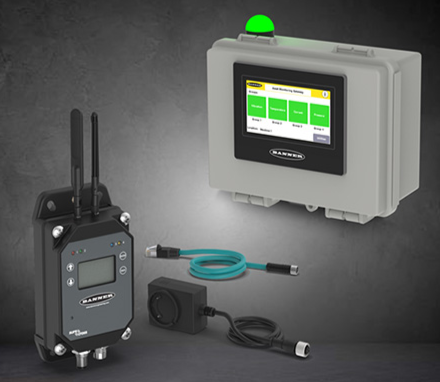
Banner Engineering offers a variety of device health monitoring (EHM) gateway options for easy access to EHM network data. Industrial EHM designers can choose between the company's SNAP ID wired gateway solution and CLOUD ID wireless gateway. The former comes with a sensor reading local display screen or optional cloud dashboard, while the latter is designed to directly connect to the cloud dashboard (Figure 1). The common characteristics of these two choices include:
Numerous sensors to choose from to optimize the operation of EHM
Automatically identify connected sensors, support rapid deployment, no additional programming required
Sensor data can be obtained at any time for adjusting equipment or scheduling required maintenance work, thereby minimizing downtime and maximizing productivity
Both systems support cloud connectivity
Pre configured dashboards can be provided and customized to achieve optimal data visualization
Banner SNAP ID wired (left) and CLOUD ID wireless (right) EHM gateway images
Figure 1: The SNAP ID wired gateway (left) and CLOUD ID wireless gateway (right) of Banner share several common features with the EHM gateway. (Image source: DigiKey)
Wired or wireless EHM gateway?
Although they share some common characteristics, there are essential differences between wired and wireless EHM gateways. The AMG-SNAP-ID Asset Monitoring Gateway (AMG) supports debugging, monitoring, and alerting of up to 20 sensors and converters. It supports SNAP SIGNAL connections for Modbus and Banner, and can scan individual sensors or converters to automatically detect model information. Users can change and assign Modbus server ID numbers to build and debug customized EHM solutions. Connected devices can be grouped and alarm thresholds can be assigned separately. The alarm status can be displayed through the color of the touch screen and the indicator light on the top of the casing.
When direct connection to the cloud is required, EHM system designers can use the DXM1200-X2 IIoT gateway to connect up to 200 devices from Banner and third-party sources to provide performance and machine health data. It can automatically detect and connect sensor nodes, and transmit data to Banner cloud software. Developers can choose between simple or complex programming tools. IIoT gateways can process information at the edge and send it over Ethernet and cellular networks for monitoring from anywhere in the world through intuitive cloud dashboards (Figure 2).