
- 4E, No.3 Shenfeng Road, Liuyao Community, Henggang Street, Longgang District, Shenzhen,China
- cc.shen@xypltd.com
- Call: +86 15112667855
News
How microgrids and DER can maximize the sustainability and resilience of industrial and commercial facilities
- 2026-11-25
Distributed energy resources (DER) such as solar energy, wind energy, combined heat and power (CHP), battery energy storage systems (BESS), and even traditional generators can greatly promote the sustainability and recovery capabilities of commercial and industrial facilities. Moreover, when these energy resources are combined into a microgrid and intelligently coordinated and managed through automated control systems for energy generation, flow, storage, and consumption, the effect is particularly significant.
In order to maximize the environmental and economic benefits of microgrids, controllers must be able to balance the operation and integration of DER in real time, and be able to manage smart loads such as lighting, heating, ventilation, and air conditioning (HVAC) systems, electric vehicle (EV) charging, and information technology devices, predict future load conditions using historical demand information, provide safe and efficient connections with the utility grid, and support demand response functions using real-time energy price data.
This article will review the components of microgrids, introduce microgrid architecture, provide an overview of IEEE 1547 (which specifies the requirements for DER interconnection) and IEEE 2030 (which specifies a comprehensive technical process for describing the functionality of microgrid controllers), then explore how microgrid controllers can enhance sustainability, resilience, and economic benefits, and finally briefly introduce the network security issues of microgrids.
What do microgrids need?
There are many implementation methods and components of microgrids. To discuss how microgrids and DER can maximize sustainability and resilience, it is best to start by understanding the definitions and examples of microgrid components and architecture. The US Department of Energy (DOE) defines a microgrid as "a set of interconnected loads and distributed energy resources within clearly defined power boundaries, which are a single controllable entity relative to the grid. A microgrid can be connected and disconnected from the grid, enabling it to operate in parallel or islanding mode. one
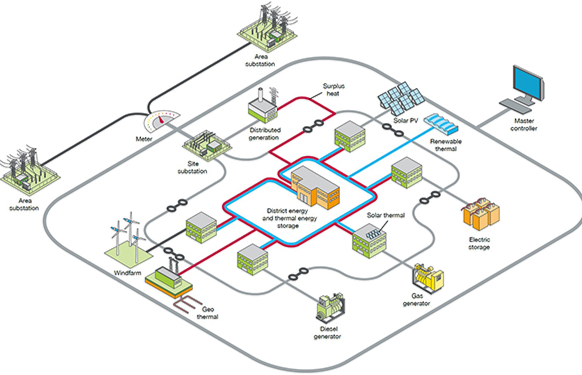
Although the definition of microgrid is simple and clear, when constructing a microgrid, it is necessary to choose from a series of microgrid categories, operating modes, and possible subsystems; To achieve maximum sustainability and resilience of microgrids, many choices need to be made in terms of construction and operation. Automation is an important consideration factor. Examples of automation subsystems include (Figure 1):
Power generation within microgrids, including various DER and CHP
distribution network
BESS
Such as HVAC systems, machines and motors in industrial facilities, and other loads
Manage electric vehicle charging and V2G connectivity
Microgrid controller and switchgear
Interconnection with the public power grid for grid connection devices
Microgrids can include various DER, CHP, and loads (click to enlarge)
Figure 1: Microgrids can include various DER, CHP, and loads. (Image source: Schneider Electric)
Classification of Microgrids
Microgrids can be classified as off grid or grid connected:
Off grid facility dominant type is the most common type of microgrid. Use cases include remote areas without commercial utility grid services, such as mines, industrial sites, mountainous residential areas, and military bases.
Remote areas also have off grid community led models. Use cases include remote villages, islands, and communities. Although facility led microgrids are controlled by a single entity, community led microgrids must meet the needs of a group of users. This type of microgrid may require more complex command and control systems.
Grid connected facilities have only one owner and are used to improve reliability in areas where the main grid is unreliable and power supply is needed, or in situations where the microgrid owner provides economic incentives for load shedding and other services. Use cases include hospitals, data centers, continuous manufacturing plants, and other high utilization buildings.
Grid connected communities have multiple energy users and producers connected to the main grid and managed as a single entity. Use cases include corporate or university campuses, villages, and small cities. These places may have various energy users, producers, and storage facilities, and their control is also the most complex.
Microgrids are sometimes isolated islands
In addition to discussing the components of microgrids, DOE's definition also mentions the operation of microgrids in both grid connected and islanded modes. The definitions of these patterns are simple and clear, but their implementation is quite complex, and some IEEE standards have made corresponding provisions for them.
The IEEE 1547-2018 Interconnection Standard for Distributed Resources and Power Systems provides a detailed introduction to the technical requirements for DER and grid interconnection. IEEE 1547 is an evolving standard. The early versions of IEEE 1547 were designed for low DER penetration levels and did not take into account the potential regional cumulative impact of DER on high-capacity power systems. IEEE 1547-2018 has added stricter requirements for voltage and frequency regulation, as well as ride through capability, to improve the reliability of transmission systems. Recently, the 1547a-2020 revision has been added to adapt to abnormal operating conditions.
IEEE 2030.74 describes the functionality of microgrid controllers using two steady-state (SS) operating modes and four transition (T) types (Figure 2):
SS1 stands for steady-state grid connection mode, which connects the microgrid to the public grid. The controller can utilize components in the microgrid to provide services such as peak shaving, frequency regulation, reactive power support, and ramp management to the grid.
SS2 stands for Stable Island Mode, also known as "islanding" mode, which refers to the disconnection and isolated operation of microgrids from the public grid. The controller needs to balance the load, microgrid power generation, and energy storage services to maintain the stable operation of the microgrid.
T1 refers to the planned transition from grid connected mode to steady-state islanding mode. Even when the public power grid is available, there may be economic or operational incentives that encourage people to switch to islanding mode. In addition, this mode can also support microgrid operation testing.
T2 refers to the unplanned transition from grid connected mode to steady-state islanding mode. This is similar to the operation of uninterruptible power supplies in data centers, which are typically put into use when the main power grid fails. Microgrids can be seamlessly disconnected and operate as independent power networks.
T3 refers to the steady-state reconnection between the island and the utility grid. This is a complex technological process, where the "grid formation" power generation machine on the microgrid perceives the frequency and phase angle of the grid power source, and accurately matches the microgrid with the main grid before reconnecting.
T4 is a black start that enters steady-state islanding mode. In this case, the microgrid experiences a malfunction and must be isolated from the utility grid before restarting in islanding mode. The reason for this situation may be that the microgrid controller cannot cope with unexpected power outages through T2 stable transition, or it may be that the island cannot generate enough electricity or the energy storage is insufficient to continue supplying power to all loads, and all non essential loads must be cut off before the generator is put into operation. In addition, any BESS on the microgrid must be partially charged before reconnecting.