
- 4E, No.3 Shenfeng Road, Liuyao Community, Henggang Street, Longgang District, Shenzhen,China
- cc.shen@xypltd.com
- Call: +86 15112667855
News
Enjoy music with a single Stomp shell
- 2026-10-10
For product designers who love music but only know how to play air guitar, perhaps they can create a band sound atmosphere by creating electronic Stomp tiles, because whether it's rock, country, blues or other genres, Stomp tiles can help existing and future guitarists shape and enhance their sound quality.
The circuit inside the electronic Stomp module allows guitarists and other musicians to use special effects such as distortion, blurring, compression, and reverberation to alter the sound output.
The Stomp module with transistors introduced in the early 1960s allowed musicians such as Jimi Hendrix to change the sound output of their guitar with just a gentle touch of their feet or toes, which was previously only possible by manipulating bulky amplifiers. Nowadays, Stomp has a global market of nearly 4 billion US dollars and is expected to grow to 5.3 billion US dollars by 2032.
These devices are used to process signals between guitars and amplifiers, controlled by various knobs and switches, as well as the most common foot pedal. They can be single effect or multi effect, using digital, analog, or hybrid circuits, and can be powered by batteries or external adapters. Analog Stomp modules use electronic components such as resistors, capacitors, transistors, and diodes, while digital Stomp modules use microcontrollers, memory, and software to process sound.
Most Stomp modules use metal casings to withstand the typical harsh usage environment in music performances. Die cast aluminum is widely popular due to its lightweight and durability, as well as its ability to shield electromagnetic interference (EMI) and radio frequency interference (RFI) that may affect signal integrity. This material is relatively easy to process and convenient for opening holes for switches, sockets, and knobs. Die cast aluminum shells can be unpainted or coated with hard powder coating, and can be customized according to the unique style of designers or musicians.
Hammond Manufacturing is a supplier of transformers, racks, cabinets, and enclosures. Their popular 1590 series Stomp units are made of sturdy and durable die cast aluminum alloy, designed to meet the requirements of stage environments.
This Stomp series comes in rectangular, octagonal, and two trapezoidal sizes, with a smooth polyester powder coating surface as standard, providing excellent surface effects for customized labels and screen printing. The paint surface only appears on the outer surface to maintain the integrity of RFI.
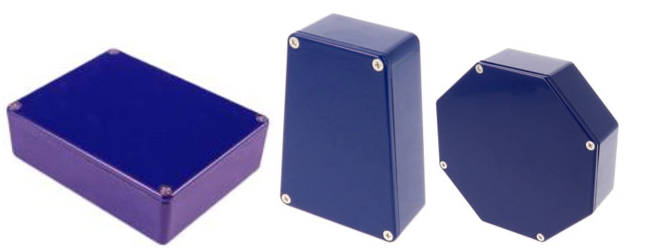
1590BBCB is a cobalt blue, EMI shielded, 4.70-inch x 3.70-inch x 1.34-inch casing (left in Figure 1). Like other devices in the series, it has an IP54 protection rating and adopts a lap seal structure to prevent dust and splashing. Like other models, it also offers the option of silicone gasket model 1590BBBASKET, which is loosely installed inside the housing and can achieve IP65 waterproof rating when in use.
Figure 1: Hammond cobalt blue 1590BBCB (left) rectangular, 1590TRPBCB (middle) narrow trapezoidal, and 1590STPCCB (right) octagonal Stomp monolithic shell. (Image source: Hammond Manufacturing)
Other shapes include the 1590TRPBCB model, which is a narrow trapezoidal Stomp monolithic shell with a length of 4.41 inches, a small end width of 2.42 inches, and a large end width of 3.11 inches (Figure 1, center), while the octagonal 1590STPCCB model (Figure 1, right) has dimensions of 5.23 inches on each side.
In addition, the side walls of the Hammond 1590 series casing have a draft angle of less than or equal to 2 degrees, ensuring easy installation of the PC board.
Customization options
These devices offer five standard colors, and other colors can also be provided upon request. Hammond has two professional modification factories in North America and Europe, where the shell modification team can customize single boxes, including punching, cutting, silk screen printing, special length extrusion, etc. These teams will confirm the design requirements to ensure correct understanding, thereby helping to eliminate waste and design errors.