
- 4E, No.3 Shenfeng Road, Liuyao Community, Henggang Street, Longgang District, Shenzhen,China
- cc.shen@xypltd.com
- Call: +86 15112667855
News
Edge perception ecosystem
- 2026-08-10
The three mainstream methods for creating edge intelligent sensor systems are shown in Figure 1. The 'classic method' is very flexible and has a complete algorithm that runs on the host MCU.
The integration of machine learning and digital signal processing functions in sensors represents a key step towards "real edge" computing. This fusion, especially in MEMS devices (microelectromechanical systems), enables edge systems to not only capture data but also parse it in real-time and make autonomous responses. The embedded intelligence of sensors improves data processing efficiency, enabling faster and more scene specific responses at the edge.
Figure 1: Mainstream sensor system architecture. (Image source: STMicroelectronics)
Classic methods
In classical computing architecture, the microcontroller (MCU) is the sensor data processing center and contains sensor processing algorithms. This method is very flexible in firmware porting and is the most scalable architecture for handling complex algorithms. However, this architecture requires the transmission of sensor data from the sensor to the MCU, which typically has a high transmission rate. MCU must also filter the raw data, find the content required for algorithm operation, and may discard many transmitted data samples. This can lead to a decrease in efficiency and usually increase system power consumption, which is an important factor affecting IoT computing. In addition, the selected MCU must have appropriately sized flash memory and storage to be able to execute all algorithms, which increases the cost and complexity of the system.
Machine Learning Core (MLC)
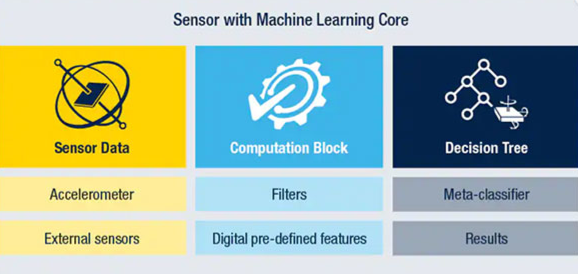
The second method for edge processing in the Internet of Things is the machine learning core shown in Figure 2. MLC is an engine embedded in sensors that can be trained through supervised learning to recognize specific events. MLC consists of computational blocks, filtering, and decision trees based on meta classification.
MLC sensors can detect motion and ultimately convey "events" rather than raw data to MCU, thereby achieving better system energy efficiency. In sensors with MLC functionality, algorithm data is mainly contained within the sensor. Compared to traditional computing architectures, MLC has weaker scalability because it only operates on sensor data. But MLC is very useful for developing events that are difficult to program, such as gestures and vibration levels.
Figure 2: Sensors with integrated machine learning cores. (Image source: STMicroelectronics)
Integrated Sensor Processing Unit (ISPU)
ISPU is a sensor with an integrated digital signal processor (DSP) used for local processing of sensor data within the chip. Compared to embedded machine learning methods, ISPU is more portable because it can execute standard C code for more complex sensor algorithms. However, the DSP in ISPU is a specialized core used for sensor related operations and has more limitations in code and data construction than traditional methods.
Similar to MLC, ISPU optimizes the required computing power as it operates sensor data in real-time without the need to transmit data upstream to MCU for processing. Compared to MLC methods, ISPU also achieves higher processing capabilities in programmable cores (ML and NN) that support AI. Due to the fact that ISPU runs in C language, it is compatible with many commercial models and open-source AI models.
Figure 3: Functions of the integrated sensor processing unit. (Image source: STMicroelectronics)
In order to successfully utilize AI technology in sensor related applications, it is also necessary to quickly adapt to intelligent sensor architectures through new tools and software examples. Nano Edge ™ AI Studio (NEAi) is a tool that is compatible with the three methods mentioned above and is also a free PC based development kit for developers. NEAi does not require advanced data science skills, software developers can create the best tinyML in a user-friendly environment ® Library. NEAi can generate four types of libraries: anomaly detection, outlier detection, classification, and regression libraries. For a detailed understanding of how to use ISPU for anomaly detection applications using NEAi software tools, please refer to reference # 4 below.