
- 4E, No.3 Shenfeng Road, Liuyao Community, Henggang Street, Longgang District, Shenzhen,China
- cc.shen@xypltd.com
- Call: +86 15112667855
News
Easily suppress EMI using filtering D-Sub connectors
- 2026-08-10
D-Sub connectors are suitable for various industries and are essential components for many applications, enabling reliable, durable, and multifunctional interconnection for signal and power transmission. This type of connector can also play a crucial role in electromagnetic compatibility (EMC) compliance.
Modern electronic systems rely on high-speed data transmission and precise control signals, but electromagnetic noise generated by adjacent equipment, power lines, or RF signals can lead to system performance degradation.
Improper management of electromagnetic interference (EMI) can result in data errors and system instability. EMI may lead to EMC compliance testing failures, ultimately resulting in product release delays and increased costs. In applications where crosstalk, impedance mismatch, and noise interference may threaten the integrity of high-speed signals, filter type D-Sub connectors help ensure reliable operation of these applications, without being affected or causing EMI. This connector is suitable for modern applications such as automobiles, renewable energy, smart meters, handheld devices, and AI systems.
The filtering type D-Sub connector integrates EMI filtering components such as capacitors and ferrite beads directly into the connector housing, reducing the complexity of the circuit board and the number of components, making it a space saving and cost-effective choice.
Although many suppliers offer high-quality connectors, the specific design and structure may vary. For example, Amphenol Communications Solutions offers a range of filtering D-Sub connectors with mechanical stress isolation design to ensure that capacitive components can withstand impact and vibration.
The company's FCE17 series connectors have enhanced EMC compliance and anti-interference capabilities, which can divert the radiation and conducted emissions generated by the equipment, as well as external EMI and radio frequency interference (RFI), to the ground. This series of connectors integrates ceramic capacitor filtering elements and adopts a solderless internal design to prevent shock and vibration, thus achieving excellent stability under temperature and voltage changes.
The filter type connector is compatible with the size of standard non filter type connectors and can directly replace existing applications. This provides a simple, economical, and efficient EMC improvement method without the need for significant design changes.
Amphenol offers a diverse range of FCE17 connectors to meet different design requirements. Product developers can choose connectors with standard pin/socket arrangement specifications such as 9, 15, 25, and 37, and their termination types can be PCB pins or solder cup type, as well as power and signal contact combinations integrated within a single connector housing.
The following lists three types of Amphenol connectors, explaining their characteristics and application applicability:
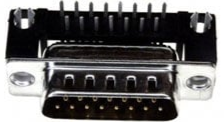
FCE17-A15PA-450 (Figure 1) is a right angle, PCB mounted, 15 pin D-Sub connector that supports low profile installation in compact board applications such as industrial controllers, testing equipment, and embedded computing systems. This type of connector adopts through-hole soldering termination method, which can firmly and reliably connect with PCB. The design of the board lock and grounding groove can enhance mechanical stability and improve electromagnetic shielding performance.
Figure 1: The right angle FCE17-A15PA-450 filtering D-Sub connector provides designers with a low profile design option. (Image source: Amphenol Communications Solutions)
FCE17-E09PM-450 (Figure 2) is a 9-pin direct insertion male plug that uses a solder cup termination method and is suitable for customized cable assemblies. Designers can utilize this feature to customize connections that meet unique system requirements, such as data transmission in industrial automation, telecommunications, and defense applications.
Figure 2: Amphenol's FCE17-E09PM-450 D-Sub filtering connector adopts a solder cup termination method, which is suitable for customized cable design. (Image source: Amphenol Communications Solutions)
FCE17-A15AD-250 (Figure 3) is a plug-in adapter that is very suitable for upgrading traditional systems, supporting designers to add EMI suppression function without changing the existing PCB layout or replacing connectors. For traditional industrial control panels and other applications that do not require a complete redesign, a 15 bit female to male D-Sub adapter is an economical, efficient, and time-saving choice.