
- 4E, No.3 Shenfeng Road, Liuyao Community, Henggang Street, Longgang District, Shenzhen,China
- cc.shen@xypltd.com
- Call: +86 15112667855
News
Developing Edge Artificial Intelligence Applications with ADI's MAX78002 MCU
- 2026-09-24
The financial competition among tech giants to commercialize generative artificial intelligence (GenAI) has to some extent obscured the extensive work done in the field of artificial intelligence, especially at the network edge, where suppliers are eager for AI applications to run on IoT devices that are often limited by memory, bandwidth, and power consumption.
A microcontroller (MCU) from Analog Devices, Inc. integrates a low-power Convolutional Neural Network (CNN) accelerator to process artificial intelligence inference on battery powered devices, breaking through the limitations of edge processing.
Given that GenAI's main investment direction is to accumulate massive data and enhance processing capabilities, it requires large-scale data centers and a large amount of electricity, while edge AI efficiently runs data locally through models that can recognize objects, analyze medical images, process car camera feedback to identify obstacles, pedestrians, and road signs, thereby achieving safe driving.
CNN can process image data at the edge, detect abnormal situations, and monitor the operation status of equipment in factory workshops. In addition, CNN can be used in the agricultural field to detect pests and crop growth conditions, processing images from drones, robots, and intelligent cameras.
Optimized for deep CNN
ADI's MAX78002 is an advanced ultra-low power on-chip system that utilizes an Arm Cortex-M4 processor with floating point unit (FPU) and a hardware based accelerator, optimized for deep CNN and tasks requiring object recognition functionality.
Connect neurons in a neural network through weights (or parameters) to control their behavior. ADI's CNN engine has 2 MB of weight storage memory and can support 1, 2, 4, and 8-bit weights, as well as complex neural network models with up to 16 million weight values. In this way, advanced artificial intelligence applications can be implemented on edge devices, and since the CNN weight memory is based on SRAM, the model can be updated during runtime.
The CNN accelerator can provide programmable input image sizes of up to 2048 x 2048 pixels, allowing designers to flexibly design applications that can handle high-resolution medical imaging or smaller input sizes on resource limited devices.
The programmable network has a depth of up to 128 layers, allowing for a balance between application performance and efficiency. In addition, the programmable channel width of up to 1024 channels per layer enables users to capture richer features with wider channels or save memory and computing resources with narrower widths.
MAX78002 supports multiple high-speed and low-power communication interfaces, including I2S, MIPI CSI-2 serial camera, parallel camera (PCIF), and SD 3.0/SDIO 3.0/eMMC 4.51 secure digital interface. This makes the device highly suitable for a wide range of artificial intelligence applications, including industrial sensors, process control, online quality assurance vision systems, portable medical diagnostic equipment, factory robots, and drone navigation.
Power management is key
Ultra low power microcontrollers are crucial for edge artificial intelligence applications, especially when it comes to battery powered IoT devices. ADI stated that the energy consumption of MAX78002 in processing artificial intelligence inference is only a few micro joules.
This artificial intelligence MCU has a built-in single inductor multiple output (SIMO) switch mode power supply (SMPS) that supports a supply voltage range of 2.85 V to 3.6 V and can adapt to various power sources. In addition, through this MCU, external switches can also be selected to provide dedicated power from the outside for CNN.
The power management unit (PMU) of MAX78002 can intelligently and accurately control the power distribution between the CPU and peripheral circuits, thereby supporting high-performance operation with minimal power consumption.
The single-chip power architecture can be powered by a single lithium battery. Users can program the voltage output of the three voltage regulators in SIMO to ensure optimal power efficiency. Due to the fact that MAX78002 only requires one inductor/capacitor, suppliers can reduce the material list for circuit design.
The integrated dynamic voltage regulation (DVS) controller can adaptively regulate voltage to reduce dynamic power consumption. By using a fixed high-speed oscillator and VCORE power supply voltage, the DVS controller can operate the Arm core at the lowest actual voltage, allowing product designers to strike a balance between performance requirements and power consumption limitations. The Arm peripheral bus interface is used for control and status access.
The microcontroller core has a large on-chip system memory of 2.5 MB flash to ensure non-volatile storage of programs and data, while its 384 KB built-in SRAM can retain application information in low-power form in all power modes except for "power off".
Simplify the application of MAX78002
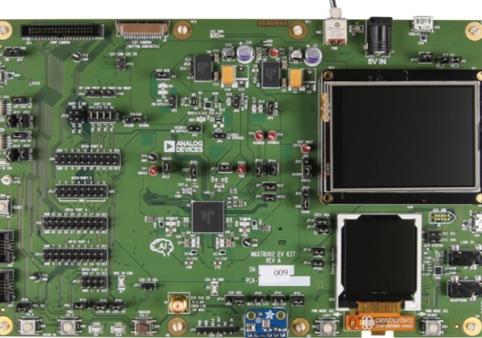
The MAX78002EVKIT (Figure 1) evaluation kit provided by ADI provides valuable resources for building artificial intelligence applications using MCUs, including a 2.4-inch TFT display screen for enhancing interactive UI development and visualizing the results of artificial intelligence inference processes.